On This Page
Description
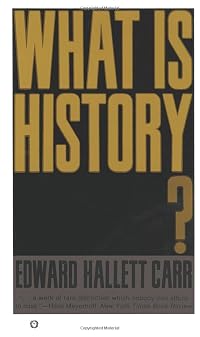
Who is to say how things really were? In formulating a modern answer to the question 'What is History?' Professor Carr shows that the 'facts' of history are simply those which historians have selected for scrutiny. Millions have crossed the Rubicon, but the historians tell us that only Caesar's crossing was significant. All historical facts come to us as a result of interpretative choices by historians influenced by the standards of their age. Yet if absolute objectivity is impossible, the show more role of the historian need in no way suffer; nor does history lose its fascination. This edition includes new material which presents the major conclusions of Professor Carr's notes for the second edition and a new preface by the author, in which he calls for ‘a saner and more balanced outlook on the future'. show lessTags
Recommendations










Member Recommendations
mcalister Richard Evans takes a stab at reconsidering or extending many of Carr's arguments.
Member Reviews
A stimulating theoretical overview of the study of history; its main strength is that you don't feel like you have to agree with everything E. H. Carr is advocating, whilst still engaging with his arguments. I agreed with a lot of his ideas, and disagreed with a lot too, and that's all fine. He was a bit too enamoured with Marx for my tastes and, as Richard J. Evans notes in his (sometimes overly-) critical introduction, some of his stuff – partly because of this quasi-Marxist worldview – now seems out of date. But What is History? continues to provoke debate and will continue to encourage students to think about what remains an undervalued and fascinating subject.
"Az a vizsgázó, aki arra a kérdésre, »Miért tört ki az 1917-es orosz forradalom?«, egyetlen okban véli megtalálni a választ, hármasnál jobbat nemigen érdemel."
Carr professzor felteszi magának a blikkfangos kérdést, hogy "Mi a történelem?", és meg is válaszolja. Közben olyas témákat jár körül, mint:
a.) mi is az a "történelmi tény"?
b.) hogyan viszonyul egymáshoz egyén és társadalom?
c.) hogyan viszonyul a történelemtudomány a tudományokhoz általában?
d.) mennyire fűzhető fel a történelemtudomány az okok és okozatiságok rabláncára?
stb.
És miközben ezzel így elgyönyörködteti olvasóját, gondoskodik arról is, hogy mondandóját időnként egymondatos aforizmákká szublimálja - ide a show more bökőt, hogy az oxfordi történelemtudományi tanszék szuvenírboltjában csupa olyan pólót kapni, amire ezek az aranyköpések vannak nyomtatva*. Emellett pedig remekül ért ahhoz, hogy a kollégák (főképp Karl Popper és Isaiah Berlin) általánosító rendszereinek egy-egy csattanós sziporkával odacsördítsen a térdhajlatába. Szóval öröm és élvezet olvasni, az ember nem talál rajta fogást. Mondjuk lehet, azért nem talál rajta fogást, mert Carr olyan rendszert épít, ami egyenlő távolságot kíván tartani a többi rendszertől - ilyen értelemben pedig bizonyos értelemben nem annyira eredeti konstrukció, mint más konstrukciók eredője, kísérlet arra, hogy a történész mértéktartón az önálló rendszerek közé pozicionálja magát. Azt mondja, a történész nem lehet tökéletesen objektív, de ne legyen szubjektív se. Hogy ne higgyen a szükségszerűségben, de ne vesse el teljesen az ok-okozatiságot se. Hogy az egyén nem a társadalom ellentéte, de nem is azonos a társadalommal. Szóval valami kozmikus konszenzusra törekszik. Ez pedig sajátos módon teszi egyszerre támadhatatlanná és továbbgondolhatatlanná. De ez legyen azoknak a baja, akik vitatkozni akarnak vele. Én csak bólogatok.
* Pl. "Ennélfogva a »Mi a történelem?« kérdésre az első válaszom az volna, hogy szakadatlan kölcsönhatás a történész és a tények, soha véget nem érő párbeszéd a múlt és a jelen között." Vagy: "Képessé tenni az embert arra, hogy megértse a múlt társadalmát, és segíteni neki abban, hogy kezelni tudja a jelen társadalmát - ez a történetírás kettős funkciója." show less
Carr professzor felteszi magának a blikkfangos kérdést, hogy "Mi a történelem?", és meg is válaszolja. Közben olyas témákat jár körül, mint:
a.) mi is az a "történelmi tény"?
b.) hogyan viszonyul egymáshoz egyén és társadalom?
c.) hogyan viszonyul a történelemtudomány a tudományokhoz általában?
d.) mennyire fűzhető fel a történelemtudomány az okok és okozatiságok rabláncára?
stb.
És miközben ezzel így elgyönyörködteti olvasóját, gondoskodik arról is, hogy mondandóját időnként egymondatos aforizmákká szublimálja - ide a show more bökőt, hogy az oxfordi történelemtudományi tanszék szuvenírboltjában csupa olyan pólót kapni, amire ezek az aranyköpések vannak nyomtatva*. Emellett pedig remekül ért ahhoz, hogy a kollégák (főképp Karl Popper és Isaiah Berlin) általánosító rendszereinek egy-egy csattanós sziporkával odacsördítsen a térdhajlatába. Szóval öröm és élvezet olvasni, az ember nem talál rajta fogást. Mondjuk lehet, azért nem talál rajta fogást, mert Carr olyan rendszert épít, ami egyenlő távolságot kíván tartani a többi rendszertől - ilyen értelemben pedig bizonyos értelemben nem annyira eredeti konstrukció, mint más konstrukciók eredője, kísérlet arra, hogy a történész mértéktartón az önálló rendszerek közé pozicionálja magát. Azt mondja, a történész nem lehet tökéletesen objektív, de ne legyen szubjektív se. Hogy ne higgyen a szükségszerűségben, de ne vesse el teljesen az ok-okozatiságot se. Hogy az egyén nem a társadalom ellentéte, de nem is azonos a társadalommal. Szóval valami kozmikus konszenzusra törekszik. Ez pedig sajátos módon teszi egyszerre támadhatatlanná és továbbgondolhatatlanná. De ez legyen azoknak a baja, akik vitatkozni akarnak vele. Én csak bólogatok.
* Pl. "Ennélfogva a »Mi a történelem?« kérdésre az első válaszom az volna, hogy szakadatlan kölcsönhatás a történész és a tények, soha véget nem érő párbeszéd a múlt és a jelen között." Vagy: "Képessé tenni az embert arra, hogy megértse a múlt társadalmát, és segíteni neki abban, hogy kezelni tudja a jelen társadalmát - ez a történetírás kettős funkciója." show less
I had wanted to read more about historiography and the theory of history since I'll be writing history myself, but it had been difficult to find books that were interesting and accessible without being aimed at undergraduates. I'm not looking for advice on how to write a course paper, but I also didn't want something overly dense that name-drops modern theorists without explanation of their ideas.
This was recommended by one of my supervisors, and it was exactly what I was looking for. Carr has written a very readable account of what he thinks history is and how ideas about history have developed over time, without talking down to the reader. This is a book about theory that's actually entertaining to read, thanks in large part to Carr's show more vivid and memorable metaphors. For example, he describes the naive writing of history without theory as a sort of Garden of Eden:
This follows a discussion of nineteenth-century historiography, with its focus on facts that could really be known. The key phrase is Ranke's, that "the task of the historian was 'simply to show how it really was (wie es eigentlich gewesen)'." Positivists and empiricists thought that history could be carried out like science, and was just a matter of gathering the facts.
I have to include another of Carr's comparisons here, because I just find them so entertaining:
And then he resumes 20 pages later:
The basic idea is that history isn't simply a matter of presenting the facts in some pure form; instead, it's about the interaction of the historian and the facts. The "facts" are what the historian makes of them. At the beginning of the first chapter, Carr answers the title question as follows: History is "a continuous process of interaction between the historian and his facts, an unending dialogue between the present and the past."
The next chapter follows in the same vein: he brings in society, arguing that people don't exist in isolation. This leads to the conclusion that history "is a dialogue not between abstract and isolated individuals, but between the society of today and the society of yesterday."
Much of what Carr says is reasonable and helpful (I particularly appreciated one point about just writing, when you reach the point where you have to set down your ideas on paper, even if it's in the middle of an idea—I've been struggling lately with the fact that my writing style does not match the extremely systematic approach promoted by one of my supervisors, so it was nice to see that in reality people don't all write like that). I found myself agreeing with a lot of what he said. But of course, there are some ideas that I'm less persuaded by. I'm not sure quite where I stand on the idea that there's not much difference between history and science because both ask the question "why". I know that the newest theories say that we can't really know anything as certainly as we think, and yet even as I accept that history is a discourse dependent for meaning on the historian and the reader and all sorts of external factors, rather than reflecting some absolute certainty in itself, I still believe in the objectivity of science in a different way. Carr acknowledges that there is a difference between physical science and history, but goes on to try to close the gap between them: "My principal objection to the refusal to call history a science is that it justifies and perpetuates the rift between the so-called 'two cultures'." Carr relates this to class prejudice ("the humanities were supposed to represent the broad culture of the ruling class, and science the skills of the technicians who served it"), and ultimately is "not convinced that the chasm which separates the historian from the geologist is any deeper or more unbridgeable than the chasm which separates the geologist from the physicist". These are interesting ideas, but not ones that I ultimately find very persuasive.
The other key point where I differ from Carr is on the idea of history as progress, and I think this is one place where I actually fall more on the side of the postmodernists, whom I usually find frustratingly negative and destructive (although I actually found it very fruitful to read a book on postmodern theory of history, which I'll review next). Basically, Carr acknowledges that "the hypothesis of progress has been refuted. The decline of the West has become so familiar a phrase that quotation marks are no longer required." But he goes on to assert that he still really believes in progress after all, because societies are always working toward improvement. In his view, "Every civilized society imposes sacrifices on the living generation for the sake of generations yet unborn." This was published in the early 60s, and it sounded almost ridiculously quaint and outdated to me when I read it in the present: my impression of the world is that people as a whole look primarily to their own immediate benefit, and leave the problems of debt/environmental degradation/various unsustainable practices for future generations to worry about. Apparently I've become sort of cynical. But I still think there's a *possibility* for progress, I just don't see it as a given for any "civilized society".
But despite these disagreements, or maybe even because of them, I found this a very rewarding read. There's lots to think about, and it's presented in a clear and accessible style that doesn't hide behind jargon. I'd definitely recommend it to anyone interested in the broader concept of history. show less
This was recommended by one of my supervisors, and it was exactly what I was looking for. Carr has written a very readable account of what he thinks history is and how ideas about history have developed over time, without talking down to the reader. This is a book about theory that's actually entertaining to read, thanks in large part to Carr's show more vivid and memorable metaphors. For example, he describes the naive writing of history without theory as a sort of Garden of Eden:
"This was the age of innocence, and historians walked in the Garden of Eden, without a scrap of philosophy to cover them, naked and unashamed before the god of history. Since then, we have known Sin and experienced a Fall; and those historians who today pretend to dispense with a philosophy of history are merely trying, vainly and self-consciously, like members of a nudist colony, to recreate the Garden of Eden in their garden suburb."
This follows a discussion of nineteenth-century historiography, with its focus on facts that could really be known. The key phrase is Ranke's, that "the task of the historian was 'simply to show how it really was (wie es eigentlich gewesen)'." Positivists and empiricists thought that history could be carried out like science, and was just a matter of gathering the facts.
I have to include another of Carr's comparisons here, because I just find them so entertaining:
"The facts are available to the historian in documents, inscriptions, and so on, like fish on the fishmonger's slab. The historian collects them, takes them home, and cooks and serves them in whatever style appeals to him. Acton, whose culinary tastes were austere, wanted them served plain...."
And then he resumes 20 pages later:
"The facts are really not at all like fish on the fishmonger's slab. They are like fish swimming about in a vast and sometimes inaccessible ocean; and what the historian catches will depend partly on chance, but mainly on what part of the ocean he chooses to fish in and what tackle he chooses to use—these two factors being, of course, determined by the kind of fish he wants to catch. By and large, the historian will get the kind of facts he wants."
The basic idea is that history isn't simply a matter of presenting the facts in some pure form; instead, it's about the interaction of the historian and the facts. The "facts" are what the historian makes of them. At the beginning of the first chapter, Carr answers the title question as follows: History is "a continuous process of interaction between the historian and his facts, an unending dialogue between the present and the past."
The next chapter follows in the same vein: he brings in society, arguing that people don't exist in isolation. This leads to the conclusion that history "is a dialogue not between abstract and isolated individuals, but between the society of today and the society of yesterday."
Much of what Carr says is reasonable and helpful (I particularly appreciated one point about just writing, when you reach the point where you have to set down your ideas on paper, even if it's in the middle of an idea—I've been struggling lately with the fact that my writing style does not match the extremely systematic approach promoted by one of my supervisors, so it was nice to see that in reality people don't all write like that). I found myself agreeing with a lot of what he said. But of course, there are some ideas that I'm less persuaded by. I'm not sure quite where I stand on the idea that there's not much difference between history and science because both ask the question "why". I know that the newest theories say that we can't really know anything as certainly as we think, and yet even as I accept that history is a discourse dependent for meaning on the historian and the reader and all sorts of external factors, rather than reflecting some absolute certainty in itself, I still believe in the objectivity of science in a different way. Carr acknowledges that there is a difference between physical science and history, but goes on to try to close the gap between them: "My principal objection to the refusal to call history a science is that it justifies and perpetuates the rift between the so-called 'two cultures'." Carr relates this to class prejudice ("the humanities were supposed to represent the broad culture of the ruling class, and science the skills of the technicians who served it"), and ultimately is "not convinced that the chasm which separates the historian from the geologist is any deeper or more unbridgeable than the chasm which separates the geologist from the physicist". These are interesting ideas, but not ones that I ultimately find very persuasive.
The other key point where I differ from Carr is on the idea of history as progress, and I think this is one place where I actually fall more on the side of the postmodernists, whom I usually find frustratingly negative and destructive (although I actually found it very fruitful to read a book on postmodern theory of history, which I'll review next). Basically, Carr acknowledges that "the hypothesis of progress has been refuted. The decline of the West has become so familiar a phrase that quotation marks are no longer required." But he goes on to assert that he still really believes in progress after all, because societies are always working toward improvement. In his view, "Every civilized society imposes sacrifices on the living generation for the sake of generations yet unborn." This was published in the early 60s, and it sounded almost ridiculously quaint and outdated to me when I read it in the present: my impression of the world is that people as a whole look primarily to their own immediate benefit, and leave the problems of debt/environmental degradation/various unsustainable practices for future generations to worry about. Apparently I've become sort of cynical. But I still think there's a *possibility* for progress, I just don't see it as a given for any "civilized society".
But despite these disagreements, or maybe even because of them, I found this a very rewarding read. There's lots to think about, and it's presented in a clear and accessible style that doesn't hide behind jargon. I'd definitely recommend it to anyone interested in the broader concept of history. show less
Going back to re-read old university textbooks for fun must be a sign of incipient nostalgia for the lost days of youth. That or masochism. I didn’t get a nostalgic buzz (possibly as I was young and foolish enough to think I could get away by essentially skimming it) but reading it with age and experience was far more rewarding than giving it to an intellectually arrogant 19 year old.
Carr’s initial question is the springboard for six essays, transcribed from a series of lectures. It’s a musing on what history is and the role it has in our society – how it actually fits neatly in with sciences, how objective a historian can be and how history tells us as much about the time it’s written in as it does about the time itself. show more It’s actually aged very well, being prescient on a number of issues and forcefully making a point of how history should be a positive force. Still, one thing is concerning– if Carr’s thesis that a nation in decline harks back to golden ages and nostalgia and turns inward on itself then the UK is in a ‘sick’ state indeed. A fascinating starting point for anyone looking at history and historiography. show less
Carr’s initial question is the springboard for six essays, transcribed from a series of lectures. It’s a musing on what history is and the role it has in our society – how it actually fits neatly in with sciences, how objective a historian can be and how history tells us as much about the time it’s written in as it does about the time itself. show more It’s actually aged very well, being prescient on a number of issues and forcefully making a point of how history should be a positive force. Still, one thing is concerning– if Carr’s thesis that a nation in decline harks back to golden ages and nostalgia and turns inward on itself then the UK is in a ‘sick’ state indeed. A fascinating starting point for anyone looking at history and historiography. show less
The legendary Sikh historian Professor Balwant Singh Dhillon suggested I read this book when I interviewed him on Sikh generalissimo Baba Banda Singh Bahadur.
https://anchor.fm/the-sikh-renaissance/episodes/Rediscovering-Banda-Singh-Bahadu...
He emphasized that E.H. Carr had transformed his generation's understanding of both history and historiography. Given the fact that the Carrian school of History has withstood the test of time, despite being besieged by post-structuralism, I decided to read What Is History?.
Carr transformed my entire perspective of History and historiography.
His epochal arguments structuring the rationale behind accepting History as an evolving science introduces a tectonic shift behind the purpose of History as show more well as why we pursue it. His dry wit and simplistic language makes his words a pleasure to read.
Penguin's current edition incorporates a brief biography of Carr; an introduction by Richard J. Evans and reproduces Carr's original summaries.
A must read for all students as well as Masters of History. show less
https://anchor.fm/the-sikh-renaissance/episodes/Rediscovering-Banda-Singh-Bahadu...
He emphasized that E.H. Carr had transformed his generation's understanding of both history and historiography. Given the fact that the Carrian school of History has withstood the test of time, despite being besieged by post-structuralism, I decided to read What Is History?.
Carr transformed my entire perspective of History and historiography.
His epochal arguments structuring the rationale behind accepting History as an evolving science introduces a tectonic shift behind the purpose of History as show more well as why we pursue it. His dry wit and simplistic language makes his words a pleasure to read.
Penguin's current edition incorporates a brief biography of Carr; an introduction by Richard J. Evans and reproduces Carr's original summaries.
A must read for all students as well as Masters of History. show less
E.H. Carr was not a ‘trained historian,’ and yet wrote many detailed histories. This book is based on a series of lectures he delivered in 1961. There are a few central themes that I picked from the book, and I will discuss them shortly. The reader must read the lectures slowly because at times he appears to ramble. Maybe he did ramble a bit to lengthen the speeches. EH Carr also references other people like Sir Isaiah Berlin during these lectures, and unless you are familiar with Sir Isaiah Berlin, these references will not help to clarify matters.
However, a few important observations stand out. One, he says that facts don’t speak for themselves, and I agree. A person wishing to reference the ‘Akbarnama,’ for instance, will show more cherry-pick sections of the book. EH Carr also mentions that a historian’s interest, social context, and background also influence what they take from historical texts. Another observation is that he disputes the commonly held belief that historians are unbiased. Anyone who sees the way historians rewrite history at the behest of politicians will agree with EH Carr.
EH Carr is also interested in causes, rather than isolated incidents.
The fundamental question raised is this: how do we know what the past really is? He avers that history is a disciplined and iterative dialogue between past and present.
I suggest reading the book’s introduction, as it discusses many critiques other historians (like Sir Isaiah Berlin) made about EH Carr. Are historians prejudiced for, and against, other historians? show less
However, a few important observations stand out. One, he says that facts don’t speak for themselves, and I agree. A person wishing to reference the ‘Akbarnama,’ for instance, will show more cherry-pick sections of the book. EH Carr also mentions that a historian’s interest, social context, and background also influence what they take from historical texts. Another observation is that he disputes the commonly held belief that historians are unbiased. Anyone who sees the way historians rewrite history at the behest of politicians will agree with EH Carr.
EH Carr is also interested in causes, rather than isolated incidents.
The fundamental question raised is this: how do we know what the past really is? He avers that history is a disciplined and iterative dialogue between past and present.
I suggest reading the book’s introduction, as it discusses many critiques other historians (like Sir Isaiah Berlin) made about EH Carr. Are historians prejudiced for, and against, other historians? show less
Edward Hallett Carr’s What is History? is still a remarkable work of historiography fifty years after it was written. Originally written as a series of lectures at Cambridge University in 1961 the book has aged very well. Carr begins by explaining what makes a fact historical rather than just a fact and goes on to explain a few other truths about historical facts. No fact is pure, even the original recording of the fact is tainted by the prejudice of the recorder. Facts need to be understood through the eyes of the tine they were created, historians need to imagine an understanding of the times. The present will always color our view of past facts.
After revealing that facts are not the vestal virgins that they are sometimes painted show more as being Carr moves on to a brilliant explanation of causality and objectivity that has been quoted by other historians for good reason. It is the clearest and most well reasoned explanation of those concepts I have read.
The last chapter of the book, the final lecture in the series, is titled “The Widening Horizon” and today can be read several ways. Was Carr, a British student of Russian history, lamenting the United Kingdom’s diminishing roll as a leading influence on history? Was he predicting, something he warned against, the rise of his primary object of study to the forefront of history? Did he actually see the Far East assuming the role we see it in today? show less
After revealing that facts are not the vestal virgins that they are sometimes painted show more as being Carr moves on to a brilliant explanation of causality and objectivity that has been quoted by other historians for good reason. It is the clearest and most well reasoned explanation of those concepts I have read.
The last chapter of the book, the final lecture in the series, is titled “The Widening Horizon” and today can be read several ways. Was Carr, a British student of Russian history, lamenting the United Kingdom’s diminishing roll as a leading influence on history? Was he predicting, something he warned against, the rise of his primary object of study to the forefront of history? Did he actually see the Far East assuming the role we see it in today? show less
Members
- Recently Added By
Lists

Books That Changed Me
158 works; 47 members

Books Read in 2021
5,361 works; 113 members

r/History Recommended Reading List
603 works; 12 members

r/AskHistorians' Recommended Books
1,068 works; 19 members

Books Read in 2006
424 works; 8 members

Read in 2006
140 works; 1 member
Author Information

87+ Works 5,020 Members
Some Editions
Awards and Honors
Series

Belongs to Publisher Series
Common Knowledge
- Canonical title*
- Sei lezioni sulla storia
- Original title
- What is history?
- Original publication date
- 1961
- People/Characters
- E.H. Carr
- Epigraph
- "I often think it odd that it should be so dull, for a great deal of it must be invention."
Catherine Morland on History
(Northanger Abbey, Ch. XIV) - First words
- What is history?
- Quotations*
- «Spesso mi stupisco che debba essere così noiosa, che in gran parte è frutto d'invenzione» CATHERINE MORLAND, a proposito della storia (Northanger Abbey, cap. XIV)
- Last words*
- (Click to show. Warning: May contain spoilers.)«Eppur si muove»
- Original language
- English
*Some information comes from Common Knowledge in other languages. Click "Edit" for more information.
Classifications
Statistics
- Members
- 2,269
- Popularity
- 8,867
- Reviews
- 32
- Rating
- (3.82)
- Languages
- 15 — Chinese, Dutch, English, Finnish, French, Greek, Hungarian, Italian, Japanese, Korean, Polish, Portuguese, Slovenian, Spanish, Swedish
- Media
- Paper, Ebook
- ISBNs
- 41
- UPCs
- 1
- ASINs
- 30