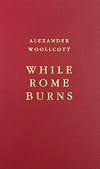
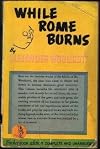
While Rome Burns
by Alexander Woollcott
On This Page
Description
"This is Woollcott speaking."...America's favorite raconteur here offers a generous selection of his best horror stories, anecdotes, personal portraits, legendary tales and reminiscences, including celebrated tales of murder as only he could tell them, his memorable profiles of the great and near-great, the exciting accounts of his journeys to far places, his war experiences, and much more.Tags
Recommendations















Member Reviews
A collection of essays by a (perhaps literally) outsize personality, covering a number of different topics, including the theatre, murders and travel. All of the essays are fairly short, but some of them are quite punchy. The murder episodes in particular are what bring the average of the essays up. Woollcott shamelessly name-drops, but in his defence, he did know a lot of people. One or two of the lines in the essays, especially his one on Dorothy Parker, have stood the test of time. Generally recommended, though you may skip through a few essays here or there.
Alexander Woollcott (1887-1043) served as a critic and self-described "incorrigible journalist" [33] for the New Yorker. He accepted good-humoredly the express acknowledgment of being the "inspiration" for the main character in The Man Who Came To Dinner" by GS Kaufman and Moss Hart, and the witty columnist in "Laura" obsessed with a beautiful, and possibly dead, woman.
Woollcott's commentary and reviews are reprinted in this collection. They are filled with seasoned erudition, and pesky private jokes, with which he assumes intimacy by sharing -- you are familiar with his ham painting? [11] Enjoy dilapidated copies of Chatterbox? [21]
Woollcott does not tell, he is too diverting, nor does he pull us into, good stories -- most of them show more are trivial -- a neighbor finds the very book she treasured as a child in a bookstore, in Paris. But the woman is Anne Parrish, "the one who wrote...the maliciously surgical All Kneeling, and that uncomfortably penetrating and richly entertaining novel called Loads of Love." [20] And so, he tells more than mere gossip, brings discernment to a head, and pillories what is taken for taste.
Woollcott's reviews of the Marx brothers are credited with their renaissance. However, the essay included here -- "My Friend Harpo" -- he describes Harpo as "an illiterate but golden-hearted clown" [37] really is about a poodle.
It should also be noted that Woollcott was often the first to promote gifted writers. "Lest we Forget" [279]is his program notes on JOURNEY'S END, "an English war play" written by an insurance adjustor for a rowing club about WWI. "I think that not in our time, by song or gesture or word or deed, has any Englishman so eloquently spoken the cause of his tribe...no braided mission, no silk-hatted plenipotentiary sent out by England since the war began, has so fairly represented her--so fairly told us the best that she has and is."[281] He revived this play which is still playing.
Woollcot's writing is ultimately well-tempered, amusing and infectious. He did apparently serve in the military, his muster described as "one who...had doggedly risen by sheer merit to the rank of sergeant". [328] show less
Woollcott's commentary and reviews are reprinted in this collection. They are filled with seasoned erudition, and pesky private jokes, with which he assumes intimacy by sharing -- you are familiar with his ham painting? [11] Enjoy dilapidated copies of Chatterbox? [21]
Woollcott does not tell, he is too diverting, nor does he pull us into, good stories -- most of them show more are trivial -- a neighbor finds the very book she treasured as a child in a bookstore, in Paris. But the woman is Anne Parrish, "the one who wrote...the maliciously surgical All Kneeling, and that uncomfortably penetrating and richly entertaining novel called Loads of Love." [20] And so, he tells more than mere gossip, brings discernment to a head, and pillories what is taken for taste.
Woollcott's reviews of the Marx brothers are credited with their renaissance. However, the essay included here -- "My Friend Harpo" -- he describes Harpo as "an illiterate but golden-hearted clown" [37] really is about a poodle.
It should also be noted that Woollcott was often the first to promote gifted writers. "Lest we Forget" [279]is his program notes on JOURNEY'S END, "an English war play" written by an insurance adjustor for a rowing club about WWI. "I think that not in our time, by song or gesture or word or deed, has any Englishman so eloquently spoken the cause of his tribe...no braided mission, no silk-hatted plenipotentiary sent out by England since the war began, has so fairly represented her--so fairly told us the best that she has and is."[281] He revived this play which is still playing.
Woollcot's writing is ultimately well-tempered, amusing and infectious. He did apparently serve in the military, his muster described as "one who...had doggedly risen by sheer merit to the rank of sergeant". [328] show less
3110. While Rome Burns, by Alexander Woollcott. I read this because of a list I found on July 1 giving Vincent Starrett's 52 books of this century picked in 1955 which he figured would "live". It is a series of short essays and some of the essays have dated, even for an old guy like me. This was published in 1934. (read Sept 12, 1998)
Ratings
Members
- Recently Added By
Lists

Best Books of 1926-1935
403 works; 10 members

Publisher's Weekly NON-Fiction list - 1912 - 1975
486 works; 4 members
Author Information

37+ Works 833 Members
Awards and Honors
Distinctions
Series
Belongs to Publisher Series
Penguin Books (118)
Common Knowledge
- Canonical title
- While Rome Burns
- Original publication date
- 1934-03
- First words
- Astray on a spring evening in the old library of William and Mary in Williamsburg in Virginia and admonished to silence by the grim female in charge, who kept warning me at the top of her lungs that all about me the young wer... (show all)e about their studies, I took down from a shelf the fat volumes of Brand Whitlock’s Belgium and renewed an old acquaintance with the stirring story he had to tell.
- Last words
- (Click to show. Warning: May contain spoilers.)As I put it down I am tempted to say of Frederick Palmer, as Booth Tarkington said of that literate marine, Captain John W. Thomason, Jr., “Here is a gentleman who knows how to hold his hand.”
Classifications
Statistics
- Members
- 213
- Popularity
- 152,778
- Reviews
- 3
- Rating
- (3.00)
- Languages
- English
- Media
- Paper, Ebook
- ISBNs
- 3
- ASINs
- 26