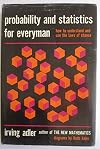
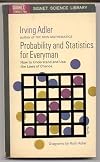
Probability and Statistics for Everyman: How to Understand and Use the Laws of Chance
by Irving Adler, Ruth Adler
On This Page
Tags
Recommendations



















Member Recommendations
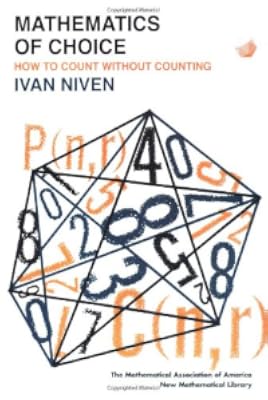
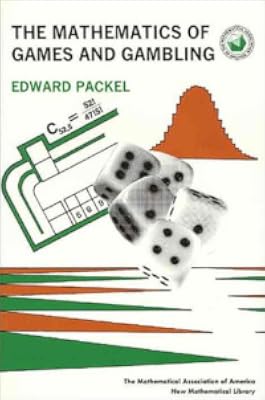
themulhern Both books use similar levels of rigor, although Adler's is a little more dense. The topics overlap, interestingly.
Member Reviews
Textbook for laypersons from the 1960s. Might be a little dense, and may cover detail at the expense of the larger picture, but overall, quite nice. Some very simple black and white diagrams, probably a challenge to typeset in that day.
Chapter III: Probability Models
This chapter is a big help. It states that we just establish a probability model and make arguments about that. We are not dealing with subjective probability, nor are we dealing with statistical probability. Instead we have chosen a model and we may subsequently establish its relation to reality. Nice and clear.
Chapter III: Probability Models
This chapter is a big help. It states that we just establish a probability model and make arguments about that. We are not dealing with subjective probability, nor are we dealing with statistical probability. Instead we have chosen a model and we may subsequently establish its relation to reality. Nice and clear.
Ratings
Members
- Recently Added By
Author Information

111 Works 1,392 Members
Irving Adler is an author, mathematician, scientists and educator, who has written more than 80 books on science and math for children and adults, which were published in 31 countries, in 19 languages. He received his B.S. degree, magna cum laude, from New York's City College (CCNY) in 1931 at age eighteen and his PhD in pure mathematics, from show more Columbia University (where he taught from 1957-1960) in 1961. Adler taught mathematics in the New York City Public Schools from 1932-1952 and was active in the New York City Teachers Union. There has served as Chairman of the Educational Policies Committee and later, as Chairman of the Salary and Legislative Committee. In his retirement, he became interested in solving the problem of why the Fibonacci Numbers and the Golden Ratio occur on plants. His papers on this subject have appeared in the Journal of Theoretical Biology, the Journal of Algebra and in the book Symmetry in Plants. show less
24+ Works 390 Members
Classifications
Statistics
- Members
- 38
- Popularity
- 765,270
- Reviews
- 1
- Rating
- (4.00)
- Languages
- Arabic, Dutch, English
- Media
- Paper
- ISBNs
- 3
- ASINs
- 4