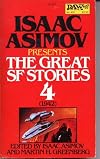
Isaac Asimov Presents : The Great SF Stories 4 (1942)
by Isaac Asimov (Editor, Foreword), Martin H. Greenberg (Foreword), Martin Harry Greenberg (Editor)
On This Page
Tags
Recommendations










Member Reviews
The year's best stories, at least as selected here, were dominated by a whole lot of dense info dumping as authors dove heavily into the "science" half of "science fiction."
Whether it's Lester del Rey detailing the medical consequences of a nuclear accident ("Nerves"), Hal Clement describing the lifeforms that might live on the sun ("Proof"), or Anthony Boucher laying out how time travel might work ("Barrier"), authors in 1942 were more interested in proving that their most fantastic ideas could be justified than they were in good storytelling.
That's perhaps a little harsh, particularly to del Rey, who does manage in between the long paragraphs of medical and nuclear speculation to build a great deal of tension, and to capture the show more stress of being a medical team coping with horrific disaster. But there were a lot of "eyes glaze over" moments in this book, and a lot of passages that I sort of skimmed through searching for the spot where the story picked up again.
The stories I liked best were the lighter ones. Fredric Brown's "The Star Mouse" sends a mouse to space and back, a trip that changes him in unexpected ways. "The Twonky" by Lewis Padgett (a pseudonym for the married writers Henry Kuttner and C. L. Moore) plops a bit of alien technology into the middle of 40s domestic life. And Donald A. Wollheim's "Mimic," though it never quite becomes an actual story, is a striking idea, and at only 6 pages, it doesn't outstay its welcome. show less
Whether it's Lester del Rey detailing the medical consequences of a nuclear accident ("Nerves"), Hal Clement describing the lifeforms that might live on the sun ("Proof"), or Anthony Boucher laying out how time travel might work ("Barrier"), authors in 1942 were more interested in proving that their most fantastic ideas could be justified than they were in good storytelling.
That's perhaps a little harsh, particularly to del Rey, who does manage in between the long paragraphs of medical and nuclear speculation to build a great deal of tension, and to capture the show more stress of being a medical team coping with horrific disaster. But there were a lot of "eyes glaze over" moments in this book, and a lot of passages that I sort of skimmed through searching for the spot where the story picked up again.
The stories I liked best were the lighter ones. Fredric Brown's "The Star Mouse" sends a mouse to space and back, a trip that changes him in unexpected ways. "The Twonky" by Lewis Padgett (a pseudonym for the married writers Henry Kuttner and C. L. Moore) plops a bit of alien technology into the middle of 40s domestic life. And Donald A. Wollheim's "Mimic," though it never quite becomes an actual story, is a striking idea, and at only 6 pages, it doesn't outstay its welcome. show less
I enjoyed "The Twonky" and "Mimic" the most. The rest I found either tolerable or excruciating. Generally, pretty awful prose, including some cringe-inducing dialect. One entry was practically a shaggy dog story.
Ratings
Members
- Recently Added By
Author Information

Isaac Asimov was born in Petrovichi, Russia, on January 2, 1920. His family emigrated to the United States in 1923 and settled in Brooklyn, New York, where they owned and operated a candy store. Asimov became a naturalized U.S. citizen at the age of eight. As a youngster he discovered his talent for writing, producing his first original fiction at show more the age of eleven. He went on to become one of the world's most prolific writers, publishing nearly 500 books in his lifetime. Asimov was not only a writer; he also was a biochemist and an educator. He studied chemistry at Columbia University, earning a B.S., M.A. and Ph.D. In 1951, Asimov accepted a position as an instructor of biochemistry at Boston University's School of Medicine even though he had no practical experience in the field. His exceptional intelligence enabled him to master new systems rapidly, and he soon became a successful and distinguished professor at Columbia and even co-authored a biochemistry textbook within a few years. Asimov won numerous awards and honors for his books and stories, and he is considered to be a leading writer of the Golden Age of science fiction. While he did not invent science fiction, he helped to legitimize it by adding the narrative structure that had been missing from the traditional science fiction books of the period. He also introduced several innovative concepts, including the thematic concern for technological progress and its impact on humanity. Asimov is probably best known for his Foundation series, which includes Foundation, Foundation and Empire, and Second Foundation. In 1966, this trilogy won the Hugo award for best all-time science fiction series. In 1983, Asimov wrote an additional Foundation novel, Foundation's Edge, which won the Hugo for best novel of that year. Asimov also wrote a series of robot books that included I, Robot, and eventually he tied the two series together. He won three additional Hugos, including one awarded posthumously for the best non-fiction book of 1995, I. Asimov. "Nightfall" was chosen the best science fiction story of all time by the Science Fiction Writers of America. In 1979, Asimov wrote his autobiography, In Memory Yet Green. He continued writing until just a few years before his death from heart and kidney failure on April 6, 1992. (Bowker Author Biography) show less

Martin Harry Greenberg (March 1, 1941 - June 25, 2011) was an American academic and speculative fiction anthologist. In all, he compiled 1,298 anthologies. He founded Tekno Books, a packager of more than 2000 published books; he was also a co-founder of the Sci-Fi Channel. Some of his anthologies included: Past Imperfect (2001), Once Upon a Galaxy show more (2002) and Sirius: The Dog Star (2004). (Bowker Author Biography) show less
All Editions
Some Editions
Series
Belongs to Publisher Series
Work Relationships
Is contained in
Contains
Proof by Hal Clement
Common Knowledge
- Canonical title
- Isaac Asimov Presents : The Great SF Stories 4 (1942) (1942)
- Original title
- Isaac Asimov Presents : The Great SF Stories 4 (1942) (1942)
- Original publication date
- 1980
- Original language*
- Englisch
*Some information comes from Common Knowledge in other languages. Click "Edit" for more information.
Classifications
Statistics
- Members
- 111
- Popularity
- 292,007
- Reviews
- 2
- Rating
- (3.30)
- Languages
- English, German, Italian
- Media
- Paper
- ISBNs
- 3
- ASINs
- 4