
Lewis Padgett
Author of Mutant
About the Author
Disambiguation Notice:
Lewis Padgett was the joint pseudonym of the science-fiction authors and spouses Henry Kuttner and C. L. Moore. This page should, therefore, not be combined with either of their individual author pages.
Lawrence O'Donnell and C. H. Liddell are also joint pseudonyms of Kuttner and Moore, and those pages also should not be combined with this or with the individual pages.
According to the Internet Speculative Fiction Database, all stories attributed to O'Donnell were written by Kuttner and Moore, and no record exists of Kuttner writing solo under the psuedonym O'Donnell.
Works by Lewis Padgett
Associated Works
The Science Fiction Hall of Fame, Volume One: The Greatest Science Fiction Stories of All Time (1970) — Contributor — 2,104 copies, 34 reviews
A Treasury of Science Fiction (1948) — Contributor, some editions; Contributor, some editions — 201 copies, 3 reviews
Isaac Asimov Presents : The Great SF Stories 5 (1943) (1981) — Author, some editions; Author, some editions — 122 copies, 3 reviews
Isaac Asimov Presents : The Golden Years of Science Fiction, 5th Series (1985) — Contributor — 103 copies
Isaac Asimov Presents : The Golden Years of Science Fiction, 4th Series (1984) — Contributor; Contributor — 100 copies, 1 review
Isaac Asimov Presents : The Golden Years of Science Fiction, 3rd Series (1984) — Contributor; Contributor — 61 copies
The Edge of the Chair: A Superlative Collection, Some Fact, Some Fiction, All Suspense (1967) — Contributor — 50 copies, 1 review
Science-Fiction Classics: The Stories That Morphed Into Movies (1999) — Contributor — 24 copies, 1 review
Beyond Human Ken: 21 Startling Stories of Science Fiction and Fantasy (1952) — Contributor — 20 copies
Science Fiction Omnibus: The Best Science Fiction Stories: 1949, 1950 (1952) — Contributor — 11 copies
Tagged
Common Knowledge
- Other names
- O'Donnell, Lawrence
Liddell, C. H.
Padgett, Lewis
Kuttner, Henry
Moore, Catherine Lucille - Gender
- n/a
- Map Location
- USA
- Disambiguation notice
- Lewis Padgett was the joint pseudonym of the science-fiction authors and spouses Henry Kuttner and C. L. Moore. This page should, therefore, not be combined with either of their individual author pages.
Lawrence O'Donnell and C. H. Liddell are also joint pseudonyms of Kuttner and Moore, and those pages also should not be combined with this or with the individual pages.
According to the Internet Speculative Fiction Database, all stories attributed to O'Donnell were written by Kuttner and Moore, and no record exists of Kuttner writing solo under the psuedonym O'Donnell.
Members
Reviews
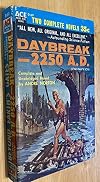
Reading the Ace Doubles tête-bêche books has introduced me to a wide range of authors from science fiction's "Golden Age," yet the authors of the two novels in this collection were well familiar to me. As a longtime fan of the husband-and-wife writing team of Henry Kuttner and C. L. Moore, their novel Beyond Earth Gates (published under their pseudonym "Lewis Padgett," though with Moore's name curiously added) was the first of the two I read. It's an enjoyable story about a Broadway actor show more who discovers that the fantastic world described to him by his uncle when he was a young boy indeed exists, as he discovers when his clingy and nagging girlfriend gets sucked into it. Accused of murdering her, he subsequently follows her into a parallel world run by a priesthood whose power comes from their control over the mysteries of mechanical technology. While the plot itself is fairly insubstantial, it's propelled by a fun exploration of the world the authors built and the interesting moral dilemma the protagonist finds himself in as to whether he should intervene in a situation he knows nothing about.
There's no such dilemma in Andre Norton's Daybreak-2250 A.D.. Originally published as Star Man's Son, it's about the journey of a mutant human to the ruins of New York City two centuries after a war (known as "the Blow-Up") devastated human civilization. It's the best kind of adventure story, with the protagonist facing a series of trials, making friends, and gradually realizing his full potential as a person. Norton was an excellent writer, and her book reflects her skill at writing a narrative that grabs the reviewer early on and doesn't let go until the last page. Norton's novel is alone worth the price of the collection, and the other novel that accompanies it is a nice bonus that together demonstrates the sort of entertainment value that made science fiction such a popular genre in the 1950s. show less
There's no such dilemma in Andre Norton's Daybreak-2250 A.D.. Originally published as Star Man's Son, it's about the journey of a mutant human to the ruins of New York City two centuries after a war (known as "the Blow-Up") devastated human civilization. It's the best kind of adventure story, with the protagonist facing a series of trials, making friends, and gradually realizing his full potential as a person. Norton was an excellent writer, and her book reflects her skill at writing a narrative that grabs the reviewer early on and doesn't let go until the last page. Norton's novel is alone worth the price of the collection, and the other novel that accompanies it is a nice bonus that together demonstrates the sort of entertainment value that made science fiction such a popular genre in the 1950s. show less

What a disappointment. Kuttner was a favorite of mine decades ago, but this is a scrambled mess. It reads like a stream of consciousness parody of 1930's SF, with stalwart hero (no background), corpulent villain (ditto), alien female heroine to fall in love with hero, alien female villainess who hisses and constantly demands the secret key to the universe, etc etc. But though Kuttner was noted for his humor, it was broader than this, and I don't think I missed a tongue parked in cheek.

Kuttner, Henry. Mutant. 1953. E-book ed., Gateway, 2013.
A nuclear exchange has created a viable mutation of hairless telepaths called “Baldies.” Mutant, by Henry Kuttner, describes the Baldies as a self-conscious minority community, most of whom wear wigs in public to hide their telepathy. They feel superior to non-telepaths, but they know they are feared and perhaps envied by non-telepaths. These themes are as timely as ever, but the stories are also creatures of their time. One can show more imagine them as episodes on Twilight Zone or Alfred Hitchcock. They share some themes with A.E. van Vogt’s Slan (1940), and they look forward to such works as Kurt Vonnegut’s “Harrison Bergeron” (1961). Mutant, a “fix-up” novel based on short stories that appeared first in Astounding, was originally published under the pseudonym “Lewis Padgett,” a name often used for works Kuttner co-authored with his wife, C. L. Moore. Later editions are usually attributed to Kuttner alone. It is still worth a read. 4 stars. show less
A nuclear exchange has created a viable mutation of hairless telepaths called “Baldies.” Mutant, by Henry Kuttner, describes the Baldies as a self-conscious minority community, most of whom wear wigs in public to hide their telepathy. They feel superior to non-telepaths, but they know they are feared and perhaps envied by non-telepaths. These themes are as timely as ever, but the stories are also creatures of their time. One can show more imagine them as episodes on Twilight Zone or Alfred Hitchcock. They share some themes with A.E. van Vogt’s Slan (1940), and they look forward to such works as Kurt Vonnegut’s “Harrison Bergeron” (1961). Mutant, a “fix-up” novel based on short stories that appeared first in Astounding, was originally published under the pseudonym “Lewis Padgett,” a name often used for works Kuttner co-authored with his wife, C. L. Moore. Later editions are usually attributed to Kuttner alone. It is still worth a read. 4 stars. show less
I have generally been a fan of Kuttner's (and Moore's...I assume that they co-wrote this as a team), but this relatively quick, if at times disjointed, read was on balance a bit of a disappointment.
The Well of the Worlds reads like an extended bad dream. Like you might expect of an extended bad dream, it includes some wildly original concepts and more than a few (descriptions of) striking and/or surreal visual images. But these original concepts don't seem to fit together in any particularly show more logical progression, and the characters, both human and alien, are almost comically under-developed. show less
The Well of the Worlds reads like an extended bad dream. Like you might expect of an extended bad dream, it includes some wildly original concepts and more than a few (descriptions of) striking and/or surreal visual images. But these original concepts don't seem to fit together in any particularly show more logical progression, and the characters, both human and alien, are almost comically under-developed. show less
Awards

You May Also Like


Associated Authors
Statistics
- Works
- 33
- Also by
- 56
- Members
- 811
- Popularity
- #31,468
- Rating
- 4.0
- Reviews
- 17
- ISBNs
- 31
- Languages
- 5