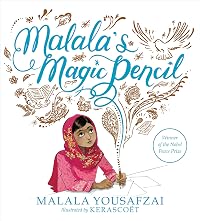
Malala's Magic Pencil
by Malala Yousafzai
On This Page
Description
Malala's first picture book will inspire young readers everywhere to find the magic all around them. As a child in Pakistan, Malala made a wish for a magic pencil. She would use it to make everyone happy, to erase the smell of garbage from her city, to sleep an extra hour in the morning. But as she grew older, Malala saw that there were more important things to wish for. She saw a world that needed fixing. And even if she never found a magic pencil, Malala realized that she could still work show more hard every day to make her wishes come true. show lessTags
Recommendations




Member Reviews
Educational rights activist and Nobel Peace Prize-winner Malala Yousafzai describes her childhood in Pakistan's Swat Valley in this lovely, deeply poignant and inspirational picture-book. Growing up, Malala wished that she had the magical pencil possessed by the hero of one of her favorite television shows, imagining all the ways she could improve both her own life and the world around her. When the Taliban took over her region, outlawing education for girls, she realized that although she didn't have a magical pencil, she did have a voice - a voice she could use to promote the right of girls to go to school. Attacked for her work, Malala survived, and went on to become one of the world's most recognizable figures in this field of show more activism...
Malala Yousafzai has written both an adult memoir, and a young reader's version of that adult memoir, but Malala's Magic Pencil is aimed at younger children, at the preschool and early primary school level. Given that this is so, it's important to note that some of the most disturbing elements of her story - the fact that the Taliban attempted to assassinate her, for instance - are treated very obliquely here. The episode is covered in a two-page spread, the right-hand page a solid black, with the words "My voice became so powerful that dangerous men tried to silence me. But they failed" on it, and the left-hand page showing Malala at a window, wearing a hospital bracelet. This seems like a good way to handle the issue given the age of the audience, concentrating on the motives behind the attack and its failure, rather than on its violence. The moving narrative here is well-matched by the gorgeous artwork of Kerascoët, a pseudonym used by the husband and wife team of Sébastien Cosset and Marie Pommepuy. The illustrations are very expressive, in the human scenes, but there is an element of visual magic too, when Malala is using her pen, and the endpapers are beautifully decorative. All in all, a lovely picture-book introduction to this important figure, one I would recommend to young children interested in their peers around the world, or to anyone searching for children's books that emphasize what a vital blessing access to educations is. show less
Malala Yousafzai has written both an adult memoir, and a young reader's version of that adult memoir, but Malala's Magic Pencil is aimed at younger children, at the preschool and early primary school level. Given that this is so, it's important to note that some of the most disturbing elements of her story - the fact that the Taliban attempted to assassinate her, for instance - are treated very obliquely here. The episode is covered in a two-page spread, the right-hand page a solid black, with the words "My voice became so powerful that dangerous men tried to silence me. But they failed" on it, and the left-hand page showing Malala at a window, wearing a hospital bracelet. This seems like a good way to handle the issue given the age of the audience, concentrating on the motives behind the attack and its failure, rather than on its violence. The moving narrative here is well-matched by the gorgeous artwork of Kerascoët, a pseudonym used by the husband and wife team of Sébastien Cosset and Marie Pommepuy. The illustrations are very expressive, in the human scenes, but there is an element of visual magic too, when Malala is using her pen, and the endpapers are beautifully decorative. All in all, a lovely picture-book introduction to this important figure, one I would recommend to young children interested in their peers around the world, or to anyone searching for children's books that emphasize what a vital blessing access to educations is. show less
In this autobiography, Malala Yousafzai begins with a TV show she watched as a young child in which the protagonist has a magic pencil that brings things into existence. She wishes for her own magic pencil to bring her mother nice dresses, her brothers a soccer ball, etc. Over time as she sees poverty and other struggles around her town, she wishes for peace and equality. She realizes that the best way to do this is make the magic come true herself, and she begins a writing campaign to make the world aware of the plight of young girls who are unable to attend school due to poverty and/or gender discrimination.
This book was so heartfelt that it did in fact make me cry. Being as this book is for young readers, Malala does not go into show more details in the main text but simply mentions how "dangerous men tried to silence" her, a statement on a starkly black page across from an illustration of Malala standing up in a hospital gown looking out the window. Her story ends optimistically and is certainly inspirational as others listen to her call. Her author's note contains some further motivation for readers: "Once, I wished for Sanju's magic pencil. Now I know that when you find your voice, every pencil can be magic. I hope that my story inspires you to find the magic in your own life and to always speak up for what you believe in. Magic is everywhere in the world -- in knowledge, beauty, love, peace. The magic is in you, in your words, in your voice."
The illustrations are beautiful and are even more striking for having an overlay of rose-gold images for any of the "magic" things that Malala dreams up. show less
This book was so heartfelt that it did in fact make me cry. Being as this book is for young readers, Malala does not go into show more details in the main text but simply mentions how "dangerous men tried to silence" her, a statement on a starkly black page across from an illustration of Malala standing up in a hospital gown looking out the window. Her story ends optimistically and is certainly inspirational as others listen to her call. Her author's note contains some further motivation for readers: "Once, I wished for Sanju's magic pencil. Now I know that when you find your voice, every pencil can be magic. I hope that my story inspires you to find the magic in your own life and to always speak up for what you believe in. Magic is everywhere in the world -- in knowledge, beauty, love, peace. The magic is in you, in your words, in your voice."
The illustrations are beautiful and are even more striking for having an overlay of rose-gold images for any of the "magic" things that Malala dreams up. show less
What an incredible book and an even more incredible story. So often we ask ourselves how can I, one little person, change the world? Yet, here we are, given the incredible story of a young girl who helped to change the status of so many lives by standing up for young women who did not have access to school. One person can make a difference and it is incredibly powerful to hear the story of a child doing so. The world in which Malala grew up was a complicated one and at first she did not understand the privileges that she had, such as going to school. Over time she realized that she was just the person to do something about it and despite looming danger she brought attention to the issue. Her story can be used to educate young people show more about the atrocities in the world while also inspiring them to use their own passions to do something about it. The illustrator does an remarkable job of capturing the emotions that Malala feels as she encounters so many challenges and finds her way. show less
I really enjoyed reading Malala’s Magic Pencil by Malala Yousafzai. It offers an inspiring look at Malala’s life and how she used her voice to advocate for change and education. The story highlights important themes of courage, perseverance, and the power of words, showing young readers that even one person can make a difference. I appreciated how the book presents Malala’s experiences in a way that is honest yet age-appropriate, touching on the challenges she faced without overwhelming younger readers. Overall, Malala’s Magic Pencil is a powerful and inspiring story that encourages children to speak up for what they believe in and recognize the impact their voices can have on the world.
This was a beautiful autobiography that would be a great book to add to any classroom library. Although Malala is talking about life in Pakistan, she draws you in by touching on universal emotions. She discusses complicated and sad aspects of life in her home country in such an honest, yet child-friendly way. When I read this book, I could imagine children everywhere empathizing with her. Her culture and experience is represented in an authentic way. She brings awareness to the extreme poverty in her country and shows compassion for those less fortunate.
The most profound thing about the story is the central character’s bravery, compassion, and ambition. She serves as a great role model because she stands up for what she believes in. show more I think she does a fine job of portraying the Taliban accurately, but I wondered why she did not mention that she was shot. My guess is that Malala did not want that to take away from what she considers to be the important parts of her own story. In other words, she didn’t want children to read this and only remember her as the girl who was shot. The important part is that she used her voice to make a difference. show less
The most profound thing about the story is the central character’s bravery, compassion, and ambition. She serves as a great role model because she stands up for what she believes in. show more I think she does a fine job of portraying the Taliban accurately, but I wondered why she did not mention that she was shot. My guess is that Malala did not want that to take away from what she considers to be the important parts of her own story. In other words, she didn’t want children to read this and only remember her as the girl who was shot. The important part is that she used her voice to make a difference. show less
The products of Malala's "magic pencil" are rendered in shimmery copper: buildings for her father to run more schools, dresses for her mother, a soccer ball for her two little brothers. But when she realizes that not all children, especially girls, have the chance to go to school, she writes, "I knew then that if I had the magic pencil, I would use it to draw a better world, a peaceful world."
Malala spoke out, and the Taliban attacked her, but she survived, and she remains an international advocate for girls' education.
Malala spoke out, and the Taliban attacked her, but she survived, and she remains an international advocate for girls' education.
This book would be best for intermediate grades. This book follows Malala Yousafzai, a girl from Pakistan who fought for her and so many others' rights to go to school after women were banned from attending. This book could definitely be used to teach about women's empowerment and oppression, as well as fighting for what you believe in. The only drawback is that there is some talk about violence and weapons, so notifying parents that this book is going to be taught is important.
Members
- Recently Added By
Lists

Childhood: Books for or about children in different cultures around the wor
345 works; 18 members

Foundation Against Intolerance and Racism Literature Guides Books
16 works; 2 members

Youth: Women's History
34 works; 1 member
Author Information

14 Works 13,188 Members
Malala Yousafzai was born in the Swat Valley of Pakistan on July 12, 1997. In 2009, she wrote a diary for BBC using a pen name about the critical situation in Swat at that time. On October 8, 2012, she was attacked by the Taliban while returning home from school. I Am Malala: The Girl Who Stood up for Education and Was Shot by the Taliban is her show more first book. She won the 2014 Nobel Peace Prize. In 2015 she launched the #BooksNotBullets campaign on social media to pressure world leaders to invest in education rather than the military. Yousafzai asks low- and middle-income countries to commit a minimum of 20% of national budgets on education, rather than the current average of 15%. (Bowker Author Biography) show less
All Editions
Awards and Honors
Awards
Distinctions
Common Knowledge
- Canonical title*
- Le crayon magique de Malala
- Original title
- Malala's Magic Pencil
*Some information comes from Common Knowledge in other languages. Click "Edit" for more information.
Classifications
- Genre
- Picture Books
- DDC/MDS
- 371.822095491 — Society, government, & culture Education Schools and their activities; special education Culture Studies Fagging and hazing; Bullying; German student duels
- LCC
- LC2330 .Y6825 — Education Special aspects of education Special aspects of education Education of special classes of persons Women
- BISAC
Statistics
- Members
- 1,034
- Popularity
- 25,038
- Reviews
- 47
- Rating
- (4.67)
- Languages
- 7 — English, French, German, Italian, Korean, Spanish, Portuguese (Portugal)
- Media
- Paper, Ebook
- ISBNs
- 25
- ASINs
- 3