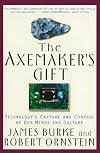
The Axemaker's Gift
by James Burke, Robert Ornstein (Author)
On This Page
Description
At the close of this century of creativity and discovery, humanists and scientists alike wonder: How could human beings in all their brilliance - those "axemakers" with the genius to invent, lead, inspire, heal, design - have brought the world to the brink of destruction? The answers can be found in The Axemaker's Gift, an imaginative and brilliantly informed double-edged history of human culture. James Burke, a leading expert on the interaction of technology and society, and Robert show more Ornstein, a pioneer in charting the evolution of consciousness, show how the interaction between innovation and the brain has continually reshaped the world and, more important, the way we think. show lessTags
Recommendations
























Member Reviews
This book surveys the broad expanse of human history through the lens of a single, powerful argument: that from the time the earliest humans fashioned stone axes tens of thousands of years ago, humans have continually accepted the double-edged gift of new technology, using it to solve apparent problems and barriers, but in so doing creating new, unforeseen and often more severe problems than those that the technology solved.
As the authors see it, technology's power has been its danger as well. From the power of the first stone axes to cut the world up into pieces that could be more readily controlled and exploited, the unfolding development of technology has encouraged an increasing reductionism that has made it hard for humans to show more appreciate the damaging effects of their actions. Technology has also consistently deepened social inequalities, focusing power and wealth in the hands of those who understand and can use the new technologies, while excluding if not oppressing those who do not. At the dawn of the new millennium, the authors suggest that the seductiveness of the axemaker's gift presents humanity with the danger of so damaging the planet through anthropocentric global warming and other environmental damage that it may no longer be able to sustain human civilization.
The author's use of this simple argument to organize so much human history is, of course, itself an axe that cuts both ways. On the one hand, they have created a sweeping narrative that is never dull and is frequently dazzling in the fresh insights it brings to familiar historical events. They also manage to strike a nice balance between capturing the excitement of technological discovery while avoiding a naive techno-triumphalism. On the other hand, their reliance on a single, overarching argument forces them to limit their choice of historical material in a way that seems highly distorted. Moreover, their argument leads them to discuss inventors, designers, engineers and scientists from radically different historical periods, who worked in fundamentally different ways for fundamentally different purposes, as a single trans-historical group (the "axemakers"), contributing to a single process of technological development. Similarly, the chieftains, kings, presidents and other social elites who accepted and benefited most from the gifts of technology are seen as all engaged in the same project of world domination.
In short, this book is well worth reading for the insight it provides on human history. But, like the technology it describes, it should be read with equal consideration for the history it distorts or ignores. show less
As the authors see it, technology's power has been its danger as well. From the power of the first stone axes to cut the world up into pieces that could be more readily controlled and exploited, the unfolding development of technology has encouraged an increasing reductionism that has made it hard for humans to show more appreciate the damaging effects of their actions. Technology has also consistently deepened social inequalities, focusing power and wealth in the hands of those who understand and can use the new technologies, while excluding if not oppressing those who do not. At the dawn of the new millennium, the authors suggest that the seductiveness of the axemaker's gift presents humanity with the danger of so damaging the planet through anthropocentric global warming and other environmental damage that it may no longer be able to sustain human civilization.
The author's use of this simple argument to organize so much human history is, of course, itself an axe that cuts both ways. On the one hand, they have created a sweeping narrative that is never dull and is frequently dazzling in the fresh insights it brings to familiar historical events. They also manage to strike a nice balance between capturing the excitement of technological discovery while avoiding a naive techno-triumphalism. On the other hand, their reliance on a single, overarching argument forces them to limit their choice of historical material in a way that seems highly distorted. Moreover, their argument leads them to discuss inventors, designers, engineers and scientists from radically different historical periods, who worked in fundamentally different ways for fundamentally different purposes, as a single trans-historical group (the "axemakers"), contributing to a single process of technological development. Similarly, the chieftains, kings, presidents and other social elites who accepted and benefited most from the gifts of technology are seen as all engaged in the same project of world domination.
In short, this book is well worth reading for the insight it provides on human history. But, like the technology it describes, it should be read with equal consideration for the history it distorts or ignores. show less
History/Technology
No notes recorded
Ratings
Members
- Recently Added By
Author Information

35+ Works 4,879 Members
James Burke's contributes a monthly column to Scientific American and serves as director, writer and host of the television series Connections 3, which airs on the Learning Channel.

Classifications
- Genres
- Nonfiction, Anthropology, Science & Nature, History, Technology, General Nonfiction, Philosophy
- DDC/MDS
- 306.46 — Society, government, & culture Social sciences, sociology & anthropology Social Behavior - Dating, Marriage, Divorce Specific aspects of culture Technology
- LCC
- HM221 .B84 — Social sciences Sociology (General) Sociology These are obsolete numbers no longer used
- BISAC
Statistics
- Members
- 314
- Popularity
- 102,320
- Reviews
- 3
- Rating
- (3.85)
- Languages
- English, Portuguese, Spanish
- Media
- Paper, Audiobook
- ISBNs
- 5
- ASINs
- 2