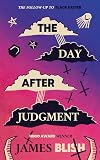
The Day After Judgement
by James Blish
After Such Knowledge (2.2), After Such Knowledge: Publication order (4)
On This Page
Description
The powerful black magician Theron Ware has opened the gates of Hell and unleashed an army of demons. Chaos and destruction prevail, and most of the world lies smouldering in ruins. But in a bunker beneath the ashes of Denver a small group of survivors are determined not to submit to the forces of evil. They summon the nuclear powers of the military arsenal to destroy Hell, but what can men do against the almighty evil that is Satan himself? A direct sequel to Blish's occult classic Black show more Easter (1968), The Day After Judgment (1971) can also be read as a standalone book. Like Black Easter , it features a blend of horror, science fiction, fantasy, philosophy, and black humor that makes it quite unlike anything else you have ever read. show lessTags
Recommendations



















Member Reviews
Read on its own, this isn't particuarly good or as coherent as it could be in exploring humanity's relationship with religion, morality and technology. However, this is really part two of Black Easter and taken as a whole, is quite the worthwhile read.
Dealing with the after effects of the actions taken in that story and the massive revelation at its climax, this is another bleak book which again draws from a deep well of classical sources of magic and mythology. Where Black Easter examines the "how", The Day After Judgment" tries to look more at the "why" and explores what happens next.
The story switches between the surviving US military and their cavalier approach of trying to blow everything up (at obscene costs) to retake control and show more the original characters who are looking for their own place in this twisted new reality. Most of these perspectives and morality questions are somewhat dated by modern, liberal standards, but there are some interesting philopsophical thoughts to pursue that give the book greater value. And the imagery - drawn direct from Dante - is quite spectacular. In fact quite a lot if packed into 100 pages.
The ending is presented in the form of an epic poem (fitting given the scene is drawn directly from The Inferno), but is no less impactful and mind blowing compared to the first book. I'm not a big poetry lover, but I appreciated the connection here and just about got what I needed from it and indeed it's one of the better examinations of Good vs Evil I have come across, presenting an interesting question about humanity's place in a grander scheme.
Ignore the terrible cover on this edition - it's well worth a read when combined with Black Easter. Together they companion with two other books Blish wrote and I look forward to exploring those next. show less
Dealing with the after effects of the actions taken in that story and the massive revelation at its climax, this is another bleak book which again draws from a deep well of classical sources of magic and mythology. Where Black Easter examines the "how", The Day After Judgment" tries to look more at the "why" and explores what happens next.
The story switches between the surviving US military and their cavalier approach of trying to blow everything up (at obscene costs) to retake control and show more the original characters who are looking for their own place in this twisted new reality. Most of these perspectives and morality questions are somewhat dated by modern, liberal standards, but there are some interesting philopsophical thoughts to pursue that give the book greater value. And the imagery - drawn direct from Dante - is quite spectacular. In fact quite a lot if packed into 100 pages.
The ending is presented in the form of an epic poem (fitting given the scene is drawn directly from The Inferno), but is no less impactful and mind blowing compared to the first book. I'm not a big poetry lover, but I appreciated the connection here and just about got what I needed from it and indeed it's one of the better examinations of Good vs Evil I have come across, presenting an interesting question about humanity's place in a grander scheme.
Ignore the terrible cover on this edition - it's well worth a read when combined with Black Easter. Together they companion with two other books Blish wrote and I look forward to exploring those next. show less
The sequel to Black Easter. Not as good, it does have excellent moments (the U.S. Army bombing the City of Dis, and scientists forced to use buzzwords that mean nothing in an effort to explain the supernatural) and the ending, although overly cheery, has such a cynical edge that I couldn't help but like it.
This is a sequel to the novella Black Easter, and to me was an anti-climax. What Stoker's Dracula and King's Salem's Lot is to vampires, Black Easter is to demons. Blish said in his Author's Note to that first novel that every one of the "novels, poems and plays about magic and witchcraft" he's read treat it as "romantic or playful." He sought to write a treatment that "neither romanticizes magic nor treats it as a game." That book is dedicated to C.S. Lewis and even included an extensive quotation from his Screwtape Letters heading one of the chapters.
So although I'm not sure I'd classify this as out and out Christian fiction, this does come out of that world view and takes the demonic seriously--that's what does make it unusual and at show more times fascinating. It's obvious not just from his note but the vividness of his details and even the quotes heading chapters Blish did extensive research--actually reading grimoires and manuscripts on ceremonial magic. At the same time Blish is best known as a science fiction writer, and approaches magic with almost scientific rigor. This sequel though is not so much Christian allegory of scientific hubris as Cold War parody--and I found that more dated and less interesting, although it did have moments of (very black) comedy. And maybe a believing Christian would have found the ending powerful and moving, as the ending of the first book was intended to be shocking--I found it trite. show less
So although I'm not sure I'd classify this as out and out Christian fiction, this does come out of that world view and takes the demonic seriously--that's what does make it unusual and at show more times fascinating. It's obvious not just from his note but the vividness of his details and even the quotes heading chapters Blish did extensive research--actually reading grimoires and manuscripts on ceremonial magic. At the same time Blish is best known as a science fiction writer, and approaches magic with almost scientific rigor. This sequel though is not so much Christian allegory of scientific hubris as Cold War parody--and I found that more dated and less interesting, although it did have moments of (very black) comedy. And maybe a believing Christian would have found the ending powerful and moving, as the ending of the first book was intended to be shocking--I found it trite. show less
A sequel to Black Easter, which follows on directly from the events of that book. The four men, priest, black magician, arms dealer and the latter's sidekick go their disparate ways to try to deal with the situation that now exists after nuclear weapons have destroyed many great cities and demons are loose on the earth. Eventually they will be drawn back to a common destination to confront their destiny. At times reminiscent of the film Doctor Strangelove, this comes across as darkly humourous in parts. The ending where Satan is revealed to be devastated at having to assume God's role in his mysterious absence or death was a bit confusing, as I wasn't sure, when the infernal city of Discussion disappeared and Death Valley was restored show more to normal whether this applied to the rest of the earth .
Read as part of the After Such Knowledge omnibus and posted as an individual review as all the other GR reviews are under the individual books. show less
Read as part of the After Such Knowledge omnibus and posted as an individual review as all the other GR reviews are under the individual books. show less
Interesting scifi/fantasy read. Pretty deep.
Ratings
Members
- Recently Added By
Lists

Cawthorn and Moorcock's Fantasy: The 100 Best Books
110 works; 7 members
Author Information

268+ Works 24,500 Members
James Benjamin Blish was born on May 23, 1921 in East Orange, N.J. Blish trained as a biologist at Rutgers and Columbia University, and spent 1942 - 1944 as a medical technician in the United States Army. After the war he became the science editor for the Pfizer pharmaceutical company. His first published story appeared in 1940, and his writing show more career progressed until he gave up his job to become a professional writer. From 1962 to 1968, he worked for the Tobacco Institute. Between 1967 and his death from lung cancer in 1975, Blish wrote authorized short story collections based upon the 1960s TV series Star Trek. He wrote 11 volumes adapting episodes of the series. He died midway through writing Star Trek 12. Perhaps Blish's most famous works were the "Okies" stories, known collectively as Cities in Flight, published in the science-fiction digest magazine Astounding Science Fiction. Some of James Blish's other works include The Vanished Jet, And All the Stars a Stage, The Quincunx of Time, and Flight of Eagles. (Bowker Author Biography) show less
Awards and Honors
Notable Lists
Series


Belongs to Publisher Series
Work Relationships
Is contained in
Has as a commentary on the text
Common Knowledge
- Original title
- The Day After Judgment
- Alternate titles
- The Day After Judgement
- Original publication date
- 1970 (serialized in Galaxy) (serialized in Galaxy); 1971 (book) (book)
- People/Characters
- Theron Ware; Baines; Father Domenico Garelli; Jack Ginsberg; General D. Willis McKnight; Satan
- Important places
- Death Valley; Dis
- Epigraph
- After such knowledge, what forgiveness? - T. S. Eliot
- Dedication
- To Robert A. W. Lowndes
- First words
- The fall of God put Theron Ware in a peculiarly unenviable position, though he was hardly alone.
- Last words
- (Click to show. Warning: May contain spoilers.)... That at last I know I never wanted to be God at all; And so, by winning all, All have I lost.
Classifications
Statistics
- Members
- 263
- Popularity
- 123,117
- Reviews
- 5
- Rating
- (3.44)
- Languages
- 5 — English, French, German, Portuguese, Swedish
- Media
- Paper, Ebook
- ISBNs
- 12
- ASINs
- 6