
On This Page
Description
The humanoid was man's ultimate mechanical triumph and perfect servant. Keth Kyrone, son of the one member of Kai's ruling body who still believes in the menace of the humanoids, comes upon the secret force that could constitute man's only hope of defeating the machines. As the humanoids arrive and begin to take over, Keth undertakes the mission to awaken his race to what is happening to them.Tags
Recommendations









Member Reviews
While this sequel doesn't have the classic status of Williamson's 1948 The Humanoids, it is a better written book. Often when authors return to an early success, the results are often a meandering essay on the original ideas. Williamson instead has written a fairly plot-heavy book, trading the pulp model of the original for the trappings of a young adult novel, with sex. It is similar in many respects to Cowper's Kuldesak from seven years earlier, also about humanity living in caves, a young man exploring the forbidden areas, finding something important to the plot but not understood while accidentally leaving something behind that will cause problems, and sex -- lots of thinking about sex. The info-dumps that filled pages in The show more Humanoids are gone, as are the long and repetitious passages on how the main character is feeling. Kept is the unstoppable onslaught of humanoids. By the end of the short novel, just hearing the humanoid greeting "Service" is enough to invoke a shudder. The only misstep IMO is near the end when the humanoids call on the population at large to find and kill our heroes. This sees out of keeping with the kill with kindness approach present everywhere else. I also found unbelievable how the humanoids could pass for human using an artificial skin, even in very intimate circumstances.
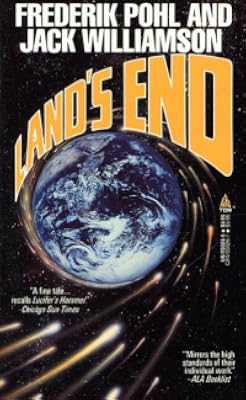
Side note: I originally took the cover of my bookclub edtion by John Berkey cover to be generic SF impressionism, but it turns out to be a quite literal representation of a scene late in the book.
Recommended. Reading the original story "With Folded Hands" and novel would be helpful, but not required. show less
Side note: I originally took the cover of my bookclub edtion by John Berkey cover to be generic SF impressionism, but it turns out to be a quite literal representation of a scene late in the book.
Recommended. Reading the original story "With Folded Hands" and novel would be helpful, but not required. show less
This novel is a reminder of the short novels that masters of science fiction like Williamson used to write.
Williamson wroughts a new twist on his humanoid menace, those robots who efficiently and implacably stifle humanity while carrying out their Prime Directive “to serve and obey and guard men from harm”. Theirs is a menace that can be seen as warning of dire consequences from well-intentioned technology or a political allegory for well-intentioned totalitarianism. In either case, if you think of this series as sort of intellectual horror, this novel shows a change in the behavior and motives of the monster, but, to fully appreciate the horror of the monster, you should read the earlier novel The Humanoids. Here, in a couple of show more scenes where they talk with humans, the humanoids take on the air of earnest communists defending their subversions or of creepy inquisitors really concerned with the fate of those they are about to inflict pain on.
The plot is something like a young adult science fiction story. Young Keth, growing up on the poor world of Kai, attempts to earn the affections of his distant father, the leader of the Lifecrew. Once a powerful and influential organization on a world settled by humans fleeing the smothering attentions of the humanoids, now the Lifecrew’s warnings of ongoing humanoid menace and possible humanoid infiltration of the neighboring world of Malili, also settled by humans though of a mutated sort, seem ridiculous and outdated. But, of course, the humanoids do show up, and Keth takes up his father’s struggle.
But the novel is also a story of family, how Keth learns about his father and mother’s past, a struggle for identity and belonging also shared by the enigmatic Bosun Brong, a half-breed of Kai and Leleyo stock. The Leleyo are the human mutant inhabitants of Malili, a primitive lot whose world thwarts settlement and exploitation by Kai due to the twin menaces of the metal destroying rockrust and the lethal bloodrot. Brong claims to have knowledge of a growing humanoid menace in the star system of Kai and Malili, but his claims are hurt by unbelievable stories of how he escaped the humanoids. Readers of the earlier series entries will correctly guess what’s going on there.
Will the third encounter with the humanoids (The Humanoids is actually a fix-up of two separate stories) show man victorious? At the end of a concise tale blending action and worldbuilding and human love thwarted and grimly affirmed, Williamson does give us a new wrinkle on humanoid-human relations. However, like the ending of The Humanoids, I think a sort of irony is present in the resolution. show less
Williamson wroughts a new twist on his humanoid menace, those robots who efficiently and implacably stifle humanity while carrying out their Prime Directive “to serve and obey and guard men from harm”. Theirs is a menace that can be seen as warning of dire consequences from well-intentioned technology or a political allegory for well-intentioned totalitarianism. In either case, if you think of this series as sort of intellectual horror, this novel shows a change in the behavior and motives of the monster, but, to fully appreciate the horror of the monster, you should read the earlier novel The Humanoids. Here, in a couple of show more scenes where they talk with humans, the humanoids take on the air of earnest communists defending their subversions or of creepy inquisitors really concerned with the fate of those they are about to inflict pain on.
The plot is something like a young adult science fiction story. Young Keth, growing up on the poor world of Kai, attempts to earn the affections of his distant father, the leader of the Lifecrew. Once a powerful and influential organization on a world settled by humans fleeing the smothering attentions of the humanoids, now the Lifecrew’s warnings of ongoing humanoid menace and possible humanoid infiltration of the neighboring world of Malili, also settled by humans though of a mutated sort, seem ridiculous and outdated. But, of course, the humanoids do show up, and Keth takes up his father’s struggle.
But the novel is also a story of family, how Keth learns about his father and mother’s past, a struggle for identity and belonging also shared by the enigmatic Bosun Brong, a half-breed of Kai and Leleyo stock. The Leleyo are the human mutant inhabitants of Malili, a primitive lot whose world thwarts settlement and exploitation by Kai due to the twin menaces of the metal destroying rockrust and the lethal bloodrot. Brong claims to have knowledge of a growing humanoid menace in the star system of Kai and Malili, but his claims are hurt by unbelievable stories of how he escaped the humanoids. Readers of the earlier series entries will correctly guess what’s going on there.
Will the third encounter with the humanoids (The Humanoids is actually a fix-up of two separate stories) show man victorious? At the end of a concise tale blending action and worldbuilding and human love thwarted and grimly affirmed, Williamson does give us a new wrinkle on humanoid-human relations. However, like the ending of The Humanoids, I think a sort of irony is present in the resolution. show less
This novel, sequel to Williamson's justifiably classic novel The Humanoids, takes place about one thousand years from now. A small remnant of humanity has fled to a pair of planets orbiting a binary star, in order to get away from robotic servants called humanoids.
What's so awful about robotic servants whose only purpose is to serve Man, and protect him from harm? Aside from the fact that they number in the trillions and are spreading throughout the galaxy, they gently, but firmly, insist on doing everything for mankind. They haven't just taken over dangerous jobs like coal mining or crab fishing, they will not let mankind even drive a car or go to the grocery store. Earth is an enslaved planet.
In this book, most of what's left of show more mankind don't believe that the humanoids are real; they are nothing more than something for parents to mention to misbehaving children. Keth Kyrone and his discredited father are among the few who still fear the humanoids. Keth inadvertently finds something that may be mankind's only weapon against them.
The humanoids arrive, and start manipulating people's beliefs. Even hard-nosed military types suddenly disappear for several days; when they re-appear, they are practically singing hosannas about the humanoids to anyone who will listen. Is it real, or have they been brainwashed? Keth has to undertake a dangerous mission, mostly on his own. to open humanity's eyes to the benevolent slavery of the humanoids. Does he succeed? Are the humanoids stopped?
By itself, this is a really good story from a master of science fiction. When compared to The Humanoids, the older novel is better. This is still a fine piece of writing that looks at the downside of robots and artificial intelligence. show less
What's so awful about robotic servants whose only purpose is to serve Man, and protect him from harm? Aside from the fact that they number in the trillions and are spreading throughout the galaxy, they gently, but firmly, insist on doing everything for mankind. They haven't just taken over dangerous jobs like coal mining or crab fishing, they will not let mankind even drive a car or go to the grocery store. Earth is an enslaved planet.
In this book, most of what's left of show more mankind don't believe that the humanoids are real; they are nothing more than something for parents to mention to misbehaving children. Keth Kyrone and his discredited father are among the few who still fear the humanoids. Keth inadvertently finds something that may be mankind's only weapon against them.
The humanoids arrive, and start manipulating people's beliefs. Even hard-nosed military types suddenly disappear for several days; when they re-appear, they are practically singing hosannas about the humanoids to anyone who will listen. Is it real, or have they been brainwashed? Keth has to undertake a dangerous mission, mostly on his own. to open humanity's eyes to the benevolent slavery of the humanoids. Does he succeed? Are the humanoids stopped?
By itself, this is a really good story from a master of science fiction. When compared to The Humanoids, the older novel is better. This is still a fine piece of writing that looks at the downside of robots and artificial intelligence. show less
It 's a sequel to The Humanoids but it stands alone as a decent SF novel. I was disappointed with the ending but it's his book not mine. I prefer the earlier novel and I really love the short story "With Folded Hands". Williamson was warning us about A. I. decades ago. He was one of the better pioneers of the SF Golden Age.
Thirty years after publishing ‘The Humanoids’, Williamson finally produced this sequel. In the original novel humans create an advanced race of machines to save mankind from itself, but the robots go too far. They create worlds where humans can do nothing for themselves, where every possible threat to life and limb is extinguished, limiting humans to nothing more than animals in a gilded cage, free to pursue any dream they choose, as long as the risk is nonexistent.
In ‘The Humanoid Touch’, the remnants of free humans have fled to a small planet in a binary system, but as centuries pass and mankind fights war after war with themselves, the threat of the humanoids takes on the aura of children’s tales. Only a few humans, called show more the Crewmen, stand vigilant, always seeking a means by which they can detect the approach of the humanoid robots and develop a weapon to stop the before the enslave the remaining humans.
In the first chapter, Keth Kyrone, is a child who matures to a young man as the tale progresses. His father, step mother and a friend of his dead mother are all who remain in the Crew when the humanoids arrive.
The story takes a sharp turn into fantasy as Keth and Bosun Brong take the fight to a neighboring planet once the humanoids enslave Kai’s inhabitants, where the local human-like species, called the Leleyo, provide Keth with the answer to humanity’s survival. The ending is as surprising as the tale that unfolds, to the reader’s delight.
This is a well-crafted novel, free of those pesky typos and oops that plague mass market reads, with characters that are all too real, replete with all the foibles and limitations one can imagine. This is a thrilling adventure tale that we can only hope we’ll never allow to come to pass.
To be honest, this novel was nothing like what I expected, but turned out to be well worth my time. That said, I wasn’t all that pleased with the ending, but in Williamson’s defense he provided an acceptable evolutionary escape from the not so benevolent humanoid servants. show less
In ‘The Humanoid Touch’, the remnants of free humans have fled to a small planet in a binary system, but as centuries pass and mankind fights war after war with themselves, the threat of the humanoids takes on the aura of children’s tales. Only a few humans, called show more the Crewmen, stand vigilant, always seeking a means by which they can detect the approach of the humanoid robots and develop a weapon to stop the before the enslave the remaining humans.
In the first chapter, Keth Kyrone, is a child who matures to a young man as the tale progresses. His father, step mother and a friend of his dead mother are all who remain in the Crew when the humanoids arrive.
The story takes a sharp turn into fantasy as Keth and Bosun Brong take the fight to a neighboring planet once the humanoids enslave Kai’s inhabitants, where the local human-like species, called the Leleyo, provide Keth with the answer to humanity’s survival. The ending is as surprising as the tale that unfolds, to the reader’s delight.
This is a well-crafted novel, free of those pesky typos and oops that plague mass market reads, with characters that are all too real, replete with all the foibles and limitations one can imagine. This is a thrilling adventure tale that we can only hope we’ll never allow to come to pass.
To be honest, this novel was nothing like what I expected, but turned out to be well worth my time. That said, I wasn’t all that pleased with the ending, but in Williamson’s defense he provided an acceptable evolutionary escape from the not so benevolent humanoid servants. show less
More engaging than the first, and much less sexist. Still, I recommend only the short story, With Folded Hands. The two books don't really add anything, imo.
John Stewart Williamson (April 29, 1908 – November 10, 2006), who wrote as Jack Williamson, was an American science fiction writer, often called the "Dean of Science Fiction" after the death of Robert Heinlein in 1988.[2] Early in his career he sometimes used the pseudonyms Will Stewart and Nils O. Sonderlund. In the 1980s, he made a sizable donation of books and original manuscripts to ENMU's library, which resulted in the formation of a Special Collections department; the library now is home to the Jack Williamson Science Fiction Library of Eastern New Mexico University (ENMU) in Portales (near the Texas panhandle),ENMU's website describes the library as "one of the top science fiction collections in the world"
Members
- Recently Added By
Author Information

210+ Works 10,095 Members
Author Jack Williamson was born in Bisbee, Arizona on April 29, 1908. In the 1950's, he received both his BA and MA degress in English from Eastern New Mexico University. After receiving his PhD from the University of Colorado, he taught linguistics, the modern novel and literary criticism at Eastern New Mexico University until he retired in 1977. show more At the age of 20, he published his first story, The Metal Man, in a December 1928 issue of Amazing Stories. Since then he has written more than 50 novels and at least 15 short story collections. Some of his best known works are The Humanoids, The Legion of Time, Manseed, and Lifeburst. He also published numerous collaborations with fellow science fiction author Frederik Pohl. He received numerous awards including the Pilgrim Award from the Science Fiction Research Association, the Hugo Award, and the Nebula Award. He was an inaugural inductee in the Science Fiction and Fantasy Hall of Fame and was named a Grand Master of Science Fiction by the Science Fiction Writers of America in 1976. He died at his home in Portales, New Mexico on November 10, 2006. (Bowker Author Biography) show less
Some Editions
Series

Belongs to Publisher Series
Work Relationships
Is contained in
Common Knowledge
- Canonical title
- The humanoid touch
- Original title
- The Humanoid Touch
- Original publication date
- 1980-09
- People/Characters*
- Keth Kyrone; Vesh; Bosun Brong; Torku Vorn; Kyrondath 'Ryn' Kyrone; Cyra Sair (show all 15); Chelni Vorn; Taiko; Zelyk Zoor; Nera Nyin; Vythle Tlo; Morgen Greel; Beg; Ilo Auli; Eyna Oong
- Important places*
- Malili; Kai
- Epigraph*
- Humanoiden – Selbstlenkende Roboter, mit dem Zweck entwickelt, der Menschheit zu dienen und sie zu behüten
- First words*
- Keth liebte die Sonnenzeiten.
- Last words*
- (Click to show. Warning: May contain spoilers.)Nera Nyin winkte ihm freudig und vergnügt zu. Sie glitt vom Rücken der Drachenfledermaus und wartete auf ihn.
- Publisher's editor*
- Alpers, Hans Joachim
- Blurbers*
- Anderson, Poul; Bova, Ben
- Original language*
- Englisch
*Some information comes from Common Knowledge in other languages. Click "Edit" for more information.
Classifications
Statistics
- Members
- 318
- Popularity
- 100,538
- Reviews
- 8
- Rating
- (3.51)
- Languages
- English, German
- Media
- Paper
- ISBNs
- 7
- ASINs
- 4


