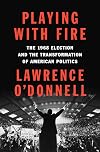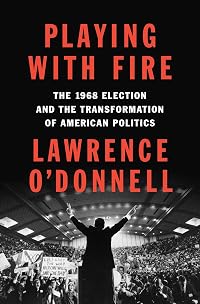
Playing with Fire: The 1968 Election and the Transformation of American Politics
by Lawrence O'Donnell
On This Page
Description
From the host of MSNBC’s The Last Word with Lawrence O'Donnell, an important and enthralling new account of the presidential election that changed everything, the race that created American politics as we know it todayThe 1968 U.S. Presidential election was the young Lawrence O’Donnell’s political awakening, and in the decades since it has remained one of his abiding fascinations. For years he has deployed one of America’s shrewdest political minds to understanding its dynamics, show more not just because it is fascinating in itself, but because in it is contained the essence of what makes America different, and how we got to where we are now. Playing With Fire represents O’Donnell’s master class in American electioneering, embedded in the epic human drama of a system, and a country, coming apart at the seams in real time.
Nothing went according to the script. LBJ was confident he'd dispatch with Nixon, the GOP frontrunner; Johnson's greatest fear and real nemesis was RFK. But Kennedy and his team, despite their loathing of the president, weren't prepared to challenge their own party’s incumbent. Then, out of nowhere, Eugene McCarthy shocked everyone with his disloyalty and threw his hat in the ring to run against the president and the Vietnam War. A revolution seemed to be taking place, and LBJ, humiliated and bitter, began to look mortal. Then RFK leapt in, LBJ dropped out, and all hell broke loose. Two assassinations and a week of bloody riots in Chicago around the Democratic Convention later, and the old Democratic Party was a smoldering ruin, and, in the last triumph of old machine politics, Hubert Humphrey stood alone in the wreckage.
Suddenly Nixon was the frontrunner, having masterfully maintained a smooth façade behind which he feverishly held his party’s right and left wings in the fold, through a succession of ruthless maneuvers to see off George Romney, Nelson Rockefeller, Ronald Reagan, and the great outside threat to his new Southern Strategy, the arch-segregationist George Wallace. But then, amazingly, Humphrey began to close, and so, in late October, Nixon pulled off one of the greatest dirty tricks in American political history, an act that may well meet the statutory definition of treason. The tone was set for Watergate and all else that was to follow, all the way through to today.
Playing With Fire is the perfect holiday gift!. show less
Tags
Recommendations









Member Reviews
Lawrence O'Donnell's Playing with Fire: The 1968 Election and the Transformation of American Politics is an engaging account of the tumultuous 1968 presidential campaign and America's social and political divisions primarily precipitated by the escalating Vietnam War and the growing anti-war movement.
Much of the book reads like a propulsive political thriller, with intriguing multifaceted characters and incredible plot twists. The primary strength of the book is the author's skill in dissecting the internal personal conflicts within the drama: Eugene McCarthy's soul searching decision of whether to spearhead the peace movement by challenging Lyndon Johnson, his party's sitting president and his political mentor, for the Democratic show more nomination; Bobby Kennedy indecisiveness (the delicate balance of political calculation versus doing what's right, seizing the moment) of whether get into the 1968 presidential race or take the safer course by waiting until 1972; and Johnson's anguish and overwhelming burden of the unwinnable Vietnam War, finally nearing the possibility of productive peace talks, only to have it sabotaged by Richard Nixon's unspeakable treasonous act (solely for single-minded political gain to avenge his prior stinging election defeats) which ultimately led to the continuation of the conflict and the deaths of many more American soldiers.
O'Donnell strikes just the right balance, providing fascinating depth and detail about the candidates, the campaigns, and the backroom dealings while still retaining a smooth page-turning narrative so that the book never becomes ponderous or unwieldy. show less
Much of the book reads like a propulsive political thriller, with intriguing multifaceted characters and incredible plot twists. The primary strength of the book is the author's skill in dissecting the internal personal conflicts within the drama: Eugene McCarthy's soul searching decision of whether to spearhead the peace movement by challenging Lyndon Johnson, his party's sitting president and his political mentor, for the Democratic show more nomination; Bobby Kennedy indecisiveness (the delicate balance of political calculation versus doing what's right, seizing the moment) of whether get into the 1968 presidential race or take the safer course by waiting until 1972; and Johnson's anguish and overwhelming burden of the unwinnable Vietnam War, finally nearing the possibility of productive peace talks, only to have it sabotaged by Richard Nixon's unspeakable treasonous act (solely for single-minded political gain to avenge his prior stinging election defeats) which ultimately led to the continuation of the conflict and the deaths of many more American soldiers.
O'Donnell strikes just the right balance, providing fascinating depth and detail about the candidates, the campaigns, and the backroom dealings while still retaining a smooth page-turning narrative so that the book never becomes ponderous or unwieldy. show less
Being before my time, the social and political events of the 1960s were always discrete entities in my mind. I knew they occurred and the impact they had, but did not necessarily know the order of events or the lesser-known people within. This book helped crystallize those aspects for me, focusing on the interstitial tissue and players that lead up to and connected these events. Seeing how everything lines up makes the narrative even more incredible. Twists of fate, both extreme (e.g. assassination) and simple (e.g. not returning a phone call) ended up changing global history and American politics forever. I appreciated the epilogue, which addressed asking the endless "what-ifs" that come up while reading. As far as the construction of show more the book, there are many ways to re-tell the events of 1968 with so many players, points of view, and events to focus on. However, O'Donnell offers a thorough, but respectively concise telling of these events from different campaign perspectives. show less
Holy crap this was a slog. It started out really promising, full of interesting details that related, if not compared, the political situation in the US today to what it was 50 years ago. It ended up being a detailed account of all that goes on in a presidential campaign, from wrangling over delegates and running mates to organizing campaign events. 1968 was undeniably an interesting time in American history, with Vietnam and Martin Luther King and Bobby Kennedy. And the events surrounding the political figures are covered pretty well here. But the minutiae of the Democratic and Republican campaigns kind of muddied up the narrative a bit too much. As a Canadian I find the American electoral system befuddling, and this book didn’t do show more much to demystify it for me. Occasional commentary relating Nixon and the evolution of the Republican party to the current situation with Trump was quite interesting (frankly I thought—and hoped—there would be more of that) and I was energized at the end by the epilogue, which told what happened to the characters from the story who did not go down in infamy. This has definitely filled my nonfiction quota for a while. show less
I was sixteen in 1968, and I remember being a Gene McCarthy supporter in spite of my inability to vote. I was anti-war, as were most of my friends, I was pro civil rights, and was discovering my conscience slowly but surely. I also lived in Chicago and have vivid memories of the bloody protests and the subsequent trial of the "Chicago 7." Remembering these things has given me more of a perspective on current events than a younger person might have. I understand protest and confrontation. I understand the need to be involved. I lived through Watergate and I understand the nature of political corruption.
Or I thought I did until I immersed myself in O'Donnell's account of the events which made Richard Nixon President of the United States, show more a complex, difficult, often painful process of backroom deals, back-stabbing, and cynical maneuvering by virtually every actor on that stage. I learned a great deal about history that I thought I knew well, and learned that a great many of the people involved in this drama were far less admirable than I had imagined. Or maybe I should just say they were more human than they appeared to be at the time.
I would urge you to read this book if you're at all interested in the people and politics of that era and especially that campaign. I was fascinated by the portraits of the major players from Johnson, who crippled himself by adhering to a losing strategy in Vietnam to the detriment of his legacy in other areas such as civil rights, Nixon who was a brilliant politician, but who put all that intellect to work in self-serving ways, Bobby Kennedy who was opaque and manipulative, and Eugene McCarthy who was a decent human being but utterly unfit to be president. They, and the more minor players in this drama, are wonderfully drawn by O'Donnell in this rich narrative.
One thing about this book which both amused and bemused me was O'Donnell's jabs at Donald Trump, a thread that ran through the book for reasons not immediately clear to me. O'Donnell isn't a cheap-shot kind of guy. He's thoughtful, well-informed, and pretty even-handed, so the connections to Trump should have been provoked by practical reasons, right?
Well it took me long enough to suss them out. This book isn't just about 1968 and Nixon, and Vietnam, it's about the here and now. The comments about Trump aren't just jabs, they're sharp and incisive parallels to the worst of the world in 1968, the things we really should have left behind us, but can't seem to shake off. 1968 was, after all, the end of the liberal wing of the Republican party. It was the year when the Dixie-crats drew the line in the sand on integration (They were not having it!) the war in Vietnam (Yes, please.) and the role of authoritarianism in government. (They were Law and Order guys right down the line.) It was the year when southern Democrats stopped being democratic and turned into the moderate wing of the Republican party.
The parallels that O'Donnell draws become quite clear when he discusses Richard Nixon's greatest crime, which had nothing to do with Watergate. He colluded with Nguyễn Văn Thiệu to keep South Vietnam out of peace talks until after the election which he expected to win (and did.) For Nixon, American lives were far less important than his political future. What he did was technically treason, and the only reason he wasn't called out on it was that Johnson and his advisers felt that win or lose, charging Nixon with treason would do more harm to the country than good. That collusion has clear parallels to the Trump campaign and Russia, though the extent of Trump's involvement isn't actually known as of this writing. And the law that made Nixon's actions treasonous probably don't apply to the Russia scandal, though again, that's not wholly clear at this time.
By the end, understanding those parallels between then and now, the deep divisions in this country, the fears and concerns, the push-pull of civil rights, it was heartening to listen to O'Donnell's epilogue in which he reminds us of the most important thing of all: Our participation in this process is what made a difference. The anti-war movement saved lives.
Political participation is life and death.
I really recommend this book to anyone who wants to read it as history, as a cautionary tale, as biographical material, or just as a surprisingly exciting story about the ins and outs of politics. I would cheerfully read anything O'Donnell has written, and would happily listen to his narration of any political history because he was just that good. show less
Or I thought I did until I immersed myself in O'Donnell's account of the events which made Richard Nixon President of the United States, show more a complex, difficult, often painful process of backroom deals, back-stabbing, and cynical maneuvering by virtually every actor on that stage. I learned a great deal about history that I thought I knew well, and learned that a great many of the people involved in this drama were far less admirable than I had imagined. Or maybe I should just say they were more human than they appeared to be at the time.
I would urge you to read this book if you're at all interested in the people and politics of that era and especially that campaign. I was fascinated by the portraits of the major players from Johnson, who crippled himself by adhering to a losing strategy in Vietnam to the detriment of his legacy in other areas such as civil rights, Nixon who was a brilliant politician, but who put all that intellect to work in self-serving ways, Bobby Kennedy who was opaque and manipulative, and Eugene McCarthy who was a decent human being but utterly unfit to be president. They, and the more minor players in this drama, are wonderfully drawn by O'Donnell in this rich narrative.
One thing about this book which both amused and bemused me was O'Donnell's jabs at Donald Trump, a thread that ran through the book for reasons not immediately clear to me. O'Donnell isn't a cheap-shot kind of guy. He's thoughtful, well-informed, and pretty even-handed, so the connections to Trump should have been provoked by practical reasons, right?
Well it took me long enough to suss them out. This book isn't just about 1968 and Nixon, and Vietnam, it's about the here and now. The comments about Trump aren't just jabs, they're sharp and incisive parallels to the worst of the world in 1968, the things we really should have left behind us, but can't seem to shake off. 1968 was, after all, the end of the liberal wing of the Republican party. It was the year when the Dixie-crats drew the line in the sand on integration (They were not having it!) the war in Vietnam (Yes, please.) and the role of authoritarianism in government. (They were Law and Order guys right down the line.) It was the year when southern Democrats stopped being democratic and turned into the moderate wing of the Republican party.
The parallels that O'Donnell draws become quite clear when he discusses Richard Nixon's greatest crime, which had nothing to do with Watergate. He colluded with Nguyễn Văn Thiệu to keep South Vietnam out of peace talks until after the election which he expected to win (and did.) For Nixon, American lives were far less important than his political future. What he did was technically treason, and the only reason he wasn't called out on it was that Johnson and his advisers felt that win or lose, charging Nixon with treason would do more harm to the country than good. That collusion has clear parallels to the Trump campaign and Russia, though the extent of Trump's involvement isn't actually known as of this writing. And the law that made Nixon's actions treasonous probably don't apply to the Russia scandal, though again, that's not wholly clear at this time.
By the end, understanding those parallels between then and now, the deep divisions in this country, the fears and concerns, the push-pull of civil rights, it was heartening to listen to O'Donnell's epilogue in which he reminds us of the most important thing of all: Our participation in this process is what made a difference. The anti-war movement saved lives.
Political participation is life and death.
I really recommend this book to anyone who wants to read it as history, as a cautionary tale, as biographical material, or just as a surprisingly exciting story about the ins and outs of politics. I would cheerfully read anything O'Donnell has written, and would happily listen to his narration of any political history because he was just that good. show less
Playing with Fire far exceeded my expectations. I grew up close enough to the 1960s that I have never had a burning desire to study the history of the 1960s. As all good books do, this one taught me that I didn't know what I don't know. In particular, the idea that in my lifetime there was a liberal wing of the GOP stunned me. While I understand Democrats were the party of racism in previous decades, I grew up associating the GOP with dog-whistle politics and race-baiting. I also grew up with a GOP hostile to the poor, women's reproductive freedom, hating government, and promoting trickle-down economics. I always thought the socially liberal GOP governors of my home state were an aberration. There is a great deal of detail in this book show more but O'Donnell really keeps it all moving along and, for the most part, riveting. show less
I enjoyed this book and thought it was well done. At certain points, I was unable to grasp / keep track of the details, but I was impressed with O'Donnell's presentation of his subject and so this work kept my interest. I normally don't read books about politics / U.S. political history, but the time period interested me as I was 8 years old in 1968. My father was a Republican (moderate conservative) and my mother a Democrat (centrist liberal). Which I mention because this kind of "bipartisanship" was still possible back in 1968 and in the years before Washington gridlock became so suffocating. From Watergate of course, I remember that Nixon was evil (a sociopath) and that he was the sworn enemy of the hippies / anti-war protesters. But show more I didn't know until reading "Playing With Fire" that he'd swung the election in his favor through treasonous actions taken via the Vietnam Peace Talks/Chennault Affair. The material about Eugene McCarthy was enlightening since as a child, I only remember his name and not what he stood for and what he achieved (which I admire). Knowing what I know now, I have great respect for McCarthy's anti-war stance and his refusal to compromise. The only thing I'd remembered about the Hubert Humphrey of 1968 is that he was a "square"; a Democrat, but an old-fashioned guy like my father.
The section about the Abbie Hoffman and the creative anarchy of the yippies and their "merry prankster tactics" was also elucidating; I've been meaning to read Abie Hoffman's "Steal This Book" and it's next on my list. I'm in agreement with O'Donnell's point of view re: the similarities between the 1968 and 2016 elections: the convergence of the far left [the yippies] the far right [George Wallace] the inability of the Democrat party to unify [the friction between Bobby / Ted Kennedy, McCarthy and Humphrey). And in terms of the "what ifs": If only Humphrey hadn't been outspent by Nixon, then maybe the course of history could have been changed. The communications between Johnson & Nixon, as presented by O'Donnell, seemed downright creepy in the way they avoided the "elephant in the room" [Nixon's treasonous actions re: the Vietnam Peace Talks/Chennault Affair]. Finally, in the context of "Playing With Fire" and in my view, the difference between 1968 and 2016 is that Nixon was implementing his corrupt actions behind the scenes (Nixon wanted to be seen as "good" / "A fine upstanding citizen"). Whereas Trump is blatantly corrupt, shameless and lacking in restraint. And he enjoys flaunting all of that in the public arena. show less
The section about the Abbie Hoffman and the creative anarchy of the yippies and their "merry prankster tactics" was also elucidating; I've been meaning to read Abie Hoffman's "Steal This Book" and it's next on my list. I'm in agreement with O'Donnell's point of view re: the similarities between the 1968 and 2016 elections: the convergence of the far left [the yippies] the far right [George Wallace] the inability of the Democrat party to unify [the friction between Bobby / Ted Kennedy, McCarthy and Humphrey). And in terms of the "what ifs": If only Humphrey hadn't been outspent by Nixon, then maybe the course of history could have been changed. The communications between Johnson & Nixon, as presented by O'Donnell, seemed downright creepy in the way they avoided the "elephant in the room" [Nixon's treasonous actions re: the Vietnam Peace Talks/Chennault Affair]. Finally, in the context of "Playing With Fire" and in my view, the difference between 1968 and 2016 is that Nixon was implementing his corrupt actions behind the scenes (Nixon wanted to be seen as "good" / "A fine upstanding citizen"). Whereas Trump is blatantly corrupt, shameless and lacking in restraint. And he enjoys flaunting all of that in the public arena. show less
I do not ordinarily read books authored by "talking heads" who host show on cable TV networks. However this was a well researched and well-written book about the 1968 presidential election. Given that I lived during this time, I was very intrigued by what I would learn and what I had forgotten from events that took place when I was 16 years old.
O'Donnell brought back many of my memories of the street violence during the Democratic National Convention. I also remember my total devastation when finding out that Bobby Kennedy had been assassinated in June 1968 after his victory in the California primary. I also remember my relief when Lyndon Johnson declined to run for another presidential term. 1968 was the time when I became extremely show more interested in politics. I remember how important it was from my personal standpoint and from the country's in our getting out of the Vietnam War.
This book is also a homage by O'Donnell to Eugene McCarthy. McCarthy decided to take on Lyndon Johnson and the Democratic Party in order to stop the Vietnam War. There is also a villain in the book. The villain is Richard Nixon who was willing to undermine Pres. Johnson's peace efforts so that he would be elected President.
The narrative of this book is extremely compelling. This may have been the most consequential year of my life and maybe in the history of the United States. Much of our poisonous politics can be traced back to 1968 due to Richard Nixon and George Wallace. I highly recommend this book for anyone interested in our history and our politics. show less
O'Donnell brought back many of my memories of the street violence during the Democratic National Convention. I also remember my total devastation when finding out that Bobby Kennedy had been assassinated in June 1968 after his victory in the California primary. I also remember my relief when Lyndon Johnson declined to run for another presidential term. 1968 was the time when I became extremely show more interested in politics. I remember how important it was from my personal standpoint and from the country's in our getting out of the Vietnam War.
This book is also a homage by O'Donnell to Eugene McCarthy. McCarthy decided to take on Lyndon Johnson and the Democratic Party in order to stop the Vietnam War. There is also a villain in the book. The villain is Richard Nixon who was willing to undermine Pres. Johnson's peace efforts so that he would be elected President.
The narrative of this book is extremely compelling. This may have been the most consequential year of my life and maybe in the history of the United States. Much of our poisonous politics can be traced back to 1968 due to Richard Nixon and George Wallace. I highly recommend this book for anyone interested in our history and our politics. show less
Members
- Recently Added By
Author Information
1 Work 310 Members
Awards and Honors
Distinctions
Common Knowledge
- Original publication date
- 2017
- People/Characters
- Richard M. Nixon
- Important events
- United States presidential election (1968)
- Dedication
- For Elizabeth
- First words
- Richard Nixon was in a makeup chair when he met Roger Ailes.
- Quotations
- My favorite poet was Aeschylus. He once wrote "Even in our sleep, pain which cannot forget falls drop by drop upon the heart until in our own despair, against our will, comes wisdom through the awful grace of God'.
- Last words
- (Click to show. Warning: May contain spoilers.)Richard Nixon also had to bear the burden of the knowledge that his pardon did not protect him from anything he did before the presidency, and that what he did to win the presidency was his greatest crime.
(Click to show. Warning: May contain spoilers.)(Epilogue) Richard Nixon made John Mitchell the sixty-seven th Attorney General of the United States and the first one convicted of a crime. - Blurbers
- Isaacson, Walter; Maddow, Rachel; Reid, Joy-Ann; Millard, Candice; Heilemann, John
- Original language
- English US
Classifications
- Genres
- Politics and Government, History, Nonfiction, General Nonfiction, Biography & Memoir
- DDC/MDS
- 324.973 — Society, government, & culture Political science Politics & Elections Biography And History North America United States
- LCC
- E851 .O33 — History of the United States United States Later twentieth century, 1961-2000 Johnson's administrations, November 22, 1963-1969
- BISAC
Statistics
- Members
- 316
- Popularity
- 101,076
- Reviews
- 18
- Rating
- (4.36)
- Languages
- English
- Media
- Paper, Audiobook, Ebook
- ISBNs
- 10
- ASINs
- 2