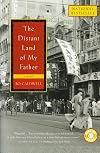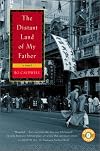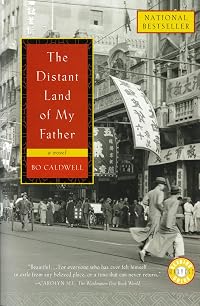
The Distant Land of My Father
by Bo Caldwell
On This Page
Description
Anna had a charmed childhood in 1930s Shanghai with her smuggler father. Anna and her mother fled the Japanese occupation and settled in California, but her father stayed behind. Fifteen years later, Anna is grown with a family of her own in Los Angeles when her father reappears.Tags
Recommendations






Member Reviews
A beautiful story of a girl whose father was an enigma - loving and available, yet also distant and unable to commit to relationship with her - Anna grew up in Shanghai with her American parents who nurtured her beautifully, yet when the Japanese overtook Shanghai and it was imperative that they leave, her father stayed on and was imprisoned.
This is a story of relationship - of love and loss, pain and forgiveness. Anna's many transformations within the story were credible and beautifully rendered - I truly got to know these characters with all their beauty and flaws - What a lovely book (yet very painful at times) to immerse myself in.
This is a story of relationship - of love and loss, pain and forgiveness. Anna's many transformations within the story were credible and beautifully rendered - I truly got to know these characters with all their beauty and flaws - What a lovely book (yet very painful at times) to immerse myself in.
Anna’s father, Joseph, is not an American who won’t come home, he is an American born in China to missionary parents and at home there. Shanghai is his home and he loves it. His wife, Eve, is an American who wants to go home, and Anna is a child with one foot in each culture.
It is obvious to everyone that there is trouble on the horizon by 1941, but when Eve decides it is time to leave China, Joseph refuses to go with her. Thus, he is still present in Shanghai when the Japanese occupy the city and he begins a life that is separate from (and no doubt unimaginable for) his family.
The story is told from Anna’s view point and is made even more poignant because it rings so true in the way it affects her life and her own choices and show more decisions. It is a story about anger, about misunderstanding, about longing and about forgiveness. My eyes were not dry by the end of the novel, and I felt as if I could understand Anna’s enigmatic father, her mother who loved him despite his seeming faults, and Anna herself, who wanted the loves and attentions of a man whose choices only seemed to make for loneliness and separation.
My thanks to my good friend, Elyse, who told me many months ago that I should read this book. I bought it back then but let it languish on my Kindle for all this time. I am happy to have gotten to it at last. show less
It is obvious to everyone that there is trouble on the horizon by 1941, but when Eve decides it is time to leave China, Joseph refuses to go with her. Thus, he is still present in Shanghai when the Japanese occupy the city and he begins a life that is separate from (and no doubt unimaginable for) his family.
The story is told from Anna’s view point and is made even more poignant because it rings so true in the way it affects her life and her own choices and show more decisions. It is a story about anger, about misunderstanding, about longing and about forgiveness. My eyes were not dry by the end of the novel, and I felt as if I could understand Anna’s enigmatic father, her mother who loved him despite his seeming faults, and Anna herself, who wanted the loves and attentions of a man whose choices only seemed to make for loneliness and separation.
My thanks to my good friend, Elyse, who told me many months ago that I should read this book. I bought it back then but let it languish on my Kindle for all this time. I am happy to have gotten to it at last. show less
The narrator of The Distant Land of My Father by Bo Caldwell is six years old in 1937 when the book begins. Anna and her parents live in Shanghai. Her father is wealthy but grew up as the son of American missionaries in China. We don't know exactly how her father earns enough to support the lavish lifestyle they lead, he just describes himself as "a businessman".
Anna's father loves China and wants her to love it too. He teaches her Mandarin words and walks with her through Shanghai on Saturday mornings teaching her street and building names. When the Japanese occupy Shanghai, Anna and her mother leave China, the only home Anna knows, to return to her mother's home in California. Her father, saying there is too much opportunity for him show more to leave, remains. Anna, through memory and later through her father's journals, continues to tell her family's story, a story of betrayal, reconciliation, and love.
Its hard to believe that this is Caldwell's first novel. She grabs our attention from the beginning: "My father was a millionaire in the 1930s. Polo ponies, a Sikh chauffeur, a villa on eight acres in Hungjao, in the western part of the city. Nights out with my mother at the Cercle Sportif Francais, the Venus Cafe, the Cathay Hotel, the Del Monte - these were the details of his life. He was also an insurance salesman and a smuggler, an importer-exporter and a prisoner, a borrower and a spender, leading, much of the time, a charmed life, always seeming to play the odds and for a long time coming out on top". show less
Anna's father loves China and wants her to love it too. He teaches her Mandarin words and walks with her through Shanghai on Saturday mornings teaching her street and building names. When the Japanese occupy Shanghai, Anna and her mother leave China, the only home Anna knows, to return to her mother's home in California. Her father, saying there is too much opportunity for him show more to leave, remains. Anna, through memory and later through her father's journals, continues to tell her family's story, a story of betrayal, reconciliation, and love.
Its hard to believe that this is Caldwell's first novel. She grabs our attention from the beginning: "My father was a millionaire in the 1930s. Polo ponies, a Sikh chauffeur, a villa on eight acres in Hungjao, in the western part of the city. Nights out with my mother at the Cercle Sportif Francais, the Venus Cafe, the Cathay Hotel, the Del Monte - these were the details of his life. He was also an insurance salesman and a smuggler, an importer-exporter and a prisoner, a borrower and a spender, leading, much of the time, a charmed life, always seeming to play the odds and for a long time coming out on top". show less
Had The Distant Land of My Father not been shelved in the fiction section of my library, it would have taken me many chapters to realize this was not a memoir. Caldwell writes about the settings so intimately that it is natural to assume she walked the very streets she is describing.
Anna Shoene is a young China-born American living in Shang-hai in the years just preceding WWII. From her point of view, the world is exactly as it should be. Foreigners are welcomed and respected in Shang-hai, her father is a wealthy entrepreneur, and she is surrounded by adults who love and adore her. For little Anna, nothing can go wrong.
When Anna is seven, however, the Japanese invade China, and it is no longer safe for foreigners to remain. She is sent show more back to the United States with her mother, but her father, also a China-born American, decides to stay. This supposedly temporary separation is one that will last for most of Anna’s life. After her father’s death, Anna inherits diaries and letters that fill in the missing years and describe the horrors her father faced in Japanese-occupied China.
It is clear from the beginning that Anna, the narrator, is not really the central character. Neither is the mother she admires or father she loves. The true heroine is Shanghai. This novel is a romance. The city is Anna’s first love and her father’s soul mate. The characters are shaped by the transformations of Shanghai as it moves from extraterritorial law to Japanese invasion to ownership by the Communist government.
During the parts of the book set in Pasadena, the novel is askew. The author has made her readers fall in love with Shanghai as thoroughly as the characters. We long to return there. Each transition back to China is bittersweet. We realize Shanghai has changed drastically, but we accept it because we love her. The reader can even forgive Anna’s father his grave errors in judgment because we, like him, would do all we could to stay in this Shanghai. show less
Anna Shoene is a young China-born American living in Shang-hai in the years just preceding WWII. From her point of view, the world is exactly as it should be. Foreigners are welcomed and respected in Shang-hai, her father is a wealthy entrepreneur, and she is surrounded by adults who love and adore her. For little Anna, nothing can go wrong.
When Anna is seven, however, the Japanese invade China, and it is no longer safe for foreigners to remain. She is sent show more back to the United States with her mother, but her father, also a China-born American, decides to stay. This supposedly temporary separation is one that will last for most of Anna’s life. After her father’s death, Anna inherits diaries and letters that fill in the missing years and describe the horrors her father faced in Japanese-occupied China.
It is clear from the beginning that Anna, the narrator, is not really the central character. Neither is the mother she admires or father she loves. The true heroine is Shanghai. This novel is a romance. The city is Anna’s first love and her father’s soul mate. The characters are shaped by the transformations of Shanghai as it moves from extraterritorial law to Japanese invasion to ownership by the Communist government.
During the parts of the book set in Pasadena, the novel is askew. The author has made her readers fall in love with Shanghai as thoroughly as the characters. We long to return there. Each transition back to China is bittersweet. We realize Shanghai has changed drastically, but we accept it because we love her. The reader can even forgive Anna’s father his grave errors in judgment because we, like him, would do all we could to stay in this Shanghai. show less
I really liked this book. I thought the description of the period was spot on (cashmere bouquet soap, Dewar's scotch etc.) The luxury experienced by the characters in Shanghai before the war was yummy. Anna as a child encountered much with her 5 senses..like any young child, and then later as an adult puts some pieces together. This is true to form in real life and brings the reader along for the ride. I wondered if we would discover that the protagonist had an undiagnosed mental illness. Like other accounts that describe communist treatment of their captives, we, like the characters, never discover why some prisoners are executed, some are tortured and some are released.. the randomness of it is bewildering.
When I was done with this book I just sat holding it because it was so moving and so intense through the whole book. I don't think there was a page I hurried through. It was so rich in its story and detail.
Briefly, Anna an only child living with her parents in Shanghai in the 30s. Her father had lived there with his missionary parents and after meeting his wife in college, they got married and moved back to Shanghai where he was a "businessman". He mostly bought things people needed for a low price and sold it to them for a high price.
Things start to turn ugly with the Japanese and Anna's mother books passage for Anna and herself hoping it will force her husband to follow.
This book was written in the first person and you would swear show more it is a memoir. I had to keep reminding myself that it wasn't. show less
Briefly, Anna an only child living with her parents in Shanghai in the 30s. Her father had lived there with his missionary parents and after meeting his wife in college, they got married and moved back to Shanghai where he was a "businessman". He mostly bought things people needed for a low price and sold it to them for a high price.
Things start to turn ugly with the Japanese and Anna's mother books passage for Anna and herself hoping it will force her husband to follow.
This book was written in the first person and you would swear show more it is a memoir. I had to keep reminding myself that it wasn't. show less
This is the sort of character-driven book that's very difficult for me to review. The Distant Land of my Father is the story of Anna Schoene and her father Joseph, a Chinese-born American citizen, in the mid-20th century. It is the story of Anna's relationship with her father; since it's a character-driven book, it won't surprise anyone to learn that the arc of the relationship is from a young girl idolizing her father, through disillusionment and rejection, to forgiveness. There is, essentially, no plot; major events of the twentieth century affect the characters, but they don't really do much, and the tone is somewhat removed. The writing is evocative of both Shanghai and Los Angeles; the LA parts ring very true, referencing specific show more places that still exist , which gives me confidence that the Shanghai part may be similarly well-researched. show less
Members
- Recently Added By
Lists

Top Five Books of 2017
757 works; 231 members
Author Information

4 Works 808 Members
Bo Caldwell has published short stories in numerous literary magazines. Her nonfiction writing includes a long-running series of personal essays in the "Washington Post Magazine". A former Stegner Fellow in creative writing at Stanford University, she lives in Northern California. "The Distant Land of My Father" is her first novel. (Bowker Author show more Biography) show less
Common Knowledge
- Important places
- Shanghai, China; Los Angeles, California, USA
- Dedication
- For my mother, Hester, and in memory of my father, John
- First words
- My father was a millionaire in Shanghai in the 1930s.
Classifications
Statistics
- Members
- 568
- Popularity
- 52,211
- Reviews
- 16
- Rating
- (4.08)
- Languages
- Dutch, English, French, Italian
- Media
- Paper, Ebook
- ISBNs
- 15
- UPCs
- 1
- ASINs
- 5