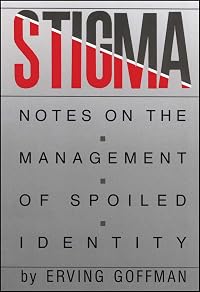
Stigma: Notes on the Management of Spoiled Identity
by Erving Goffman
On This Page
Description
From the author of The Presentation of Self in Everyday Life, Stigma is analyzes a person's feelings about himself and his relationship to people whom society calls "normal."Stigma is an illuminating excursion into the situation of persons who are unable to conform to standards that society calls normal. Disqualified from full social acceptance, they are stigmatized individuals. Physically deformed people, ex-mental patients, drug addicts, prostitutes, or those ostracized for other reasons show more must constantly strive to adjust to their precarious social identities. Their image of themselves must daily confront and be affronted by the image which others reflect back to them.Drawing extensively on autobiographies and case studies, sociologist Erving Goffman analyzes the stigmatized person's feelings about himself and his relationship to "normals" He explores the variety of strategies stigmatized individuals employ to deal with the rejection of others, and the complex sorts of information about themselves they project. In Stigma the interplay of alternatives the stigmatized individual must face every day is brilliantly examined by one of America's leading social analysts. show lessTags
Recommendations











































Member Reviews
Finished this while locked out of GR due to some no doubt well-intentioned addition of captcha software to the login process, so initial impressions were not captured.
This is not a scientific book, nor is it an analysis. As the title and introduction both indicate, these essays are notes or thoughts in response to Goffman's various readings on stigmatized individuals. These would be referred to as "marginalized" now, and 21st-century readers may take issue with some of the groups identified as such. That would miss the point, though: what Goffman has noticed is that the strategies for dealing with a stigma are similar across different communities or stigmas or what have you, and it is these strategies that interest him. What also show more intrigues him is the gradient nature of stigma, or as someone who spends too much time online might say, how stigma is a spectrum: the criteria that define the "normal" are very, very narrow, and every person is guaranteed to pass out of it at some point in their life (too young, too old, unemployed, etc). So in a very real sense, everybody is stigmatized at some point in their lives, and the stategies they have adopted for coping with this are similar to, or even learned from, those who are stimagtized for their entire lives.
It's a good book, worth reading. Other GR reviewers seem hung up on the fact that it's not written like a self-help book. Let's be honest: if you find this book to be dry or difficult reading , you're not going to make it very far past the sort of thing offered in airport newsstands. Goffman is readable, he makes a few amusing points some of which might be generously construed as "jokes", and he neatly summarizes information or episodes from multiple sources (synthesizes, as a friend used to describe it, and really that is what social scientists do). What Goffman does *not* do is start from a premise and work towards a definite conclusion, and this can make the book feel pointless or meandering: but as the title says, these are notes, not a Theory. show less
This is not a scientific book, nor is it an analysis. As the title and introduction both indicate, these essays are notes or thoughts in response to Goffman's various readings on stigmatized individuals. These would be referred to as "marginalized" now, and 21st-century readers may take issue with some of the groups identified as such. That would miss the point, though: what Goffman has noticed is that the strategies for dealing with a stigma are similar across different communities or stigmas or what have you, and it is these strategies that interest him. What also show more intrigues him is the gradient nature of stigma, or as someone who spends too much time online might say, how stigma is a spectrum: the criteria that define the "normal" are very, very narrow, and every person is guaranteed to pass out of it at some point in their life (too young, too old, unemployed, etc). So in a very real sense, everybody is stigmatized at some point in their lives, and the stategies they have adopted for coping with this are similar to, or even learned from, those who are stimagtized for their entire lives.
It's a good book, worth reading. Other GR reviewers seem hung up on the fact that it's not written like a self-help book. Let's be honest: if you find this book to be dry or difficult reading , you're not going to make it very far past the sort of thing offered in airport newsstands. Goffman is readable, he makes a few amusing points some of which might be generously construed as "jokes", and he neatly summarizes information or episodes from multiple sources (synthesizes, as a friend used to describe it, and really that is what social scientists do). What Goffman does *not* do is start from a premise and work towards a definite conclusion, and this can make the book feel pointless or meandering: but as the title says, these are notes, not a Theory. show less
In many ways the book shows its age. Some of the language--for instance, using the word "normal" to describe non-stigmatized people (implying others are "not normal") sounds odd and--to use a word that wasn't available to Goffman when he wrote--"ableist" today. As is often the case for me when reading sociology books, I was frequently irritated or critical of the way this author, like others in this field, makes sweeping generalizations about how people behave. The beauty and complexity of individual experience is smoothed over; the only way sociologists seem to write about "society" is by lumping everyone together into a bland wad of humanity and then write about how alike we all are. What I'm writing here all sounds highly critical of show more the book, and I have to say I spent much of my time as I read in a state of actively disliking what I was reading on the page. And yet it challenged my thinking and made me re-examine my notions about stigma and identity and even challenged how I thought such things should be written about, which are all great things.
This book makes an interesting contrast with Andrew Solomon's "Far From the Tree," which deals with the same topic--how society treats people who belong to marginalized and stigmatized groups--but Solomon builds his arguments by piling on one unique anecdote after another in a beautiful mosaic, a book that celebrates individuality rather than erasing it. show less
This book makes an interesting contrast with Andrew Solomon's "Far From the Tree," which deals with the same topic--how society treats people who belong to marginalized and stigmatized groups--but Solomon builds his arguments by piling on one unique anecdote after another in a beautiful mosaic, a book that celebrates individuality rather than erasing it. show less
Goffman examines the issues surrounding social and personal identity of the stigmatized, and how this contrasts with, interacts with, and overlaps with the social and personal identity of the “normals”. The chapters take us through various relevant areas, including information control, personal identity, group alignment, ego identity, self and others, and deviance. Various stigmas are discussed throughout the book as examples, including mental health issues, criminal backgrounds, physical or cosmetic deformities, blindness, deafness, illiteracy, sexuality, and social and educational background.
Goffman had various theories that he brings into this work from other areas of his writings and researches, including the idea of show more “personas”, and the “dramaturgic approach” to social reality. The latter of which makes the analogy of being “on”, ie “on stage”, where we act a specific character that is not really us, when put in certain situations, and relax only into being our real selves when with others who we know well and trust to understand us. This may be for a number of reasons: the celebrity does it to retain a level of privacy around their personal identity and social relations and distance these from public consumption, the (potential) son in law does it to keep on-side with his in-laws, the employee does it to present himself favorably to his boss or colleagues, and of course here the stigmatized (or stigmatizable), discredited (or discreditable) do it to either hide their socially unaccepted feature (or history), in order to relieve social tensions and live an easier or more accepted life in public.
Goffman is an entertaining, clear, and engaging writer, who had interests in various areas of psychology, and I will be looking out for some of his other works in the future. What he makes clear here is that stigma is very much a spectrum, and few of us will go through our lives without ever being in a situation as some point where we are the stigmatised. Indeed it is very much relative on environment, and what makes us accepted in one place and time may very well be a stigma somewhere else. Appreciating this fact allows us to better understand the difficulties of those who are more obviously and continuously stigmatized, and the adaptations they have to make to their social interactions in order to manage their identity and social relations. show less
Goffman had various theories that he brings into this work from other areas of his writings and researches, including the idea of show more “personas”, and the “dramaturgic approach” to social reality. The latter of which makes the analogy of being “on”, ie “on stage”, where we act a specific character that is not really us, when put in certain situations, and relax only into being our real selves when with others who we know well and trust to understand us. This may be for a number of reasons: the celebrity does it to retain a level of privacy around their personal identity and social relations and distance these from public consumption, the (potential) son in law does it to keep on-side with his in-laws, the employee does it to present himself favorably to his boss or colleagues, and of course here the stigmatized (or stigmatizable), discredited (or discreditable) do it to either hide their socially unaccepted feature (or history), in order to relieve social tensions and live an easier or more accepted life in public.
Goffman is an entertaining, clear, and engaging writer, who had interests in various areas of psychology, and I will be looking out for some of his other works in the future. What he makes clear here is that stigma is very much a spectrum, and few of us will go through our lives without ever being in a situation as some point where we are the stigmatised. Indeed it is very much relative on environment, and what makes us accepted in one place and time may very well be a stigma somewhere else. Appreciating this fact allows us to better understand the difficulties of those who are more obviously and continuously stigmatized, and the adaptations they have to make to their social interactions in order to manage their identity and social relations. show less
Reviewing this book, I'm reminded of being sat in the pub with three lecturers at my university when I was an undergraduate a year or two ago. Conversation was centred on the reading of sociological books and the way in which each sociologist would have a different opinion, one loving a theorist and the other hating him thinking he was completely wrong. At that point, one of the lecturers broke in, "Apart from Goffman. He's just right." To this comment, the other two merely nodded, intonating their agreement and sipping on their pints. It was then that I decided I really must read Goffman, and luckily I was not let down.
Goffman theorises from a dramaturgical angle, discussing the way in which people perceive themselves and are perceived show more by others. What follows is a wonderfully explained account of the way in which stigmas can affect peoples' lives. People may have stigmas such as unseen disabilities, which may allow them to "pass" for being "normal", or they may wear the badge of their stigma at all times. They may be part of a social group formed on the basis of a stigma (disability pressure groups or homosexual friendship circles) or they may feel isolated completely. A broad array of circumstances are explored and the way in which people with a stigma, or people talking to someone with a stigma, deal with these situations is detailed through the use of carefully constructed examples.
Goffman begins by outlining the concept of virtual and actual social identity: virtual identity being that which is projected to other people in a social circumstance, actual being what the person actually is, or at least perceives themselves to be. It is the disparity between a person's virtual and actual social identity which can create social situations fraught with danger and anxiety for a stigmatised person. Also of high interest was the formulation of the concepts of the primary and auxiliary traits. For example if one goes to see a doctor, their primary trait was usually that of doctor, however if (at the time of writing Stigma) the doctor had been black, that stigma would be their primary trait, overtaking their qualification.
I could not review this book as a sociologist and not mention the lack of gender equality in this book, but at the time it was written, the accepted mode of academic writing even within sociology was to refer to "he" when speaking of a person. The book is talking largely about males, yet this was a book of its time and the theories held within are still applicable to gendered situations. I consider this book of high value for feminist theory, as do most published feminists. Goffman does explicitly explain that whilst he focuses on those with disabilities for the sake of ease of explanation of his theories, all people are stigmatised at some point in their life. Depending on what is considered the social norm in a group, becoming stigmatised, even briefly, is a common event. For this reason, Stigma is especially important for sociology, as the theory expounded by Goffman is applicable to so many situations, across gender, ability, class and racialised identity. show less
Goffman theorises from a dramaturgical angle, discussing the way in which people perceive themselves and are perceived show more by others. What follows is a wonderfully explained account of the way in which stigmas can affect peoples' lives. People may have stigmas such as unseen disabilities, which may allow them to "pass" for being "normal", or they may wear the badge of their stigma at all times. They may be part of a social group formed on the basis of a stigma (disability pressure groups or homosexual friendship circles) or they may feel isolated completely. A broad array of circumstances are explored and the way in which people with a stigma, or people talking to someone with a stigma, deal with these situations is detailed through the use of carefully constructed examples.
Goffman begins by outlining the concept of virtual and actual social identity: virtual identity being that which is projected to other people in a social circumstance, actual being what the person actually is, or at least perceives themselves to be. It is the disparity between a person's virtual and actual social identity which can create social situations fraught with danger and anxiety for a stigmatised person. Also of high interest was the formulation of the concepts of the primary and auxiliary traits. For example if one goes to see a doctor, their primary trait was usually that of doctor, however if (at the time of writing Stigma) the doctor had been black, that stigma would be their primary trait, overtaking their qualification.
I could not review this book as a sociologist and not mention the lack of gender equality in this book, but at the time it was written, the accepted mode of academic writing even within sociology was to refer to "he" when speaking of a person. The book is talking largely about males, yet this was a book of its time and the theories held within are still applicable to gendered situations. I consider this book of high value for feminist theory, as do most published feminists. Goffman does explicitly explain that whilst he focuses on those with disabilities for the sake of ease of explanation of his theories, all people are stigmatised at some point in their life. Depending on what is considered the social norm in a group, becoming stigmatised, even briefly, is a common event. For this reason, Stigma is especially important for sociology, as the theory expounded by Goffman is applicable to so many situations, across gender, ability, class and racialised identity. show less
I read this in sociology 101 ten years ago and it opened my mind and my ability to see sociological concepts in my life since then and to articulate them. It made me reflect on my own interactions in society as an Indian woman attorney.
A classic sociology text that deftly showcases stigma in a way that is easy to understand and internalize. A must read for everyone from psychologists to marketers. Goffman died in 1982, before the meteoric rise of gender equality and LGBT rights. I'd love to see someone add a section to this book, or write a companion book expanding his theories to include new stigmas.
Books Reaad in the Past:
A critical sociological text with great utility for therapists, among others. Goffman explored the construct of stigma accessibly and before many others. This is a text I recommend to both students and clients struggling with "spoiled identity" or trying not to engage in unwitting stigmatizing processes in relation to themselves or others.
A critical sociological text with great utility for therapists, among others. Goffman explored the construct of stigma accessibly and before many others. This is a text I recommend to both students and clients struggling with "spoiled identity" or trying not to engage in unwitting stigmatizing processes in relation to themselves or others.
Members
- Recently Added By
Lists

Sociology
18 works; 1 member

Recommendations by Tim Keller
50 works; 1 member
Author Information

35+ Works 6,050 Members
Erving Goffman, an American sociologist, received his Ph.D. from the University of Chicago. He is known for his distinctive method of research and writing. He was concerned with defining and uncovering the rules that govern social behavior down to the minutest details. He contributed to interactionist theory by developing what he called the show more "dramaturgical approach," according to which behavior is seen as a series of mini-dramas. Goffman studied social interaction by observing it himself---no questionnaires, no research assistants, no experiments. The title of his first book, The Presentation of Self in Everyday Life (1959), became one of the themes of all of his subsequent research. He also observed and wrote about the social environment in which people live, as in his Total Institutions. He taught his version of sociology at the University of Pennsylvania; he died in 1983, the year in which he served as president of the American Sociological Association. (Bowker Author Biography) show less
Some Editions
Awards and Honors
Series
Belongs to Publisher Series
Common Knowledge
- First words
- The Greeks, who were apparently strong on visual aids, originated the term stigma to refer to bodily signs designed to expose something unusual and bad about the moral status of the signifier.
- Last words
- (Click to show. Warning: May contain spoilers.)Perhaps in each case the choice would be to retain the old substantive areas, but at least it would be clear that each is merely an area to which one should apply several perspectives, and that the development of any one of these coherent analytic perspectives is not likely to come from those who restrict their interest exclusively to one substantive area.
Classifications
Statistics
- Members
- 1,082
- Popularity
- 23,654
- Reviews
- 13
- Rating
- (4.11)
- Languages
- 12 — Czech, Danish, Dutch, English, French, German, Hebrew, Italian, Portuguese, Spanish, Swedish, Turkish
- Media
- Paper, Ebook
- ISBNs
- 31
- ASINs
- 13