On This Page
Description
A corpse in a top hat leads Dr. Gideon Fell to a killer with a sick sense of humor in this mystery by the celebrated author of Hag's Nook. At the hand of an outrageous prankster, top hats are going missing all over London, snatched from the heads of some of the city's most powerful people?but is the hat thief the same as the person responsible for stealing a lost story by Edgar Allan Poe, the manuscript of which has just disappeared from the collection of Sir William Bitton? Unlike the show more manuscript, the hats don't stay stolen for long, each one reappearing in unexpected and conspicuous places shortly after being taken: on the top of a Trafalgar Square statue, hanging from a Scotland Yard lamppost, and now, in the foggy depths of the Tower of London, on the head of a corpse with a crossbow bolt through the heart. Amateur detective and lexicographer Dr. Gideon Fell is on the case, and when the dead man is identified as the nephew of the collector, he discovers that the connections underlying the bizarre and puzzling crimes may be more intimate than initially expected . . . Reprinted for the first time in thirty years, the second novel in the Dr. Gideon Fell series, which need not be read in any order, finds the iconic character investigating one of the most extraordinary murders of his career. A baffling whodunnit with menace at every turn, The Mad Hatter Mystery proves that Carr is the "unexcelled master of creepy erudition, swift-moving excitement and suspense through atmosphere" (New York Times). "Every sentence gives a thrill of positive pleasure. {The Mad Hatter Mystery} is the most attractive mystery I have read for a long time."?Dorothy Sayers. show lessTags
Recommendations


















Member Reviews
Warning: This review contains spoilers
For a description of the plot, I can’t do any better than what’s on the back of the American Mystery Classics edition:
At the hand of an outrageous prankster, top hats are going missing all over London, snatched from the heads of some of the city’s most powerful people—but is the hat thief the same as the person responsible for stealing a lost story by Edgar Allan Poe, the manuscript of which has just disappeared from the collection of Sir William Bitton? Unlike the manuscript, the hats don’t stay stolen for long, each one reappearing in unexpected and conspicuous places shortly after being taken: on the top of a Trafalgar Square statue, hanging from a Scotland Yard lamppost, and now, in show more the foggy depths of the Tower of London, on the head of a corpse with a crossbow bolt through the heart. Amateur detective and lexicographer Dr. Gideon Fell is on the case, and when the dead man is identified as the nephew of the collector, he discovers that the connections underlying the bizarre and puzzling crimes may be more intimate than initially expected.
It’s just totally bananapants and I love it. The setting was definitely a draw—death at the Tower of London is suitably macabre. And the way Carr writes about these settings always has me totally convinced that he is British, even though he is actually American. The only thing that felt in any way stereotypically American was the description of Laura Bitton—she’s got a full bosom and is wearing a slinky dress, which doesn’t feel like something a British writer of the period would have written about or noticed (at least not among the writers I’ve read).
Gideon Fell makes an amusing sleuth, because he doesn’t take himself seriously and he has a good working relationship with the police. He helps them out, but he doesn’t think they’re dumb, as many amateur sleuths might do. And the police get some amusing dialogue as well; my favourite was when the chief inspector did his impression of Socratic dialogue and asked why nobody in these dialogues whacked Socrates over the head with an obelisk.
I did feel the solution went a bit like M. Bencolin (one of Carr’s other sleuths), in that a perfectly plausible solution was presented, and the reader thinks “Great, the case is closed!” except PSYCH! it isn’t, actually — here’s what happened. To be fair, though, this book did that only once, whereas the one Bencolin book I read had like three different PSYCH! moments.
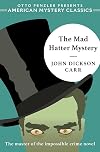
I would for sure recommend this if you’re interested in checking out John Dickson Carr’s work and you like British Golden Age writers as well. But maybe get a cover to hide the really creepy Mad Hatter on the cover of the American Mystery Classics edition. show less
For a description of the plot, I can’t do any better than what’s on the back of the American Mystery Classics edition:
At the hand of an outrageous prankster, top hats are going missing all over London, snatched from the heads of some of the city’s most powerful people—but is the hat thief the same as the person responsible for stealing a lost story by Edgar Allan Poe, the manuscript of which has just disappeared from the collection of Sir William Bitton? Unlike the manuscript, the hats don’t stay stolen for long, each one reappearing in unexpected and conspicuous places shortly after being taken: on the top of a Trafalgar Square statue, hanging from a Scotland Yard lamppost, and now, in show more the foggy depths of the Tower of London, on the head of a corpse with a crossbow bolt through the heart. Amateur detective and lexicographer Dr. Gideon Fell is on the case, and when the dead man is identified as the nephew of the collector, he discovers that the connections underlying the bizarre and puzzling crimes may be more intimate than initially expected.
It’s just totally bananapants and I love it. The setting was definitely a draw—death at the Tower of London is suitably macabre. And the way Carr writes about these settings always has me totally convinced that he is British, even though he is actually American. The only thing that felt in any way stereotypically American was the description of Laura Bitton—she’s got a full bosom and is wearing a slinky dress, which doesn’t feel like something a British writer of the period would have written about or noticed (at least not among the writers I’ve read).
Gideon Fell makes an amusing sleuth, because he doesn’t take himself seriously and he has a good working relationship with the police. He helps them out, but he doesn’t think they’re dumb, as many amateur sleuths might do. And the police get some amusing dialogue as well; my favourite was when the chief inspector did his impression of Socratic dialogue and asked why nobody in these dialogues whacked Socrates over the head with an obelisk.
I did feel the solution went a bit like M. Bencolin (one of Carr’s other sleuths), in that a perfectly plausible solution was presented, and the reader thinks “Great, the case is closed!” except PSYCH! it isn’t, actually — here’s what happened. To be fair, though, this book did that only once, whereas the one Bencolin book I read had like three different PSYCH! moments.
I would for sure recommend this if you’re interested in checking out John Dickson Carr’s work and you like British Golden Age writers as well. But maybe get a cover to hide the really creepy Mad Hatter on the cover of the American Mystery Classics edition. show less
I've been wanting to read The Hollow Man (aka The Three Coffins) for ages, but I've been stubbornly waiting until I found an older edition (mission: impossible), rather than buying a spiffy new reprint. But when Otto Penzler's American Mystery Classics released this spiffy new reprint with it's classic looking cover, I caved.
In Penzler's introduction, he refers to this as one of Dickson Carr's masterpieces. It's the only one I've read –so far– but I'll agree with him in principle, because I can't imagine the mysteries he'd have had to write to knock this one out of, say, his top 3 (we'll take it as read that The Hollow Man occupies the first spot). The writing is sublime, the humor is well timed and a perfect blend of American and show more UK wit, and the plotting is incredible. The ending... well, the ending is twisty and dodgy and Dickson Carr uses one of my favorite devices; one I think elevates the story to another level.
Woven within the narrative is Dickson Carr's ode to books; to a good mystery; the legitimacy of genre literature; to the love of reading and the places it can take you. Round about the edges are tip of the hats to Conan Doyle and more obviously, his friend and debate partner, G.K. Chesterton.
My reading was constantly interrupted by real life, which I feel hampered my ability to 'play along', though, ironically, I did guess the murderer in the end, purely because the fractured reading left me misunderstanding what I thought was a 'big' clue.
All in all an incredibly entertaining read; I'd recommend it to anyone who enjoys a good, classic mystery, with the caveat that it is best read when the reader has time to devote to it. show less
In Penzler's introduction, he refers to this as one of Dickson Carr's masterpieces. It's the only one I've read –so far– but I'll agree with him in principle, because I can't imagine the mysteries he'd have had to write to knock this one out of, say, his top 3 (we'll take it as read that The Hollow Man occupies the first spot). The writing is sublime, the humor is well timed and a perfect blend of American and show more UK wit, and the plotting is incredible. The ending... well, the ending is twisty and dodgy and Dickson Carr uses one of my favorite devices; one I think elevates the story to another level.
Woven within the narrative is Dickson Carr's ode to books; to a good mystery; the legitimacy of genre literature; to the love of reading and the places it can take you. Round about the edges are tip of the hats to Conan Doyle and more obviously, his friend and debate partner, G.K. Chesterton.
My reading was constantly interrupted by real life, which I feel hampered my ability to 'play along', though, ironically, I did guess the murderer in the end, purely because the fractured reading left me misunderstanding what I thought was a 'big' clue.
All in all an incredibly entertaining read; I'd recommend it to anyone who enjoys a good, classic mystery, with the caveat that it is best read when the reader has time to devote to it. show less
Topped at the Tower
Review of the Penzler Publishers American Mystery Classics eBook (July 17, 2019) of the Harper and Brothers hardcover original (1933).
The Mad Hatter Mystery is the second of Carr's Dr. Gideon Fell mysteries. It is not quite in Carr's trademark "locked room" style, as the murder appears to have taken place in the open air by the Tower of London. It is still an apparently impossible crime though with the usual elaborate explanation required to get to the show more final solution. There is also an odd subplot complication where someone is stealing various hats from public figures and authorities, such as an opera top hat, a policeman's helmet, a lawyer's wig, etc. To add to the mystery, the dead body is found with one of the hats on his head. Then there is a stolen manuscript of a rare Edgar Allan Poe story. Only Docter Fell can explain it all!
See cover at https://images-na.ssl-images-amazon.com/images/S/compressed.photo.goodreads.com/...
The front cover of the original 1933 Harper and Brothers hardcover. Image sourced from Goodreads.
I am really enjoying the Dr. Gideon Fell mysteries, especially in the enhanced editions with Foreword Introductions by other authors in the American Mystery Classics series. Unlike almost all of the other Golden Age of Crime writers, there are almost no film or TV adaptations of John Dickson Carr's novels. I think the reason is that the crimes are so elaborate, that they would probably play out as farce if they were presented in dramatized film versions. Also, the mysteries are basically unsolvable, all being 10s out of 10 on the Berengaria Ease of Solving Scale (i.e. impossible to solve). There are always slim clues presented which you do realize in hindsight, but the misdirection is so complete that you'll miss picking up the thread. Anyway, I find them quite a delight.
Trivia and Links
This book is in the Public Domain and there are various online sources where it is available to read such as at archive.org
John Dickson Carr (1906-1977) is one of the 99 authors listed in The Book of Forgotten Authors (2017) by Christopher Fowler. He is No. 20 in the alphabetical listing which you can see towards the bottom of my review here.
This edition of The Mad Hatter Mystery is part of the Otto Penzler American Mystery Classics series (2018-ongoing). There is a related Goodreads Listopia here with 57 books listed as of late April 2024. There are currently 71 titles listed at the Mysterious Press online bookshop. The official website for the series at Penzler Publishers seems to show only the most recent and upcoming titles.
John Dickson Carr took the inspiration for Dr. Gideon Fell's appearance from that of author G.K. Chesterton (1874-1936), writer of the Father Brown mysteries and other works.
See photograph at https://upload.wikimedia.org/wikipedia/commons/thumb/7/75/Gilbert_Chesterton.jpg...
Photograph of G.K. Chesterton. Image sourced from Wikipedia.
The source of the name Dr. Fell is apparently from the apocryphal epigram:
Review of the Penzler Publishers American Mystery Classics eBook (July 17, 2019) of the Harper and Brothers hardcover original (1933).
You see, General, in his own way Doctor Fell is invaluable. But he gets his ideas of police procedure from the cinema, and he is under the impression that he can act any sort of part. Whenever I let him question anybody in my presence he tries to give an imitation of me.
The Mad Hatter Mystery is the second of Carr's Dr. Gideon Fell mysteries. It is not quite in Carr's trademark "locked room" style, as the murder appears to have taken place in the open air by the Tower of London. It is still an apparently impossible crime though with the usual elaborate explanation required to get to the show more final solution. There is also an odd subplot complication where someone is stealing various hats from public figures and authorities, such as an opera top hat, a policeman's helmet, a lawyer's wig, etc. To add to the mystery, the dead body is found with one of the hats on his head. Then there is a stolen manuscript of a rare Edgar Allan Poe story. Only Docter Fell can explain it all!
“‘It must be confessed,’” he repeated, “‘it will be confessed; there is no refuge from confession but suicide, and suicide is confession.’” - Doctor Fell quotes lawyer Daniel Webster as he begins to zero in on the solution to the crime.
See cover at https://images-na.ssl-images-amazon.com/images/S/compressed.photo.goodreads.com/...
The front cover of the original 1933 Harper and Brothers hardcover. Image sourced from Goodreads.
I am really enjoying the Dr. Gideon Fell mysteries, especially in the enhanced editions with Foreword Introductions by other authors in the American Mystery Classics series. Unlike almost all of the other Golden Age of Crime writers, there are almost no film or TV adaptations of John Dickson Carr's novels. I think the reason is that the crimes are so elaborate, that they would probably play out as farce if they were presented in dramatized film versions. Also, the mysteries are basically unsolvable, all being 10s out of 10 on the Berengaria Ease of Solving Scale (i.e. impossible to solve). There are always slim clues presented which you do realize in hindsight, but the misdirection is so complete that you'll miss picking up the thread. Anyway, I find them quite a delight.
Trivia and Links
This book is in the Public Domain and there are various online sources where it is available to read such as at archive.org
John Dickson Carr (1906-1977) is one of the 99 authors listed in The Book of Forgotten Authors (2017) by Christopher Fowler. He is No. 20 in the alphabetical listing which you can see towards the bottom of my review here.
This edition of The Mad Hatter Mystery is part of the Otto Penzler American Mystery Classics series (2018-ongoing). There is a related Goodreads Listopia here with 57 books listed as of late April 2024. There are currently 71 titles listed at the Mysterious Press online bookshop. The official website for the series at Penzler Publishers seems to show only the most recent and upcoming titles.
John Dickson Carr took the inspiration for Dr. Gideon Fell's appearance from that of author G.K. Chesterton (1874-1936), writer of the Father Brown mysteries and other works.
See photograph at https://upload.wikimedia.org/wikipedia/commons/thumb/7/75/Gilbert_Chesterton.jpg...
Photograph of G.K. Chesterton. Image sourced from Wikipedia.
The source of the name Dr. Fell is apparently from the apocryphal epigram:
I do not like thee, Doctor Fell,show less
The reason why – I cannot tell;
But this I know, and know full well,
I do not like thee, Doctor Fell.
John Dickson Carr’s best-known for his Dr. Gideon Fell mysteries from the Golden Age of British detective fiction. The tall, corpulent Dr. Fell — closely modeled on the great G.K. Chesterton — sports pince nez glasses on a ribbon, a cape, a shovel hat and a cane; also just like Chesterton himself, Dr. Fell has a great sense of humor and a profound forgetfulness about everyday, household matters. Unfortunately, Dr. Fell cannot compare with Chesterton’s excellent creation, Father Brown, a seemingly naïve Roman Catholic priest with a knack for solving crimes.
Carr pens a passable mystery with The Mad Hatter Mystery, the second in a long series, and I enjoyed the twist ending — but not enough to read another Dr. Fell novel. I show more think I’ll reread Father Brown instead.
In the interest of full disclosure, I received this book from NetGalley, Penzler Publishing and American Mystery Classics in exchange for an honest review. show less
Carr pens a passable mystery with The Mad Hatter Mystery, the second in a long series, and I enjoyed the twist ending — but not enough to read another Dr. Fell novel. I show more think I’ll reread Father Brown instead.
In the interest of full disclosure, I received this book from NetGalley, Penzler Publishing and American Mystery Classics in exchange for an honest review. show less
This is a classic John Dickson Carr novel. It is highly original and very unpredictable to the end. A body is found at the bottom of some steps at Traitor's Gate at the Tower of London. This seemingly unexplainable crime is tied to mysterious thefts of people's hats and the disappearance of a valuable manuscript. Gideon Fell is on the case, and he is not disturbed by all the extraneous information that comes out in the investigation. The action takes place over one evening and night which tightens up the mystery considerably. Carr's classic mysteries are always enjoyable reading.
This Golden Age mystery not only involves a "mad hatter" (someone stealing hats off people's heads and then leaving them prominently displayed elsewhere) but also a murdered man at the Tower of London who is wearing one of these stolen hats.
I enjoyed this very much and found Dr. Fell less bombastic than usual. However, it struck me as an atypical Carr mystery since it wasn't a true locked room or impossible mystery. Everyone was prevented from leaving the Tower once the body was found but there was a period of time when people could come in or go out.
I enjoyed this very much and found Dr. Fell less bombastic than usual. However, it struck me as an atypical Carr mystery since it wasn't a true locked room or impossible mystery. Everyone was prevented from leaving the Tower once the body was found but there was a period of time when people could come in or go out.
This book has been widely praised (at least on the Internet) as being one of John Dickson Carr's best. I remember reading somewhere that Dorothy Sayers gave this book rave reviews. So once again I swim upstream against the tide of great reviews because this was one of those books where by the end I just didn't care about who the killer was -- I just wanted to finish the book so I could move on to the next one.
As the story opens, it seems that one Sir William Bitton has been a victim of "the Mad Hatter," someone who goes around stealing hats and leaving them in bizarre places, for example, leaving a barrister's wig on a horse. Bitton also has lost something very valuable: a manuscript that turns out to be the first recorded detective show more story by Edgar Allan Poe. But these problems are miniscule in comparison to the fact that his nephew has turned up dead at the Traitor's Gate at the Tower of London, done in by a crossbow bolt. It is up to Dr. Gideon Fell and Inspector Hadley of Scotland Yard to get to the root of the problem -- which is difficult because of the number of possible suspects.
The basic mystery here is awesome. There are enough people to give any would-be armchair detective a run for his/her money in trying to solve the mystery. The story tends to drag on (imho) a bit too long, imho, as Carr lays out hints and clues for the reader to follow.
Overall...not bad, but the book prior to this one in the series (Hag's Nook) is much more serious and tends to get down to business a bit more quickly -- my preference in mystery novels precisely. I wouldn't recommend this to people who think they're getting a cozy mystery, because it's not; hard-core and British mystery readers might enjoy it, but do remember it was written in 1933 so the language tends to be a bit overdone and somewhat archaic at times. Overall, not bad; I'll continue the series for sure! show less
As the story opens, it seems that one Sir William Bitton has been a victim of "the Mad Hatter," someone who goes around stealing hats and leaving them in bizarre places, for example, leaving a barrister's wig on a horse. Bitton also has lost something very valuable: a manuscript that turns out to be the first recorded detective show more story by Edgar Allan Poe. But these problems are miniscule in comparison to the fact that his nephew has turned up dead at the Traitor's Gate at the Tower of London, done in by a crossbow bolt. It is up to Dr. Gideon Fell and Inspector Hadley of Scotland Yard to get to the root of the problem -- which is difficult because of the number of possible suspects.
The basic mystery here is awesome. There are enough people to give any would-be armchair detective a run for his/her money in trying to solve the mystery. The story tends to drag on (imho) a bit too long, imho, as Carr lays out hints and clues for the reader to follow.
Overall...not bad, but the book prior to this one in the series (Hag's Nook) is much more serious and tends to get down to business a bit more quickly -- my preference in mystery novels precisely. I wouldn't recommend this to people who think they're getting a cozy mystery, because it's not; hard-core and British mystery readers might enjoy it, but do remember it was written in 1933 so the language tends to be a bit overdone and somewhat archaic at times. Overall, not bad; I'll continue the series for sure! show less
Members
- Recently Added By
Lists

Must Read Detective Stories (Nick Fuller)
278 works; 2 members
Author Information

231+ Works 19,002 Members
John Dickson Carr, the master of locked room mysteries, was born in Uniontown, Pennsylvania, in 1906. He was educated at Haverford College and the Sorbonne in Paris. Carr is a prolific writer with more than 80 novels and collections of short stories to his credit. He began his writing career at the age of 26 with his first published novel, It show more Walks At Night. Some of his most popular works are The Three Coffins (1935), The Burning Coat (1937), and The Bride of Newgate (1951). Carr also collaborated with Adrian Doyle, the son of Sir Arthur Conan Doyle in The Exploits of Sherlock Holmes (1954). Carr met his wife in 1932 and settled in England in 1933. He was drafted by the United States military in World War II, and was ordered to remain in England and work with the BBC. He lived in many cities throughout the world until 1967, when he permanently moved to Greenville, South Carolina. John Dickson Carr also wrote mystery novels under the name Carter Dickson. He died in Greenville in 1977. (Bowker Author Biography) show less
Awards and Honors
Distinctions
Series

Belongs to Publisher Series
Work Relationships
Common Knowledge
- Canonical title
- The Mad Hatter Mystery
- Original title
- The Mad Hatter Mystery
- Original publication date
- 1933
- People/Characters
- Dr. Gideon Fell; Superintendent Hadley; Ted Rampole; Philip Driscoll; Sir William Bitton; Julius Arbor (show all 34); Lester Bitton; Laura Bitton; Sheila Bitton; Mrs. Larkin; General Mason; Robert Dalrye; Parker; Sergeant Betts; Sergeant Hamper; Dr. Watson; Theophilus Marks; Aylmer Valence; Police Constable James McGuire; George G. Bebber; Mrs. Bebber; Jno. Simms; John Smith; Mrs. Smith; Lucien Lefèvre; Mlle. Clémentine Lefèvre; Dorothea Delevan Mercenay; Mr. Radburn; John Brownlow; Sir Leonard Haldyne; Dr. Robertson; Joseph McCartney; Mr. Spengler; Mrs. Spengler
- Important places
- London, England, UK; Tower of London, London, England, UK
- First words
- It began, like most of Dr. Fell's adventures, in a bar.
- Last words
- (Click to show. Warning: May contain spoilers.)"'Unsolved,'" he said.
- Original language
- English
Classifications
Statistics
- Members
- 433
- Popularity
- 71,199
- Reviews
- 11
- Rating
- (3.56)
- Languages
- 13 — Chinese, simplified, English, Finnish, French, German, Italian, Japanese, Korean, Norwegian (Bokmål), Norwegian, Russian, Spanish, Swedish
- Media
- Paper, Ebook
- ISBNs
- 17
- ASINs
- 19