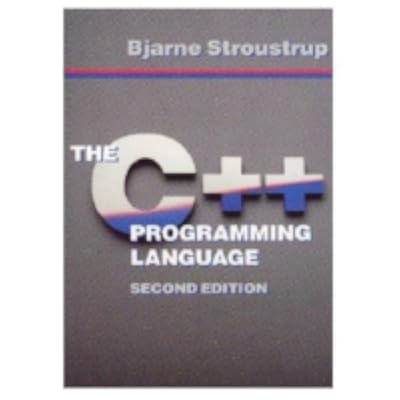
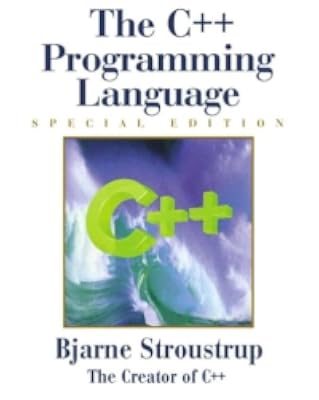
The C++ Programming Language {2nd Edition}
by Bjarne Stroustrup
On This Page
Description
This definitive guide, written by the designer of C++ and substantially expanded in its second edition, provides coverage of the features available in the most recent release, including multiple inheritance, typesafe linkage, abstract classes, etc. For serious programmers using C++ for nontrivial prTags
Recommendations

Member Reviews
[I am only going to include 10 tech books, a represtative sample]
A fundamental book. Rather than read any of the 100's of 'how to C ', I read this instead.
A fundamental book. Rather than read any of the 100's of 'how to C ', I read this instead.
Indeholder "Preface", " Acknowledgements", "Preface to the first Edition", " Acknowledgements", "Contents", "Notes to the Reader", " The Structure of This Book", " Implementation Notes", " Exercises", " Design Notes", " Historical Note", " C and C++", " Efficiency and Structure", " Philosophical Note", " Thinking about Programming in C++", " Rules of Thumb", " Note to C Programmers", " References", "1. A Tour of C++", " 1.1 Introduction", " 1.2 Programming Paradigms", " 1.3 'A Better C'", " 1.4 Support for Data Abstraction", " 1.5 Support for Object-Oriented Programming", " 1.6 Limits to Perfection", "2. Declarations and Constants", " 2.1 Declarations", " 2.2 Names", " 2.3 Types", " 2.4 Literals", " 2.5 Named Constants", " 2.6 Saving show more Space", " 2.7 Exercises", "3. Expressions and Statements", " 3.1 A Desk Calculator", " 3.2 Operator Summary", " 3.3 Statement Summary", " 3.4 Comments and Indentation", " 3.5 Exercises", "4. Functions and Files", " 4.1 Introduction", " 4.2 Linkage", " 4.3 Header Files", " 4.4 Linkage to Non-C++ Code", " 4.5 How to Make a Library", " 4.6 Functions", " 4.7 Macros", " 4.8 Exercises", "5. Classes", " 5.1 Introduction and Overview", " 5.2 Classes and Members", " 5.3 Interfaces and Implementation", " 5.4 Minor Class Features", " 5.5 Construction and Destruction", " 5.6 Exercises", "6. Derived Classes", " 6.1 Introduction and Overview", " 6.2 Derived Classes", " 6.3 Abstract Classes", " 6.4 A Complete Program", " 6.5 Multiple Inheritance", " 6.6 Access Control", " 6.7 Free Store", " 6.8 Exercises", "7. Operator Overloading", " 7.1 Introduction", " 7.2 Operator Functions", " 7.3 User-defined Type Conversion", " 7.4 Literals", " 7.5 Large Objects", " 7.6 Assignment and Initialization", " 7.7 Subscripting", " 7.8 Function Call", " 7.9 Dereferencing", " 7.10 Increment and Decrement", " 7.11 A String Class", " 7.12 Friends and Members", " 7.13 Caveat", " 7.14 Exercises", "8. Templates", " 8.1 Introduction", " 8.2 A Simple Template", " 8.3 List Templates", " 8.4 Function Templates", " 8.5 Template Function Overloading Resolution", " 8.6 Template Arguments", " 8.7 Derivation and Templates", " 8.8 An Associative Array", " 8.9 Exercises", "9. Exception Handling", " 9.1 Error Handling", " 9.2 Discrimination of Exceptions", " 9.3 Naming of Exceptions", " 9.4 Resource Acquisition", " 9.5 Exceptions that are not Errors", " 9.6 Interface Specifications", " 9.7 Uncaught Exceptions", " 9.8 Error-Handling Alternatives", " 9.9 Exercises", "10. Streams", " 10.1 Introduction", " 10.2 Output", " 10.3 Input", " 10.4 Formatting", " 10.5 Files and Streams", " 10.6 C Input/Output", " 10.7 Exercises", "11. Design and Development", " 11.1 Introduction", " 11.2 Aims and Means", " 11.3 The Development Process", " 11.4 Management", " 11.5 Rules of Thumb", " 11.6 Annotated Bibliography", "12. Design and C++", " 12.1 Design and Programming Language", " 12.2 Classes", " 12.3 Components", " 12.4 Interfaces and Implementations", " 12.5 Rules of Thumb", "13. Design of Libraries", " 13.1 Introduction", " 13.2 Concrete Types", " 13.3 Abstract Types", " 13.4 Node Classes", " 13.5 Run-time Type Information", " 13.6 Fat Interfaces", " 13.7 Application Frameworks", " 13.8 Interface Classes", " 13.9 Handle Classes", " 13.10 Memory Management", " 13.11 Exercises", "14. Reference Manual", " r.1 Introduction", " r.2 Lexical Conventions", " r.3 Basic Concepts", " r.4 Standard Conversions", " r.5 Expressions", " r.6 Statements", " r.7 Declarations", " r.8 Declarators", " r.9 Classes", " r.10 Derived Classes", " r.11 Member Access Control", " r.12 Special Member Functions", " r.13 Overloading", " r.14 Templates", " r.15 Exception Handling", " r.16 Preprocessing", " r.17 Appendix A: Grammar Summary", " r.18 Appendix B: Compatibility", "Index".
Udmærket bog om C++, men den er kommet i et hav af udgaver siden, så den her har mest historisk interesse. show less
Udmærket bog om C++, men den er kommet i et hav af udgaver siden, så den her har mest historisk interesse. show less
Dec 7, 2016Danish
Ratings
Members
- Recently Added By
Author Information

Bjarne Stroustrup is the designer and original implementer of C++ and the author of Programming: Principles and Practice Using C++, Second Edition, and The C++ Programming Language, Fourth Edition, among others. Having previously worked at Bell Labs, ATT Labs, and Texas AM University, he is currently managing director in the technology division of show more Morgan Stanley in New York City and a visiting professor at Columbia University. The recipient of numerous honors, including The National Academy of Engineering's 2018 Charles Stark Draper Prize for Engineering "for conceptualizing and developing the C++ programming language," Dr. Stroustrup is a member of the National Academy of Engineering, an IEEE Fellow, and an ACM Fellow. show less
Common Knowledge
- Canonical title
- The C++ Programming Language {2nd Edition}
- Original publication date
- 1992
- Disambiguation notice
- Please do not combine with other editions of the C++ Programming Language; the language they describe changed widely between the first, second and third editions.
Classifications
- Genres
- Technology, Nonfiction, General Nonfiction
- DDC/MDS
- 005.133 — Computer science, information & general works Computer science, knowledge & systems Artificial Intelligence/Virtual Reality Software development Computer programming Specific programming languages
- LCC
- QA76.73 .C15 .S79 — Science Mathematics Mathematics Instruments and machines Calculating machines Electronic computers. Computer science
- BISAC
Statistics
- Members
- 425
- Popularity
- 72,421
- Reviews
- 2
- Rating
- (3.64)
- Languages
- English, French, German, Italian
- Media
- Paper
- ISBNs
- 4
- ASINs
- 1