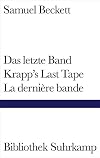
Krapp's Last Tape
by Samuel Beckett
On This Page
Tags
Recommendations





















Member Reviews
The protagonist of Krapp’s Last Tape is certain that he possesses the talent to change the world with his art but the focus of Beckett’s play is how Krapp’s certainty is worn down to a terrible moment of doubt and despair. Krapp ultimately realizes that nothing will ever be different and that his masterpiece has had no effect whatsoever in the world. The fact that Krapp wasted his life in pursuit of such a grandiose ‘‘vision’’ (as he calls it) marks the play as one of Beckett’s most ironic and chilling works.
Like all of Beckett’s work, Krapp’s Last Tape may strike the first-time viewer as odd and unsettling: there is a minimal set, no dramatic lighting cues, nothing that a theatergoer would call a traditional show more ‘‘plot,’’ and only one character, a character whose only conversations are with a tape recording of himself that he made thirty years ago. However, many of the play’s original reviewers noted the force that Beckett was able to contain in what initially seems like the framework (rather than the final draft) of a play. [http://www.enotes.com/krapps-last] show less
Like all of Beckett’s work, Krapp’s Last Tape may strike the first-time viewer as odd and unsettling: there is a minimal set, no dramatic lighting cues, nothing that a theatergoer would call a traditional show more ‘‘plot,’’ and only one character, a character whose only conversations are with a tape recording of himself that he made thirty years ago. However, many of the play’s original reviewers noted the force that Beckett was able to contain in what initially seems like the framework (rather than the final draft) of a play. [http://www.enotes.com/krapps-last] show less
Ratings
Members
- Recently Added By
Lists

My TBR
371 works; 3 members

New Lifetime Reading Plan by Fadiman and Major
225 works; 5 members
Author Information

529+ Works 43,150 Members
Nobel Prize winner (1969) Samuel Beckett was born on April 13, 1906 near Dublin, Ireland into a middle-class Protestant family. As a boy, he studied French and enjoyed cricket, tennis, and boxing. At Trinity College he continued his studies in French and Italian and became interested in theater and film, including American film. After graduation, show more Beckett taught English in Paris and traveled through France and Germany. While in Paris Beckett met Suzanne Deschevaus-Dusmesnil. During World War II when Paris was invaded, they joined the Resistance. They were later forced to flee Paris after being betrayed to the Gestapo, but returned in 1945. Beckett and Deschevaus-Dusmesnil married in 1961. Samuel Beckett's first novel was Dream of Fair to Middling Women. Among his many works are Murphy; Malone Dies; and The Unnameable. His plays include Endgame, Happy Days, Not I, That Time, and Krapp's Last Tape. In 1953, the production of Waiting For Godot in Paris by director and actor Roger Blin earned Beckett international fame. Beckett was awarded the Nobel Prize in Literature in 1969. His style was postmodern minimalist and some of his major themes were imprisonment in one's self, the failure of language, and moral conduct in a godless world. Despite his fame, Samuel Beckett led a secluded life. In his later years he suffered from cataracts and emphysema. His wife Suzanne died on July 17, 1989 and Beckett died on December 22nd of the same year. (Bowker Author Biography) show less
Series
Belongs to Publisher Series
suhrkamp taschenbuch (0200)
Work Relationships
Is contained in
The Dramatic Works of Samuel Beckett: Volume III of The Grove Centenary Editions (Works of Samuel Beckett the Grove Centenary Editions) by Samuel Beckett (indirect)
The Grove Centenary Editions of Samuel Beckett Boxed Set: Contains Novels I and II of Samuel Beckett, The Dramatic Works of Samuel Beckett, and The Poems, Short Fiction and Critcism of Samuel Beckett by Samuel Beckett (indirect)
Has as a supplement
Has as a student's study guide
Common Knowledge
- Canonical title
- Krapp's Last Tape
- Original title
- Krapp's Last Tape
- Original publication date
- 1958
- Disambiguation notice
- Do not combine an edition of the play Krapp’s Last Tape with one also containing Embers and/or other short plays.
Classifications
Statistics
- Members
- 45
- Popularity
- 662,910
- Reviews
- 1
- Rating
- (3.25)
- Languages
- 5 — English, Finnish, French, German, Spanish
- Media
- Paper
- ISBNs
- 3
- ASINs
- 1