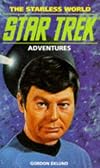
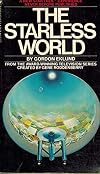
The Starless World
by Gordon Eklund
Star Trek Adventures (Titan) (3), Star Trek Adventures (Bantam) (9), Star Trek (novels) (1978.11), Star Trek (1978.11)
On This Page
Description
Captain Kirk and his crew must convince their captors that they are facing destruction unless they free the Enterprise and allow them all to reach safety.Tags
Recommendations




















Member Reviews
One of the very first Star Trek books back in the day. Captures the original Star Trek spirit but has a weak plot. The Enterprise and a Klingon ship get pulled into a Dyson sphere with the inhabitants claiming that the sun is their god, how will Kirk and co escape? Good setup with some interesting happenings but falls apart in execution because of a very sudden and anticlimactic ending. Really could have used another 100 pages or so.
The author won a nebula for a short story about god like aliens living in stars/being stars and that idea is reused here. If that concept interests you, you might find this worth the read, otherwise leave it for collectors only.
The author won a nebula for a short story about god like aliens living in stars/being stars and that idea is reused here. If that concept interests you, you might find this worth the read, otherwise leave it for collectors only.
The Enterprise is at the Galactic Core, charting black holes and searching for signs of Klingon activity, when they encounter a Federation shuttlecraft, identified as coming from the USS Rickover, lost more than twenty years prior.
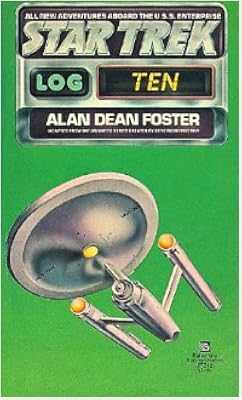
The shuttlecraft is piloted by a madman calling himself Jesus Christ, who Kirk recognizes to be Thomas Clayton, Kirk's old roommate at the academy (he must have had a lot of those--in Star Trek Log Seven, we learn that he had a Klingon roommate named Kumara, who returns in Star Trek Log Ten).
Clayton has come out of a Dyson sphere which the Enterprise soon finds itself pulled into. They find within a place called Lyra (McCoy initially suggests Pellucidar as a name), apparently ruled over by a god called Ay-nab, show more who is the sun.
Nothing very interesting happens for a hundred pages or so, and Kirk telepathically convinces Ay-nab to send the Enterprise back out before the whole Dyson sphere falls into a black hole. Spock ends the story unsure of whether the most logical explanation is that Ay-nab is a god, a telepathic computer, or what. The end.
Although there's a little exposition about what Ay-nab is doing (punishing the Lyrans for repeatedly starting wars), it's not satisfying.
The only alien that gets any meaningful amount of 'screen time', Ola, doesn't do much other than wring her hands and follow Kirk around, until she saves them all with the power of love. When we meet her, Kirk's appraisal isn't terribly inspiring:
And half the book later, when Ola has risked her life to help Kirk find Uhura (who had been kidnapped):
Well, it's not just Kirk and Spock who don't seem to think much of women, either:
Even Uhura doesn't think of Chapel except in relation to Spock.
Enough nitpicking. The book's not very interesting. Dyson sphere, hollow world, whatever. It's been done. By Trek, even. Ditto the space god ruling over the primitive people who once had more advanced tech. It's like Trek's Greatest Hits Volume 3: More B-sides.
Pass. show less
The shuttlecraft is piloted by a madman calling himself Jesus Christ, who Kirk recognizes to be Thomas Clayton, Kirk's old roommate at the academy (he must have had a lot of those--in Star Trek Log Seven, we learn that he had a Klingon roommate named Kumara, who returns in Star Trek Log Ten).
Clayton has come out of a Dyson sphere which the Enterprise soon finds itself pulled into. They find within a place called Lyra (McCoy initially suggests Pellucidar as a name), apparently ruled over by a god called Ay-nab, show more who is the sun.
Nothing very interesting happens for a hundred pages or so, and Kirk telepathically convinces Ay-nab to send the Enterprise back out before the whole Dyson sphere falls into a black hole. Spock ends the story unsure of whether the most logical explanation is that Ay-nab is a god, a telepathic computer, or what. The end.
Although there's a little exposition about what Ay-nab is doing (punishing the Lyrans for repeatedly starting wars), it's not satisfying.
The only alien that gets any meaningful amount of 'screen time', Ola, doesn't do much other than wring her hands and follow Kirk around, until she saves them all with the power of love. When we meet her, Kirk's appraisal isn't terribly inspiring:
Kirk now had a chance to study the alien female more carefully. Her bare face struck him as very human; in fact, she was almost pretty. Her lips were thin and expressive. Her eyes were round and pink. The top of her head was as hirsute as her body. She had no ears. Her breasts were small, firm, and very feminine. She was young, Kirk guessed, and childless. The Starless World (1978-11), 49
And half the book later, when Ola has risked her life to help Kirk find Uhura (who had been kidnapped):
Spock was cautious. “I wish you could be certain Lieutenant Uhura is indeed there.” “I'm as sure as I'm going to be.” “Unfortunately, you have only the word of the female.” The Starless World (1978-11), 124
Well, it's not just Kirk and Spock who don't seem to think much of women, either:
Well, thought Uhura, turning on her right side, now, wasn’t that odd? Here she was thinking about Mr. Spock, while beside her slept poor Chapel, who was in love with him, very possibly dreaming of the same man. Spock did not love Chapel. The Starless World (1978-11), 87–88
Even Uhura doesn't think of Chapel except in relation to Spock.
Enough nitpicking. The book's not very interesting. Dyson sphere, hollow world, whatever. It's been done. By Trek, even. Ditto the space god ruling over the primitive people who once had more advanced tech. It's like Trek's Greatest Hits Volume 3: More B-sides.
Pass. show less
This was an odd one. It took just enough chances to feel like more than a large-scale episode. It pushed the characters in ways that threatened (although ultimately didn't change) the status quo, and it read, at times, more like fantasy than sci-fi.
I liked it.
I liked it.
The story was alright, but I had a difficult time getting into it. There's nothing particularly exciting that happens - a lackluster villain, a plot that spends most of its time stumbling aimlessly over well-worn and better-done ground, and an overall forgettability that keeps it from really ever taking off. There were a couple really nice moments, specifically when Uhura's dreaming about her family and father, but that's about it.
The Enterprise and a Klingon ship contend over a newly discovered world inside a hollow shell, much like Edgar Rice Burroughs' Pellucidar, as it falls toward a black hole. A decent story, but that's all.
Not great. "A god who is also a star." Okay then. Doesn't hold up to Q, et al! Plus use of "Klingonese." Okay theeeeen.
Ratings
Members
- Recently Added By
Author Information

Series


Work Relationships
Is abridged in
Common Knowledge
- Canonical title
- The Starless World
- Original title
- Star Trek: The Starless World
- Alternate titles
- Star Trek: The Starless World
- Original publication date
- 1978-11 (eng.) (eng.)
- People/Characters
- Thomas Clayton; James T. Kirk; Leonard McCoy (Bones); Spock; Ay-nab
- Important places
- USS Enterprise NCC-1701 (spaceship)
- First words
- Captain's Log, Stardate 6527.5: The awesome spectacle of the Galactic Core continues to weave a spell over the ship's crew, even those veterans who've passed this way before.
- Last words
- (Click to show. Warning: May contain spoilers.)"Chess, it is," he said.
Classifications
Statistics
- Members
- 431
- Popularity
- 71,277
- Reviews
- 6
- Rating
- (3.09)
- Languages
- English, German
- Media
- Paper
- ISBNs
- 4
- ASINs
- 7