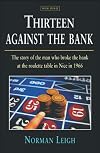
Thirteen Against the Bank
by Norman Leigh
On This Page
Description
In the summer of 1966 Norman Leigh took a team to the Casino Municipal in Nice with the express intention of systematically winning large sums of money at roulette. Two weeks later the team was banned from every casino in France. Not for cheating, or rowdy behaviour - but for winning, methodically and consistently. An absolute classic detailing the events leading up to - and, most importantly, the system that allowed this to happen - an event held as impossible by all expert opinion - show more breaking the bank at roulette. show lessTags
Recommendations


































Member Reviews
What a ridiculous book. It belongs to a category I've never witnessed before: a purportedly true autobiography that I simply don't believe. Either that or it's a very subtle parody of the genre.
The author/narrator claims to have applied a system of betting to roulette tables in England and France many decades ago (fifties? sixties?) and to have successfully made a pile of money with a team of conspirators before being eventually banned from the casinos. But it doesn't stack up.
According to his system, he places 6 people on a table, who cover all the "even chances", betting simultaneously on red, black, odd, even, high and low. This is beyond naive, it's beyond simple, it's simply plain stupid. The first bet of the day, in his system show more wagers 30 "units" (5 each for the 6 players) and stands to gain precisely zero. And if the zero comes up, it loses the lot. Some system. After the first spin, the winners will bet 6 units, and the losers will bet 5. So after two spins, sometimes he's up 3 units, sometimes he's down 3 units, sometimes he's down as much as 60 units. It's pure nonsense.
The nonsense weaves its way into every explanation, or lack thereof. Why must all betting be done so intensively, with multiple tables played simultaneously? No reason, other than an obsession with "breaking the bank". His explanation of the system being "the bank being forced to play a losing system" has some sort of simplistic appeal but is meaningless.
And his stories don't really stack up either. When they first play in England, they go several days without winning, with a team of 30. In France, their winnings are consistent, day after day, with a team of 12. And they hit multiple "progressions" per day. Ridiculous.
And the training! They spend weeks "training" for what is a very simple system - each bet, add two numbers and write them down. Cross them off if you lose. The only part that requires any training is handling chips, and he doesn't train them on that.
And the chips! In his system, let's say the two numbers on your page are 25 and 43. You would bet their sum, 68. If you win, the next bet would be 68+25. That's actually easy to calculate, because you simply leave your previous stake, and add 25 more chips - a fact he never mentions.
So there you have it: a story full of holes, that doesn't stand up to any scrutiny, yet passed off as fact. Perhaps it is simply fiction misleadingly presented. I don't get it. show less
The author/narrator claims to have applied a system of betting to roulette tables in England and France many decades ago (fifties? sixties?) and to have successfully made a pile of money with a team of conspirators before being eventually banned from the casinos. But it doesn't stack up.
According to his system, he places 6 people on a table, who cover all the "even chances", betting simultaneously on red, black, odd, even, high and low. This is beyond naive, it's beyond simple, it's simply plain stupid. The first bet of the day, in his system show more wagers 30 "units" (5 each for the 6 players) and stands to gain precisely zero. And if the zero comes up, it loses the lot. Some system. After the first spin, the winners will bet 6 units, and the losers will bet 5. So after two spins, sometimes he's up 3 units, sometimes he's down 3 units, sometimes he's down as much as 60 units. It's pure nonsense.
The nonsense weaves its way into every explanation, or lack thereof. Why must all betting be done so intensively, with multiple tables played simultaneously? No reason, other than an obsession with "breaking the bank". His explanation of the system being "the bank being forced to play a losing system" has some sort of simplistic appeal but is meaningless.
And his stories don't really stack up either. When they first play in England, they go several days without winning, with a team of 30. In France, their winnings are consistent, day after day, with a team of 12. And they hit multiple "progressions" per day. Ridiculous.
And the training! They spend weeks "training" for what is a very simple system - each bet, add two numbers and write them down. Cross them off if you lose. The only part that requires any training is handling chips, and he doesn't train them on that.
And the chips! In his system, let's say the two numbers on your page are 25 and 43. You would bet their sum, 68. If you win, the next bet would be 68+25. That's actually easy to calculate, because you simply leave your previous stake, and add 25 more chips - a fact he never mentions.
So there you have it: a story full of holes, that doesn't stand up to any scrutiny, yet passed off as fact. Perhaps it is simply fiction misleadingly presented. I don't get it. show less
Ratings
Members
- Recently Added By
Author Information
1 Work 33 Members
Common Knowledge
- Original publication date
- 1976
- People/Characters
- Norman Leigh
- Important places
- Twickenham, London, England, UK; London, England, UK; Nice, Alpes-Maritimes, Provence-Alpes-Côte d'Azur, France
Classifications
- Genres
- Nonfiction, General Nonfiction, Biography & Memoir
- DDC/MDS
- 795.2 — Arts & recreation Recreation, sports, and performing arts Games of chance Machine games [pinball now 794.75]
- LCC
- HV6722 .G86 .L65 — Social sciences Social pathology. Social and public welfare. Criminology Social pathology. Social and public welfare. Criminology Crimes and offenses
- BISAC
Statistics
- Members
- 33
- Popularity
- 857,875
- Reviews
- 1
- Rating
- (3.44)
- Languages
- English, Spanish
- Media
- Paper
- ISBNs
- 8
- ASINs
- 1