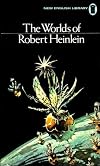
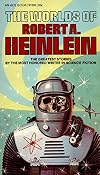
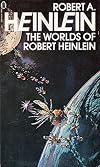
The worlds of Robert A. Heinlein
by Robert A. Heinlein (Introduction)
On This Page
Description
The Zigzag Zebras have been challenged by the Timpanzi School Tigers to a race. They'll have to practice hard. Too bad Gina is a better opera singer than a runner. Ramon has them running all over--in the schoolyard, down Stone Street, back into the gym, down the stairs. They have to win!Tags
Recommendations












Member Reviews
I have read and loved other Heinlein works, though this is the first collection of short stories I have read. I have to say, I was unimpressed.
The introductory essay was likely the best part of this collection for me, as an exploration of what science fiction is in terms of extrapolation and speculation, and why prediction should not play into a story teller's hand.
"Searchlight" was perhaps the most human to me, the story of a lost little girl who sees with her ears. Though, whereas in the other stories, I felt as though Heinlein was providing all sorts of details I cared nothing about, this one felt as though it was written with a word limitation in mind, where many things could have been expounded upon, I felt just as in the dark as show more Betsy must have been. show less
The introductory essay was likely the best part of this collection for me, as an exploration of what science fiction is in terms of extrapolation and speculation, and why prediction should not play into a story teller's hand.
"Searchlight" was perhaps the most human to me, the story of a lost little girl who sees with her ears. Though, whereas in the other stories, I felt as though Heinlein was providing all sorts of details I cared nothing about, this one felt as though it was written with a word limitation in mind, where many things could have been expounded upon, I felt just as in the dark as show more Betsy must have been. show less
(Original Review, 1980-07-26)
Although Clarke was far ahead of his time in regard to synchronous communications satellites, even here he missed a few beats. Although I have not read his science article detailing the suggestion, his early fiction always had the satellites MANNED. He did not foresee the fantastic reductions in size of electronics (semi-conductors were yet to be invented) or their corresponding increase in reliability.
Heinlein is another author who made some good conceptual predictions. He broached the concept that nuclear power plants might entail serious hazards in 'Blowups Happen' (although the specific danger he was talking about never really materialized). He also 'predicted' the nuclear stalemate in 'Solution show more Unsatisfactory', although here his technical details concerning the bomb were off (he considered radioactive dust, a version of fallout, as the primary weapon, not nuclear bombs).
Just goes to show that even though people have correctly predicted a CONCEPT on occasion, they have seldom correctly predicted the eventual implementation (and thus many of the major economic, social, and political implications). As a matter of fact, I cannot remember a non-trivial prediction that really predicted the full implications of several novel ideas interacting (like satellites and electronics). To do so seems to be a task an order of magnitude harder than simply predicting a single concept.
[2018 EDIT: This review was written at the time as I was running my own personal BBS server. Much of the language of this and other reviews written in 1980 reflect a very particular kind of language: what I call now in retrospect a “BBS language”.]
NB: In my blog this was a review only for "Blowups Happen", show less
Although Clarke was far ahead of his time in regard to synchronous communications satellites, even here he missed a few beats. Although I have not read his science article detailing the suggestion, his early fiction always had the satellites MANNED. He did not foresee the fantastic reductions in size of electronics (semi-conductors were yet to be invented) or their corresponding increase in reliability.
Heinlein is another author who made some good conceptual predictions. He broached the concept that nuclear power plants might entail serious hazards in 'Blowups Happen' (although the specific danger he was talking about never really materialized). He also 'predicted' the nuclear stalemate in 'Solution show more Unsatisfactory', although here his technical details concerning the bomb were off (he considered radioactive dust, a version of fallout, as the primary weapon, not nuclear bombs).
Just goes to show that even though people have correctly predicted a CONCEPT on occasion, they have seldom correctly predicted the eventual implementation (and thus many of the major economic, social, and political implications). As a matter of fact, I cannot remember a non-trivial prediction that really predicted the full implications of several novel ideas interacting (like satellites and electronics). To do so seems to be a task an order of magnitude harder than simply predicting a single concept.
[2018 EDIT: This review was written at the time as I was running my own personal BBS server. Much of the language of this and other reviews written in 1980 reflect a very particular kind of language: what I call now in retrospect a “BBS language”.]
NB: In my blog this was a review only for "Blowups Happen", show less
A 24 page Introduction called Pandora's Box. And 5 Short Stories. FREE MEN, BLOWUPS HAPPEN, SEARCHLIGHT, LIFE-LINE, SOLUTION UNSATISFACTORY
Indeholder "Introduction: Pandora's Box", "Free Men", "Blowups Happen", "Searchlight", "Solution Unsatisfactory".
"Introduction: Pandora's Box" handler om ???
"Free Men" handler om ???
"Blowups Happen" handler om ingeniører, der bryder sammen, fordi de arbejder på eksplosionsfarlige a-kraftværker. Da en af dem opdager at Månen engang har været beboelig og at nogle af de store kratere passer med et eksploderende kraftværk tvinges de til at finde en bedre løsning og det gør de så. De regner også på hvordan man får en organisation til at acceptere en ændring - i stil med Asimovs Stiftelse.
"Searchlight" handler om en snedig måde at finde Elizabeth Barnes på. Hun er strandet et sted på Månen og er blind, men god til at kende show more toner.
"Solution Unsatisfactory" handler om ???
??? show less
"Introduction: Pandora's Box" handler om ???
"Free Men" handler om ???
"Blowups Happen" handler om ingeniører, der bryder sammen, fordi de arbejder på eksplosionsfarlige a-kraftværker. Da en af dem opdager at Månen engang har været beboelig og at nogle af de store kratere passer med et eksploderende kraftværk tvinges de til at finde en bedre løsning og det gør de så. De regner også på hvordan man får en organisation til at acceptere en ændring - i stil med Asimovs Stiftelse.
"Searchlight" handler om en snedig måde at finde Elizabeth Barnes på. Hun er strandet et sted på Månen og er blind, men god til at kende show more toner.
"Solution Unsatisfactory" handler om ???
??? show less
Sep 26, 2012 (Edited)Danish
Ratings
Members
- Recently Added By
Author Information

Robert Anson Heinlein was born on July 7, 1907 in Butler, Mo. The son of Rex Ivar and Bam Lyle Heinlein, Robert Heinlein had two older brothers, one younger brother, and three younger sisters. Moving to Kansas City, Mo., at a young age, Heinlein graduated from Central High School in 1924 and attended one year of college at Kansas City Community show more College. Following in his older brother's footsteps, Heinlein entered the Navel Academy in 1925. After contracting pulmonary tuberculosis, of which he was later cured, Heinlein retired from the Navy and married Leslyn MacDonald. Heinlein was said to have held jobs in real estate and photography, before he began working as a staff writer for Upton Sinclair's EPIC News in 1938. Still needing money desperately, Heinlein entered a writing contest sponsored by the science fiction magazine Thrilling Wonder Stories. Heinlein wrote and submitted the story "Life-Line," which went on to win the contest. This guaranteed Heinlein a future in writing. Using his real name and the pen names Caleb Saunders, Anson MacDonald, Lyle Monroe, John Riverside, and Simon York, Heinlein wrote numerous novels including For Us the Living, Methuselah's Children, and Starship Troopers, which was adapted into a big-budget film for Tri-Star Pictures in 1997. The Science Fiction Writers of America named Heinlein its first Grand Master in 1974, presented 1975. Officers and past presidents of the Association select a living writer for lifetime achievement. Also, the Science Fiction and Fantasy Hall of Fame inducted Heinlein in 1998. Heinlein died in 1988 from emphysema and other related health problems. Heinlein's remains were scattered from the stern of a Navy warship off the coast of California. (Bowker Author Biography) show less
Some Editions
Series
Belongs to Publisher Series
Work Relationships
Common Knowledge
- Canonical title
- The worlds of Robert A. Heinlein
- Original title
- The Worlds of Robert A. Heinlein
- Alternate titles
- The Worlds of Robert Heinlein
- Original publication date
- 1966 (Collection) (Collection)
- First words
- Once opened, the Box could never be closed.
- Last words
- (Click to show. Warning: May contain spoilers.)And neither does Manning.
- Publisher's editor*
- Schelwokat, Günter M.
- Original language*
- Englisch
*Some information comes from Common Knowledge in other languages. Click "Edit" for more information.
Classifications
Statistics
- Members
- 698
- Popularity
- 40,733
- Reviews
- 4
- Rating
- (3.56)
- Languages
- English, German
- Media
- Paper
- ISBNs
- 9
- ASINs
- 26