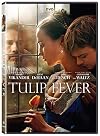
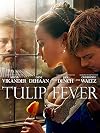
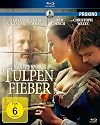
Tulip Fever [2017 film]
by Justin Chadwick (Director), Tom Stoppard (Screenwriter)
On This Page
Description
An artist falls for a young married woman while he's commissioned to paint her portrait during the Tulip mania of seventeenth century Amsterdam.Tags
Recommendations















Member Reviews
I'm torn about this one.
I feel like all of the actors turned in worthwhile performances, and that Christoph Waltz absolutely stole the show. He was beyond reproach, and I enjoyed how everyone else played their parts well enough that you could invest your opinions into each character's behavior and feel it was worth doing so.
I loved the concept of the ending, and how I went into this movie expecting certain tropes to be true of various characters, only to have those expectations turned upside down.
Having said that... Whomever cut 'Tulip Fever' has committed a gross injustice to the movie. More than once the movie felt rushed and sloppily put together, as if all of the right components were carefully crafted and submitted, only to have a show more toddler haphazardly glue them to a piece of construction paper.
I wanted to love this movie, and I still have so many good thoughts for the story. Maybe if it'd been a mini-series of sorts it could have been presented better. show less
I feel like all of the actors turned in worthwhile performances, and that Christoph Waltz absolutely stole the show. He was beyond reproach, and I enjoyed how everyone else played their parts well enough that you could invest your opinions into each character's behavior and feel it was worth doing so.
I loved the concept of the ending, and how I went into this movie expecting certain tropes to be true of various characters, only to have those expectations turned upside down.
Having said that... Whomever cut 'Tulip Fever' has committed a gross injustice to the movie. More than once the movie felt rushed and sloppily put together, as if all of the right components were carefully crafted and submitted, only to have a show more toddler haphazardly glue them to a piece of construction paper.
I wanted to love this movie, and I still have so many good thoughts for the story. Maybe if it'd been a mini-series of sorts it could have been presented better. show less
This film sets out to be a love story set against the 'tulipmania' of 17th century Netherlands. The basic plot (woman sold into arranged marriage, has affair with artist hired to do portrait) is hardly original, and the mainspring of the action involving a baby is scarcely credible. There are lots of scenes of tulip selling but the mechanics are not well explained and the result is often confusing. But perhaps the worst part of the film is that none of the characters, except perhaps Judi Dench's acerbic abbess, seem to be real three dimensional people. The end is very predictable. The period settings, which concentrate on the contrast between private comfort and public squalor, are okay. The film was apparently mangled by the studio show more after it was made, but would perhaps have been best not started at all. show less
Ratings
Members
- Recently Added By
Author Information


When the National Theatre needed a last-minute substitute for a canceled production of As You Like It, Kenneth Tynan decided to stage Rosencrantz and Guildenstern Are Dead, a work by an unfamiliar author that had received discouraging notices from provincial critics at its Edinburgh Festival debut. Of course, the play, when it opened in April show more 1967, met with universal acclaim. In New York the next year, it was chosen best play by the Drama Critics Circle. In such an unlikely way, Tom Stoppard came to light. Born in Czechoslovakia, a country he left (for Singapore) when he was an infant, he began his literary career as a journalist in Bristol, where play reviewing led to playwriting. After Rosencrantz and Guildenstern, Stoppard's reputation suffered through the production of a number of minor works, whose intellectual preoccupations were shrugged off by reviewers: Enter a Free Man (1968; "an adolescent twinge of a play," N.Y. Times), The Real Inspector Hound (1968; "lightweight," N.Y. Times), and After Magritte. But in the 1970s, the initial enthusiasms aroused by Rosencrantz and Guildenstern were more than vindicated by the production of two full-length plays, Jumpers (1974) and the antiwar play Travesties (1975), whose immense verbal and theatrical inventiveness made them absolute successes on both sides of the Atlantic. Stoppard's method from the start has been to contrive explanations for highly unlikely encounters---of objects (the ironing board, old lady, and bowler hat of After Magritte), characters (Joyce, Lenin, and Tzara in Travesties), and even plays (Hamlet, Rosencrantz and Guildenstern, The Importance of Being Earnest, Travesties, and The Real Thing, 1982). In the 1970s, Tynan called for Stoppard---as a Czech and as an artist---to engage himself politically. But although political subjects have since found their way into pieces from Every Good Boy Deserves Favor (1977) to Squaring the Circle (1985), politics and art seem to have become just two more of the playwright's irreconcilables, which meet, but never join, in the logical frames of his comedy. The presence of political material---such as the Lenin sections that nearly ruin the second part of Travesties---has occasionally strained the structure of the plays. But in The Real Thing Stoppard is comfortable enough with the satire on art and activism to bring a third subject, love, into the mix. Stoppard has acknowledged his Eastern European heritage nonpolitically, in a series of adaptations of plays by Arthur Schnitzler (see Vol. 2), Johann Nestroy, and Ferenc Molnar. (Bowker Author Biography) Tom Stoppard is the author of many plays, including Rosencrantz and Guildenstern Are Dead, Jumpers, Travesties, and The Invention of Love. He lives in London. (Publisher Provided) show less
All Editions
Work Relationships
Is an adaptation of
Common Knowledge
- Canonical title
- Tulip Fever [2017 film]
- Original title
- Tulip Fever
- Original publication date
- 2017-08-13
- People/Characters
- Jan van Loos; Sophia Sandvoort; Cornelis Sandvoort; Willem Brok
- Important places
- Amsterdam, North Holland, Netherlands; North Holland, Netherlands; Netherlands
- Important events
- Dutch Golden Age; 17th century
- Related movies
- Tulip Fever (2017 | IMDb)
- Original language
- English
Classifications
Statistics
- Members
- 27
- Popularity
- 1,012,667
- Reviews
- 2
- Rating
- (2.58)
- Languages
- English
- ISBNs
- 2
- UPCs
- 2
- ASINs
- 11