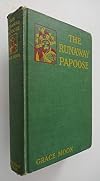
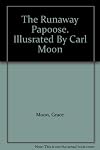
The Runaway Papoose
by Grace Moon
On This Page
Tags
Recommendations












Member Reviews
One of the six Newbery Honor Books chosen in 1929 - the others include: The Pigtail of Ah Lee Ben Loo, Millions of Cats, The Boy Who Was, Clearing Weather, and Tod of the Fens - this story of a little Native American girl and her adventures in the southwestern desert, after she becomes separated from her family, really shows its age. Written in the deliberately "clunky" style that Beverly Slapin lampoons in her essay, "How to Write a Historical Young Adult Novel With an Indian Theme (For Fun and Profit)," it is chock-a-block with odd word choices and language patterns, from the "fear thoughts" that its young heroine, Nah-tee, has, to the "laugh things" (or, more precisely, the not "laugh things") that she experiences, and the "shelter show more places" in which she lives. I can only assume that the almost constant oddity of the language utilized here indicates Moon's desire to create an "authentic" narrative.
Grace and Carl Moon were apparently well-known anthropologists in their day, and I have to admit that the portrait painted of native life in the American southwest - both Navajo and Pueblo (which Pueblo is never really specified) is far more sympathetic than I would have expected. Although I'm no expert, certain things "felt right" to me, from the evident respect all the children - Nah-tee, Moyo, Chi-weé - were taught to show for their elders, to the use of storytelling as a teaching tool, when Nah-tee and Moyo are briefly cared for by the elderly keeper of the canyon. Someone else, in a book-club discussion, described the Moons as "well intentioned," and I think that was probably true. I even considered giving this two stars, since I did find myself getting involved in the story, towards the end. But I just couldn't get past the stereotypical language, and the way it "othered" the characters and their story.
Definitely one that Newbery completists will want to check out, but I don't think it will have much interest for the contemporary child, and that's probably for the best. show less
Grace and Carl Moon were apparently well-known anthropologists in their day, and I have to admit that the portrait painted of native life in the American southwest - both Navajo and Pueblo (which Pueblo is never really specified) is far more sympathetic than I would have expected. Although I'm no expert, certain things "felt right" to me, from the evident respect all the children - Nah-tee, Moyo, Chi-weé - were taught to show for their elders, to the use of storytelling as a teaching tool, when Nah-tee and Moyo are briefly cared for by the elderly keeper of the canyon. Someone else, in a book-club discussion, described the Moons as "well intentioned," and I think that was probably true. I even considered giving this two stars, since I did find myself getting involved in the story, towards the end. But I just couldn't get past the stereotypical language, and the way it "othered" the characters and their story.
Definitely one that Newbery completists will want to check out, but I don't think it will have much interest for the contemporary child, and that's probably for the best. show less
I don’t think the story was that bad… but the writing style put me off so horrendously that I couldn't keep my head in it. I may have gotten a little too spoiled reading earlier Newbery books with fluid writing, and I forgot when other types of stiff styles were kosher. Stale, very stale.
A lot of that seemed to be due to weird grammar choices more than anything else. There was an enormous of amount of super long sentences and “-“ to keep them going. I thought my iffy English skill set made me a supporter of weird, run-on sentences, but apparently I have my limits. I can only throw my hands up and cry, "too dated!"
Other than that, I thought the story could have been sweet or empowering. The plot wasn’t inherently bad, and it show more was one of the stronger pro-American Indian Newberies. But, yeesh. That writing style. Runaway indeed. show less
A lot of that seemed to be due to weird grammar choices more than anything else. There was an enormous of amount of super long sentences and “-“ to keep them going. I thought my iffy English skill set made me a supporter of weird, run-on sentences, but apparently I have my limits. I can only throw my hands up and cry, "too dated!"
Other than that, I thought the story could have been sweet or empowering. The plot wasn’t inherently bad, and it show more was one of the stronger pro-American Indian Newberies. But, yeesh. That writing style. Runaway indeed. show less
A small Navajo girl gets frightened by a fight her father has with a stranger and inadvertently runs away and can't find her way home. She does find a kindly shepherd boy, who helps her find her way back to her family, but not without all sorts of adventures and mishaps along the way. A fun little story, with a nice mystery as well.
Ratings
Members
- Recently Added By
Lists

Newbery Honor Books By Year - I - 1922-1980
199 works; 3 members

Best Newbery Honor Books
257 works; 30 members

Books Read in 2023
5,638 works; 147 members
Author Information

25+ Works 111 Members
All Editions
Awards and Honors
Awards
Common Knowledge
- Original publication date
- 1928
Classifications
Statistics
- Members
- 29
- Popularity
- 955,796
- Reviews
- 3
- Rating
- (3.00)
- Languages
- English
- Media
- Paper
- ISBNs
- 1
- ASINs
- 2