On This Page
Description
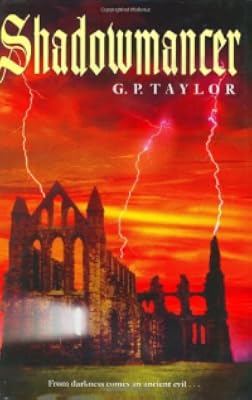
When Obadiah Demurral, the power-hungry Vicar of Thorpe, attempts to become a god by dabbling in magic, Raphah (who has come from Africa to get back the artifact stolen from his Temple and sold to Demurral) joins forces with Kate and Thomas to stop him.Tags
Recommendations









Member Reviews
Described by one critic as "the thinking Christian’s response to Philip Pullman," G.P. Taylor's Shadowmancer was one of the most keenly anticipated children's titles of 2004. Sadly, it utterly fails to live up to its billing...
It is the story of evil Parson Obadiah Demurrel, who decides that instead of worshiping God he will become a god. To that end he has stolen the Keruvim, an ancient African artefact of great power, which is pursued by the young spiritual warrior Raphah, intent on returning it to its rightful keepers. Kate and Thomas, two young children from Demurrel’s village, find their fates tied to Raphah, as does the smuggler Jacob Crane.
While the story begins promisingly enough, with the implication that it is man that is show more the source of religious corruption and injustice as opposed to God (Riathamus in the story), in clear opposition to Pullman’s cosmology of a corrupt god (the Authority), the book quickly devolves into a cliched sermon, parading the usual bogeymen feared by conservative Christians. Tarot cards and witchcraft are condemned, as is practically every folk practice or belief. The character Raphah reflects at one point that it is absurd that "civilized" people who believe in Riathamus should also believe in woodland spirits.
Predictably, Demurrel turns out not simply to be motivated by human evil, but is being controlled and manipulated by Pyratheon, a devil-figure who claims: "I am the one behind every deity that is not him. I am whatever distraction I could think of to call myself and get your kind to worship me." The implications of such statements for religious tolerance are chilling: only those who worship Riathamus (fill in the name of any real-life god/religion here) believe in the true god, and other faiths and gods are really the devil? I'm not sure what part of that would be considered "thoughtful..." show less
It is the story of evil Parson Obadiah Demurrel, who decides that instead of worshiping God he will become a god. To that end he has stolen the Keruvim, an ancient African artefact of great power, which is pursued by the young spiritual warrior Raphah, intent on returning it to its rightful keepers. Kate and Thomas, two young children from Demurrel’s village, find their fates tied to Raphah, as does the smuggler Jacob Crane.
While the story begins promisingly enough, with the implication that it is man that is show more the source of religious corruption and injustice as opposed to God (Riathamus in the story), in clear opposition to Pullman’s cosmology of a corrupt god (the Authority), the book quickly devolves into a cliched sermon, parading the usual bogeymen feared by conservative Christians. Tarot cards and witchcraft are condemned, as is practically every folk practice or belief. The character Raphah reflects at one point that it is absurd that "civilized" people who believe in Riathamus should also believe in woodland spirits.
Predictably, Demurrel turns out not simply to be motivated by human evil, but is being controlled and manipulated by Pyratheon, a devil-figure who claims: "I am the one behind every deity that is not him. I am whatever distraction I could think of to call myself and get your kind to worship me." The implications of such statements for religious tolerance are chilling: only those who worship Riathamus (fill in the name of any real-life god/religion here) believe in the true god, and other faiths and gods are really the devil? I'm not sure what part of that would be considered "thoughtful..." show less
Not a great book, but certainly a fun one. Taylor brings just a little wonder and mystery into the English landscape in this book, which is ultimately a battle between heaven and hell with three young people in the middle. It is rather fun to see how he weaves some rather deep theology into a story without making it overly religious.
For those looking for a decent Christian Fantasy novel, this would be a good choice. Parents should watch the theology a little, since I think Taylor makes a couple of slips in that area, but generally it would be a good way to introduce some spiritual ideas to the kids.
For those looking for a decent Christian Fantasy novel, this would be a good choice. Parents should watch the theology a little, since I think Taylor makes a couple of slips in that area, but generally it would be a good way to introduce some spiritual ideas to the kids.
In Shadowmancer, by G.P. Taylor, two English youths, Thomas Barrick and Kate Coglan, assist a visitor from far off named Raphah in stealing the much coveted Keruvim from the powerful vicar Demmural. The Keruvim is a device that can give the one possessing it ultimate power over all dimensions of time and space. The three are on the run and must face the treacherous obstacles thrown in their path by the unrelenting vicar, who'll conjure up all forms of terror to regain that which will make him all powerful. This story starts off well enough and is high drama in explaining how a central character arrives on scene to reclaim a religious object stolen from his land. But the reliable theme of good vs. evil gets transformed into a show more heavy-handed parable of Christian elements that detract from a rollicking chase of the story's three main characters through the English countryside. Additionally, the reader will need a scorecard to keep track of all the vile, iniquitous creatures the author conveniently places in the way of the young protagonists throughout the story. This book could be used by high school English teachers as one possible selection students can read and summarize for a book report in the genre of fantasy. show less
This started off as a self published book that was taken up by mainstream publishers. Unfortunately, it reads like something that hasn't had proper editing. There were things that threw me from page 1 such as a character carrying a 'case' which turned out to be a box, when I'd pictured a briefcase or some such. Dense pieces of description that aren't required and infelicitous mixtures of tenses, and bits where you think he's talking about one character in a scene and it turns out to be the other. There are strong ideas and some powerful set pieces such as when the evil vicar tricks the previous incumbent out of the living in a flashback, but it all reads like a first draft that should have had a lot more work done on it.
I would not recommend this book. On one level I thought that the plotting was clumsy, convoluted and hurried. Furthermore at this level, I also found the depiction of the characters to be unconvincing and shallow. At a deeper level, I was disconcerted by the treatment of the subject matter. I think that the mix of reality and allegory is unhelpful and counter productive.
This book failed to get and hold my attention. It's not the religious underpinings, it's the wildly inconsistent style. The action starts quickly but it's so poorly described to become both boring and confusing!
I read the sequel to this book, Wormwood, before I read this one. I loved Wormwood, it was one of the few books I would describe as being "cool", it was full of action and just a really fun book to read. So I was expecting the same from Shadowmancer, obviously. But just didn't get it. I got about a third of the way through it before I gave up. I don't like to give up on books, but I felt I was just wasting my time with the book. And the Christian theme (which was much heavier in Shadowmancer than it was in Wormwood) really put me off. Maybe the last two thirds of this book is better than the first, and maybe one day I'll give it another chance, but really, there are a whole lot of better books out there than this one.
Members
- Recently Added By
Lists

Young Adult Book Recs From My Home Library
13 works; 2 members

...read all, pay nowt (Books set in Yorkshire)
86 works; 14 members
Author Information

28 Works 4,316 Members
G. P. Taylor has spent his life pursuing the secrets of the universe. He has had a multifaceted career spanning the music industry and law enforcement. Today, he is the vicar of Cloughton and lives near Whitby on the Yorkshire coast, a countryside of cliffs and moors, richly steeped in history and folklore
Some Editions
Awards and Honors
Awards
Distinctions
Series

Work Relationships
Is contained in
Common Knowledge
- Canonical title*
- Der Schattenbeschwörer
- Original title
- Shadowmancer
- Original publication date
- 2003
- People/Characters
- Thomas Barrick; Kate Coglan; Raphah; Demmural; Beadle; Pyratheon (show all 13); Rueben Wayfoot; Isabella Wayfoot; Jacob Crane; Abram Rickards; Lord Finnesterre; Captain Farrell; Mrs Landas
- Important places
- Yorkshire, England, UK; The Vicarage, Thorpe, Yorkshire, England, UK (fictional); Boggle Mill, Thorpe, Yorkshire, England, UK (fictional); Stregoika Manor, Thorpe, Yorkshire, England, UK (fictional); Whitby, North Yorkshire, England, UK; York, North Yorkshire, England, UK (show all 7); The Alum Mines, Thorpe, Yorkshire, England, UK (fictional)
- Dedication
- To Kathy, Hannah, Abigail & Lydia, the golden girls - it wouldn't have been possible without you & Riathamus
- First words
- Foreword: The people places and spirits you will read about in Shadowmancer are drawn from the Yorkshire coastline.
It was a still October night. - Last words
- (Click to show. Warning: May contain spoilers.)Beneath the cry of the seagulls could faintly be heard the singing of the Seloth...
- Original language*
- Englisch
*Some information comes from Common Knowledge in other languages. Click "Edit" for more information.
Classifications
- Genres
- Fiction and Literature, Fantasy, Christian Fiction, Teen
- DDC/MDS
- 823.92 — Literature & rhetoric English & Old English literatures English fiction 1900- 2000-
- LCC
- PZ7 .T2134 .S — Language and Literature Fiction and juvenile belles lettres Fiction and juvenile belles lettres Juvenile belles lettres
- BISAC
Statistics
- Members
- 1,787
- Popularity
- 12,222
- Reviews
- 16
- Rating
- (2.71)
- Languages
- 14 — Czech, Danish, Dutch, English, Finnish, German, Hungarian, Italian, Norwegian (Bokmål), Polish, Spanish, Swedish, Thai, Portuguese (Portugal)
- Media
- Paper, Audiobook, Ebook
- ISBNs
- 53
- ASINs
- 15