On This Page
Description
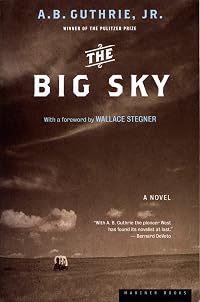
Originally published more than fifty years ago, The Big Sky is the first of A. B. Guthrie's epic adventure novels of America's vast frontier. The Big Sky introduces Boone Caudill, Jim Deakins, and Dick Summers, three of the most memorable characters in western American literature. Traveling the Missouri River from St. Louis to the Rockies, these frontiersmen live as trappers, traders, guides, and explorers. The story centers on Caudill, a young Kentuckian driven by a raging hunger for life show more and a longing for the blue sky and brown earth of big, wild places. Caught up in the freedom and savagery of the wilderness, Caudill becomes an untamed mountain man whom only the beautiful daughter of a Blackfoot chief dares to love. With The Big Sky, Guthrie gives us an unforgettable portrait of a spacious land and a unique way of life. show lessTags
Recommendations














Member Reviews
"This was the way to live, free and easy, with time all a man's own and none to say no to him." (pg. 201)
The Big Sky is a book that demands to be taken slow. Prose and plot have a loping gait that mirrors the mountain men it brings to life, and if this seems irregular to a modern reader conditioned to pace and pandering, it is all the better for that. Taken slow, the book grounds the reader, and its quiet confidence vindicates author A. B. Guthrie's singular approach.
The prose is excellent – Hemingway was an admirer – and a good thing too, for the book must succeed or fail based on its evocation of the untapped American West of the 1830s and 40s, the 'big sky' of the title. Guthrie paints these scenes astonishingly well, evoking not show more only the sights and sounds and the harsh beauty of the land, but the sense of freedom it brings to the main characters, and the sense of loss and wanderlust that serve as counterpoint to that freedom. The sentences are simple but rich, in the manner of the afore-mentioned Hemingway, providing all the room Guthrie needs to let his mountain men, and the reader, roam at will. The prose, like the western land it evokes, is "country a man could get his breath in" (pg. 21).
But the book is more than just weather and landscape and country; these fine traits are allied to strong characterization and many well-taken dramatic scenes. The mechanics of the storytelling are quietly strong, with every scene and setting providing texture to Guthrie's purpose without being consciously literary. All three of the main characters – Boone Caudill, Jim Deakins and Dick Summers – stay with you, and even those readers who don't want to engage with the deeper textures of the story will still enjoy their adventure.
That said, it is the American West itself which stirs the reader most profoundly, and when it is said of the solitary, taciturn Boone Caudill that it was "as if he talked to the country for company, and the country talked to him" (pg. 185), we can believe it, for the reader is experiencing that too. "There was the sky above, blue as paint, and the brown earth rolling underneath, and himself between them with a free, wild feeling in his chest" (pg. 123). This book shines with my soul. show less
The Big Sky is a book that demands to be taken slow. Prose and plot have a loping gait that mirrors the mountain men it brings to life, and if this seems irregular to a modern reader conditioned to pace and pandering, it is all the better for that. Taken slow, the book grounds the reader, and its quiet confidence vindicates author A. B. Guthrie's singular approach.
The prose is excellent – Hemingway was an admirer – and a good thing too, for the book must succeed or fail based on its evocation of the untapped American West of the 1830s and 40s, the 'big sky' of the title. Guthrie paints these scenes astonishingly well, evoking not show more only the sights and sounds and the harsh beauty of the land, but the sense of freedom it brings to the main characters, and the sense of loss and wanderlust that serve as counterpoint to that freedom. The sentences are simple but rich, in the manner of the afore-mentioned Hemingway, providing all the room Guthrie needs to let his mountain men, and the reader, roam at will. The prose, like the western land it evokes, is "country a man could get his breath in" (pg. 21).
But the book is more than just weather and landscape and country; these fine traits are allied to strong characterization and many well-taken dramatic scenes. The mechanics of the storytelling are quietly strong, with every scene and setting providing texture to Guthrie's purpose without being consciously literary. All three of the main characters – Boone Caudill, Jim Deakins and Dick Summers – stay with you, and even those readers who don't want to engage with the deeper textures of the story will still enjoy their adventure.
That said, it is the American West itself which stirs the reader most profoundly, and when it is said of the solitary, taciturn Boone Caudill that it was "as if he talked to the country for company, and the country talked to him" (pg. 185), we can believe it, for the reader is experiencing that too. "There was the sky above, blue as paint, and the brown earth rolling underneath, and himself between them with a free, wild feeling in his chest" (pg. 123). This book shines with my soul. show less
"By day Boone could get himself on a hill and see forever, until the sky came down and shut off his eye. There was the sky above, blue as paint, and the brown earth rolling underneath, and himself between them with a free, wild feeling in his chest, as if they were the ceiling and floor of a home that was all his own."
First published in 1947 and set between 1830 and 1843, A.B. Guthrie's classic novel of mountain men and the opening of the west to white settlement is both a tribute to the breathtaking beauty of the vast northern plains and Rocky Mountains, and a eulogy for the territory in its unspoiled state. His descriptions of the landscape are like the best of paintings; they evoke the images, the light, the sounds, and the feeling, show more the precious loneliness of the landscape.
Guthrie also creates memorable characters: Boone Caudill and Jim Deakins and Dick Summers will live forever in my mental cast of favorites. These are not completely idealized heroes, although they do lean in that direction. They are tough and, to greater or lesser degrees, stone-hearted. But they each have redeeming qualities to balance out the brutal self-determination. Boone, too quick to judge, is nonetheless deeply loyal and unflinchingly honest. Jim is optimistic and warm, never underestimating the risks inherent in the adventures to which he is inexorably drawn. Dick, the father figure (Boone's own callous and vicious father failing to serve), is the quintessential hunter: he understands the land, its human occupants, and the creatures that roam her vast expanses.
Sexism and racism run deep in the narrative; it is a product of its time. And yet you get the sense that Guthrie knew things would change, that they must change. You can also sense that he grieves the invasion of white civilization into a territory that was never perfect, never fully peaceful or easy, but untainted and beautiful in the simplicity of its seasons. show less
First published in 1947 and set between 1830 and 1843, A.B. Guthrie's classic novel of mountain men and the opening of the west to white settlement is both a tribute to the breathtaking beauty of the vast northern plains and Rocky Mountains, and a eulogy for the territory in its unspoiled state. His descriptions of the landscape are like the best of paintings; they evoke the images, the light, the sounds, and the feeling, show more the precious loneliness of the landscape.
Guthrie also creates memorable characters: Boone Caudill and Jim Deakins and Dick Summers will live forever in my mental cast of favorites. These are not completely idealized heroes, although they do lean in that direction. They are tough and, to greater or lesser degrees, stone-hearted. But they each have redeeming qualities to balance out the brutal self-determination. Boone, too quick to judge, is nonetheless deeply loyal and unflinchingly honest. Jim is optimistic and warm, never underestimating the risks inherent in the adventures to which he is inexorably drawn. Dick, the father figure (Boone's own callous and vicious father failing to serve), is the quintessential hunter: he understands the land, its human occupants, and the creatures that roam her vast expanses.
Sexism and racism run deep in the narrative; it is a product of its time. And yet you get the sense that Guthrie knew things would change, that they must change. You can also sense that he grieves the invasion of white civilization into a territory that was never perfect, never fully peaceful or easy, but untainted and beautiful in the simplicity of its seasons. show less
This is a wonderful book full of winds, savagery, unsullied nature, friendship, hard men, and loss. When I was young there were men who sat beneath a tree at the bottom of our garden, watching the world go by. WW2 had left them to fend for themselves. Some of them were hard men: men who said little, who had something about the set of jaw and lips that signaled pain, loss, and the toll of life. Set in the mid-1800s, Guthrie's hard men are mountain men; who are quiet, keenly observant, more at ease in open space than indoors, men who have known hardship, and men who remain calm in crisis.
The narrative arc follows Boone who is bold, too quick to anger, and instinctive; not just in his search for a better life, but in his single-minded show more quest for the girl/woman, Teal Eye. But living instinctively has its difficulties. Guthrie writes with a sparse precision and his use of backwoods dialogue is masterful, not only in its economy of expression but in its richness:
The narrative arc follows Boone who is bold, too quick to anger, and instinctive; not just in his search for a better life, but in his single-minded show more quest for the girl/woman, Teal Eye. But living instinctively has its difficulties. Guthrie writes with a sparse precision and his use of backwoods dialogue is masterful, not only in its economy of expression but in its richness:
A dog that was all hair and bark ran from behind the house and yipped at Blue. Blue winked one eye and let a low growl out of his Phlegmy throat, and the small dog backed up, still yipping. Then he lifted his leg against a bush and scratched the ground afterwards and trotted away with his head held high as if he had made a good out of it. p 370.The Big Sky has rhythms where we rest between passages of extreme tension, such as the theft of a horse at night, with closely observed evocations of landscape and the natural world inhabiting it. If the allegorical trajectory of the novel is the steady progression of Boone becoming part of that world as theystruggle up-stream. it is also the steady destruction of it and the over-riding sense of inevitable loss as Boone staggers towards internal and external confrontation at the very end. Summers shows us another side as he faulters in old-age. In many respects this is such a well observed book that I can also read it as the struggle today between the vanishing values of the analogue world as they are subsumed by the digital.
Summers couldn't see anything among the willows, not so much as a branch bent out of shape or the grass trampled where a man might have gone through, but he knew the Sioux were there. He brought his head back, still slowly, and turned about, to see an Indian screened in the brush only an arm's length away. Two black stripes ran down the Indian's cheeks. They pulled downward as the Indian caught his movement. There was one still instant, - a flash of seeing, in which nothing moved or sounded - and then the Indian jerked up his battle axe. (p. 119)show less
[b:The Big Sky|202035|The Big Sky (The Big Sky, #1)|A.B. Guthrie Jr.|https://i.gr-assets.com/images/S/compressed.photo.goodreads.com/books/1441429378l/202035._SY75_.jpg|1461085] is the first in A.B. Guthrie’s series of novels about the settling of the American West. It is the story of three men, Boone Caudill, Jim Deakins, and Dick Summers, each of whom braves the unknown and difficult life in the cold mountains west of civilization, for his own unique reasons. It is a portrait of what a mountain man was and what it took to be such an adventurer.
There is nothing sugar-coated in this book. It is often raw and coarse and startling.
They were a heap better than squaw meat, which men had been known to butcher and eat, probably after show more bedding with the squaws first.
This is a hard, cruel and unforgiving life, and the men who live it are sometimes little more than animals. Boone Caudill, fleeing an already hard and abusive life with his father, becomes a kind of savage survivalist. Dick Summers, in many ways the most skilled and intuitive of the three men, is only half a mountain man. He has altered his life, but not his soul. He likes to get to town and doesn’t mind the idea of farming, and he is the only one who still manages to fit into the world of white men.
One of the main characters of The Big Sky is the West itself. Guthrie paints it the way Ansel Adams photographed it, large and beautiful and powerful.
From the top Boone could see forever and ever, nearly any way he looked. It was open country, bald and open, without an end. It spread away flat now and then rolling, going on clear to the sky. A man wouldn’t think the whole world was so much. It made the heart come up. It made a man little and still big, like a king looking out.
This is God’s country, but even the men who love it and choose it, question what kind of God rules in such a wilderness. Jim Deakins contemplates his relationship with God and what God expects from him fairly frequently, and I particularly enjoyed his thoughts, because I think having such close connections to nature, but also experiencing its cruelties up close, would raise doubts and wonder.
These men are like the wildness of the country they inhabit, they are being worn away, being lost, becoming the last of their kind. The country is on the cusp of westward expansion, the buffalo are being slaughtered into extinction, Greeley is about to urge young men to go west, and the young men are going to take young women with them and build and plow.
It was strange about time; it slipped under a man like quiet water, soft and unheeded but taking a part of him with every drop--a little quickness of the muscles, a little sharpness of the eye, a little of his youngness, until by and by he found it had taken the best of him almost unbeknownst.
A historical picture of life in 1830s Montana, The Big Sky is also about change--the change in the country and the change in the people who populate it. There is no room for the Indians in the society that is coming, and there is no room for the mountain men either. Both are dying breeds. Both are living on borrowed time.
I must note that the portrayal of the Indians in this book seems remarkably accurate to me. They are seen as both victim and aggressor, but neither the noble savage nor the devil’s spawn. The attitude of the white men toward them is primarily one of exploitation or dread, and only a few, like Boone and Summers, come to really know anything about them individually. There is a graphic chapter that deals with the devastating effects of smallpox on the Indian population, that is one I will find it hard to ever forget.
Wallace Stegner wrote the foreward to the volume I was reading. If you would truly like to recognize the importance and meaning of this novel, you need do nothing more than read it.
Boone Caudill is “both mountain man and myth, both individual and archetype, which means that the record of his violent life is both credible and exhilarating.” Don’t think anyone could have said it better than that. show less
There is nothing sugar-coated in this book. It is often raw and coarse and startling.
They were a heap better than squaw meat, which men had been known to butcher and eat, probably after show more bedding with the squaws first.
This is a hard, cruel and unforgiving life, and the men who live it are sometimes little more than animals. Boone Caudill, fleeing an already hard and abusive life with his father, becomes a kind of savage survivalist. Dick Summers, in many ways the most skilled and intuitive of the three men, is only half a mountain man. He has altered his life, but not his soul. He likes to get to town and doesn’t mind the idea of farming, and he is the only one who still manages to fit into the world of white men.
One of the main characters of The Big Sky is the West itself. Guthrie paints it the way Ansel Adams photographed it, large and beautiful and powerful.
From the top Boone could see forever and ever, nearly any way he looked. It was open country, bald and open, without an end. It spread away flat now and then rolling, going on clear to the sky. A man wouldn’t think the whole world was so much. It made the heart come up. It made a man little and still big, like a king looking out.
This is God’s country, but even the men who love it and choose it, question what kind of God rules in such a wilderness. Jim Deakins contemplates his relationship with God and what God expects from him fairly frequently, and I particularly enjoyed his thoughts, because I think having such close connections to nature, but also experiencing its cruelties up close, would raise doubts and wonder.
These men are like the wildness of the country they inhabit, they are being worn away, being lost, becoming the last of their kind. The country is on the cusp of westward expansion, the buffalo are being slaughtered into extinction, Greeley is about to urge young men to go west, and the young men are going to take young women with them and build and plow.
It was strange about time; it slipped under a man like quiet water, soft and unheeded but taking a part of him with every drop--a little quickness of the muscles, a little sharpness of the eye, a little of his youngness, until by and by he found it had taken the best of him almost unbeknownst.
A historical picture of life in 1830s Montana, The Big Sky is also about change--the change in the country and the change in the people who populate it. There is no room for the Indians in the society that is coming, and there is no room for the mountain men either. Both are dying breeds. Both are living on borrowed time.
I must note that the portrayal of the Indians in this book seems remarkably accurate to me. They are seen as both victim and aggressor, but neither the noble savage nor the devil’s spawn. The attitude of the white men toward them is primarily one of exploitation or dread, and only a few, like Boone and Summers, come to really know anything about them individually. There is a graphic chapter that deals with the devastating effects of smallpox on the Indian population, that is one I will find it hard to ever forget.
Wallace Stegner wrote the foreward to the volume I was reading. If you would truly like to recognize the importance and meaning of this novel, you need do nothing more than read it.
Boone Caudill is “both mountain man and myth, both individual and archetype, which means that the record of his violent life is both credible and exhilarating.” Don’t think anyone could have said it better than that. show less
My father read this book in the 1960s when he was serving as a fire lookout for the Forest Service. We have often discussed what it was like to live in the lookout tower for three months at a time. He told me this book really helped him survive that first time he did this, and that for him it was "the Great American Novel." It is a very powerful book about a mountain man, Boone Caudill (seriously, is there a better mountain man name than that? It is the ur-mountain man name). It is not a happy book, but it is a memorable look at a short time in American history (pre-Civil War in the American West) when men could actually decide to be mountain men and trap beaver for a living. Much of the plot concerns the ways in which Native Americans show more and white people met, fought, and sometimes cooperated, and the differences and similarities in their lifestyles. The dialect is really interesting, a far cry from Mark Twain, lots of profanity and colorful expressions. It rang very true to me, though I am no scholar of the Old West. This was also a tragedy, in the Greek sense, in that you could see the trajectory of the hero and know from the get-go that it was not going to end happily. I can see why my father loved it so much when he was a young man coping with isolation in the wilderness that was very different but not entirely dissimilar from the lifestyle described in the book. I am very happy that I read it. It should be more widely known, but I think it is one of those books that was written in the mid-20th century that was famous in its day and has been at least partly forgotten. This is a shame. Read this book, you won't soon forget it. show less
Originally published in 1947, The Big Sky by A. B. Guthrie is the first in a limited series that the author wrote about the taming of western America. This first book deals with the mountain man, a unique breed that were the first white men to come to the western mountains trapping beaver and staying to live the free lifestyle. The story follows the life of Boone Cauldill who starts off as a young runaway from a farm in Kentucky and grows to be a weathered, veteran mountain man, wise in the ways of both the country and the Indians that reside there.
Spanning the years of 1830 to 1843, the book is full of the adventures of Boone, his friend Jim Deacon and their mentor Dick Summers. Boone grows to admire Summers a great deal but although show more Summers can see that this way of life is ending, Boone has no desire to be anything but a trapper and hunter. He dismisses any idea that the country could change and that settlers will come. Although one can’t help but root for him, Boon Caldill is far from perfect. Much like the father that he ran away from, he is hot tempered and stubborn. He never learned how to express his feelings and he tends to act without thinking about the consequences.
The Big Sky is an epic adventure novel, set in the Rocky Mountains of Montana, Idaho and Wyoming an area that the author knows wells and obviously loved. This is a skillful depiction of how the west was able to capture the hearts of these independent men whose time was so colorful yet short-lived. While not setting out to romanticize these men, nevertheless, reading of them makes one yearn to experience that lifestyle, if only for a short time. Beautifully written and full of lyrical descriptions, The Big Sky recreates the savagery and splendor of this untouched frontier. show less
Spanning the years of 1830 to 1843, the book is full of the adventures of Boone, his friend Jim Deacon and their mentor Dick Summers. Boone grows to admire Summers a great deal but although show more Summers can see that this way of life is ending, Boone has no desire to be anything but a trapper and hunter. He dismisses any idea that the country could change and that settlers will come. Although one can’t help but root for him, Boon Caldill is far from perfect. Much like the father that he ran away from, he is hot tempered and stubborn. He never learned how to express his feelings and he tends to act without thinking about the consequences.
The Big Sky is an epic adventure novel, set in the Rocky Mountains of Montana, Idaho and Wyoming an area that the author knows wells and obviously loved. This is a skillful depiction of how the west was able to capture the hearts of these independent men whose time was so colorful yet short-lived. While not setting out to romanticize these men, nevertheless, reading of them makes one yearn to experience that lifestyle, if only for a short time. Beautifully written and full of lyrical descriptions, The Big Sky recreates the savagery and splendor of this untouched frontier. show less
The Big Sky is the first in a series of great Western novels by A.B. Guthrie. The story begins in 1830 as young Boone Caudill escapes his Kentucky home for the plains and mountains of the west. He meets up with Jim Deakins, a pleasant country philosopher, early on his journey and finally the experienced mountain man Dick Summers on the keelboat trip up the Missouri.
I enjoyed Deakins' theological disquisitions. "You can't beat God for bein' picky. No, sir. If he catches you playin' cards or sayin' one swear word...it's to hell with you forever and ever...Even thinkin' is mighty dangerous. As a man thinketh, that's how he is, and to hell with him ag'in. Why you reckon he gave us a thinker then?...God is some busybody."
Guthrie takes us show more up the Missouri, a slow fight all the way, across the plains, into the mountains and back. He creates for the reader the palpable sense of the openness and wildness of the West. Yet the book steps back from fully romanticizing the end of the mountain man era. The story is often disturbing, not the least in Boone Caudill's quick and often brutal ways.
Highest recommendation for anyone interested in the American West. show less
I enjoyed Deakins' theological disquisitions. "You can't beat God for bein' picky. No, sir. If he catches you playin' cards or sayin' one swear word...it's to hell with you forever and ever...Even thinkin' is mighty dangerous. As a man thinketh, that's how he is, and to hell with him ag'in. Why you reckon he gave us a thinker then?...God is some busybody."
Guthrie takes us show more up the Missouri, a slow fight all the way, across the plains, into the mountains and back. He creates for the reader the palpable sense of the openness and wildness of the West. Yet the book steps back from fully romanticizing the end of the mountain man era. The story is often disturbing, not the least in Boone Caudill's quick and often brutal ways.
Highest recommendation for anyone interested in the American West. show less
Members
- Recently Added By
Lists

Best Historical Fiction
620 works; 257 members

Set in the Pacific Northwest
136 works; 7 members

The Joe Rogan Experience Library
254 works; 3 members

25 Best Western Novels (Western Writers of America)
25 works; 1 member
Author Information

42+ Works 3,163 Members
A. B. Guthrie, Jr., is one of America's most celebrated writers of western literature. He received the 1950 Pulitzer Prize in fiction for "The Way West". Guthrie died in 1991. (Bowker Author Biography)
Some Editions
Awards and Honors
Distinctions
Series

Belongs to Publisher Series
Work Relationships
Has the adaptation
Common Knowledge
- Original publication date
- 1947
- People/Characters
- Boone Caudill; Dick Summers; Jim Deakins; Teal Eye
- Important places
- Montana, USA
- Related movies
- The Big Sky (1952 | IMDb)
- Dedication
- To my father
- First words
- Serena Caudill heard a step outside and then the squeak of the cabin door and knew that John was coming in.
- Last words
- (Click to show. Warning: May contain spoilers.)His woman had gone to bed, she tired so easy these days.
Classifications
- Genres
- Fiction and Literature, General Fiction, Historical Fiction
- DDC/MDS
- 813.52 — Literature & rhetoric American literature in English American fiction in English 1900-1999 1900-1945
- LCC
- PS3513 .U855 .B53 — Language and Literature American literature American literature Individual authors 1900-1960
- BISAC
Statistics
- Members
- 1,261
- Popularity
- 19,486
- Reviews
- 28
- Rating
- (4.10)
- Languages
- 7 — English, Finnish, French, German, Italian, Spanish, Portuguese (Portugal)
- Media
- Paper, Audiobook, Ebook
- ISBNs
- 31
- UPCs
- 3
- ASINs
- 43