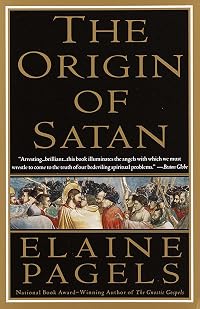
The Origin of Satan: How Christians Demonized Jews, Pagans, and Heretics
by Elaine Pagels
On This Page
Description
From the National Book Award-winning and National Book Critics Circle Award-winning author of The Gnostic Gospels comes a dramatic interpretation of Satan and his role on the Christian tradition."Arresting...brilliant...this book illuminates the angels with which we must wrestle to come to the truth of our bedeviling spritual problems." —The Boston Globe
With magisterial learning and the elan of a born storyteller, Pagels turns Satan’s story into an audacious exploration of show more Christianity’s shadow side, in which the gospel of love gives way to irrational hatreds that continue to haunt Christians and non-Christians alike. show less
Tags
Recommendations

























Member Recommendations

Member Reviews
Once again Pagels provides an incisive and readable overview of the origin of the Bible and the historical context shaping both Christian & Jewish identities, and the Catholic Church as an institution. This title focuses on how the concept of Satan emerged from the story of Job (the angel "challenging" God's faith in his servant, Job), evolving from a "loyal obstacle" to a representation of evil. Pagel's findings are that the evolution had more to do with social developments than theological: groups of people vilified their enemies by associating them with Satan. Somewhat counterintuitively, this trend was followed primarily by Jews against other Jews, not against non-Jews, as they struggle to define / defend themselves and their faith show more in the face of increasing repression.
Pagels' analysis highlights the war between Jews and Roman authorities (especially the siege of Jerusalem) as the key contextual event in which to place an understanding of the Bible. This war and its aftermath motivated the very writing of the Bible, and defined who would be around to write it. Interestingly, this event is also pretty much irrelevant to understanding Jesus, since he died 30-35 years before -- unless by "understanding Jesus" is meant the portrait put forth by different groups claiming him as their own, in which case this is merely another way of saying "understanding the Bible" (and helps explain the rift between heretics such as the gnostics and the Church).
Also interesting: Pagels seems to have come to this topic / question in part out of her grieving for her husband, who died in a hiking accident. That Pagels would acknowledge this personal motive in her introduction marks out the perspective she uses in all her popular writings: a critical and scholarly examination undertaken by a believer. I respect her scholarship and thesis all the more for this perspective. show less
Pagels' analysis highlights the war between Jews and Roman authorities (especially the siege of Jerusalem) as the key contextual event in which to place an understanding of the Bible. This war and its aftermath motivated the very writing of the Bible, and defined who would be around to write it. Interestingly, this event is also pretty much irrelevant to understanding Jesus, since he died 30-35 years before -- unless by "understanding Jesus" is meant the portrait put forth by different groups claiming him as their own, in which case this is merely another way of saying "understanding the Bible" (and helps explain the rift between heretics such as the gnostics and the Church).
Also interesting: Pagels seems to have come to this topic / question in part out of her grieving for her husband, who died in a hiking accident. That Pagels would acknowledge this personal motive in her introduction marks out the perspective she uses in all her popular writings: a critical and scholarly examination undertaken by a believer. I respect her scholarship and thesis all the more for this perspective. show less
Elaine Pagels' lucid history of the social construction of Satan is not only a wealth of historical information but also a source of important insights into the demonization of "intimate enemies" that has marked the history of Christianity. Pagels writes that she began with the assumption that Christian discourse about invisible beings, including Satan and other angels, had as its primary purpose what Martin Buber called the "moralizing" of the natural universe. She discovered that it had far more to do with social relations among particular persons, and that discovery informs the entire book. She traces the development of Satan in the Jewish community from a sort of roving agent acting on God's behalf-always obstructing but not always show more evil-to an increasingly evil force identified more and more with intimate enemies, members of one's own community with whom one is in conflict. That trend toward demonization of portions of the Jewish community intensified with the emergence of Christianity and became the basis for demonization of heretics and centuries of anti-Semitism. This is an informative, beautifully written book, an excellent illustration of how careful historical research can illuminate questions of more than passing historical interest. show less
Elaine Pagels' Origin of Satan has surprisingly little to say about Satan as such. She notes in her introduction that she doesn't intend to enter the crowded field of existing scholarship regarding the cultural, symbolic, literary and psychological genealogies of Satan (xviii). Her ambition instead is to examine the social motives and consequences of the Satan figure in the formation of ideas in early Christianity and related movements. The way she pursues this goal is by using Satan's appearance in Hebrew apocalypses and apocrypha, Christian gospels, and patriarchal writings as an index of enmity. The identification of Satan with particular figures in these literatures allows Pagels to trace the self-definition of Christianity by its show more opposition to Jews, pagans, and heretics.
She starts with the context of the imperial war in Palestine at the start of the Christian era, highlighting the objectively surprising fact that the Romans do not appear as the chief villains in the Gospel of Mark. Her interpretive work on the four canonical gospels accounts for about half of the book, and serves to adumbrate the development of Christian identities within, against, and in lieu of Judaism. Naturally, these same scriptural facts account for the intractability of anti-Semitism in subsequent Christian history.
Pagels writes of the four gospels that "everyone who interprets the texts has to sort out the tradition to some extent, and to reconstruct, however provisionally, what may have happened, and correspondingly, what each evangelist added, and for what reasons" (94). She's wrong here. It's not at all necessary to identify a factual model when interpreting and evaluating parallel (or reiterated) narratives. Pagels is obviously comfortable with the notion that the Christian Satan is a product of mythopoeia. Why wouldn't this be the case of his opponent Jesus, who is defined within the same literature--and who, in the earliest texts, appears just as vaporous and metaphysical as Satan or the Essene Prince of Light? Pagels is quite evidently a Liberal Christian, who needs a "real Jesus" to buttress her interpretations, and she demonstrates this shortcoming in the conclusion of the book, where she invokes this character as a teacher of reconciliation and an explicit and overriding alternative to a champion in the fight against evil powers.
The sections of the book that I found most rewarding were the chapters on paganism and Gnosticism. Despite my familiarity with the subject matter, there were any number of new details and realizations prompted by viewing the material through this lens. These two sets of enemies are the stigmata of key developments in Christianity: the shift from radicalism to establishment and the formation of orthodoxy. The account of Tertullian's promotion of mental heat death is as mortifying as the picture of Valentinian heresiarchy is inspiring.
The Origin of Satan is a short book in a popular style (albeit with scholarly end-notes and references to more academic works). I enjoyed it, but I learned less from it than I had from the author's earlier work Adam, Eve, and the Serpent. Both books have similar scopes and concerns in the effort to relate early Christian teachings to social problems at a profound historical level. Considering how quickly they read, they are both worth the bother. show less
She starts with the context of the imperial war in Palestine at the start of the Christian era, highlighting the objectively surprising fact that the Romans do not appear as the chief villains in the Gospel of Mark. Her interpretive work on the four canonical gospels accounts for about half of the book, and serves to adumbrate the development of Christian identities within, against, and in lieu of Judaism. Naturally, these same scriptural facts account for the intractability of anti-Semitism in subsequent Christian history.
Pagels writes of the four gospels that "everyone who interprets the texts has to sort out the tradition to some extent, and to reconstruct, however provisionally, what may have happened, and correspondingly, what each evangelist added, and for what reasons" (94). She's wrong here. It's not at all necessary to identify a factual model when interpreting and evaluating parallel (or reiterated) narratives. Pagels is obviously comfortable with the notion that the Christian Satan is a product of mythopoeia. Why wouldn't this be the case of his opponent Jesus, who is defined within the same literature--and who, in the earliest texts, appears just as vaporous and metaphysical as Satan or the Essene Prince of Light? Pagels is quite evidently a Liberal Christian, who needs a "real Jesus" to buttress her interpretations, and she demonstrates this shortcoming in the conclusion of the book, where she invokes this character as a teacher of reconciliation and an explicit and overriding alternative to a champion in the fight against evil powers.
The sections of the book that I found most rewarding were the chapters on paganism and Gnosticism. Despite my familiarity with the subject matter, there were any number of new details and realizations prompted by viewing the material through this lens. These two sets of enemies are the stigmata of key developments in Christianity: the shift from radicalism to establishment and the formation of orthodoxy. The account of Tertullian's promotion of mental heat death is as mortifying as the picture of Valentinian heresiarchy is inspiring.
The Origin of Satan is a short book in a popular style (albeit with scholarly end-notes and references to more academic works). I enjoyed it, but I learned less from it than I had from the author's earlier work Adam, Eve, and the Serpent. Both books have similar scopes and concerns in the effort to relate early Christian teachings to social problems at a profound historical level. Considering how quickly they read, they are both worth the bother. show less
A brilliant book about Satan as an historically constructed character. From the obstructive angel of the Hebrew Bible, to the Prince of Darkness and the incarnation of Evil in the Gospels, the processes that led to the diabolization of Satan (no pun intended!) were manifold: theological, but also social and political. This book, by a prestigious Princeton scholar of early Christianity, does a terrific job in analysing and presenting these events in a historical perspective and in a way intelligible by an interested lay person. The book describes in considerable detail the conflicts emerging within the jewish communities in the aftermath of the Jewish War and the destruction of Jerusalem's temple by the Romans, as well as the progressive show more separation of the followers of Jesus, from a jewish sect into an autonomous movement, and their efforts to simultaneous exculpate the romans from the death of their founding leader, and to blame it on their fellow jews, whose non recognition of their dead leader as the Messiah could only be satanicaly inspired. In Jesus' followers view this ill fated inspiration was seen as the reason for the cataclysmic war that have just been lost. This frame of mind, conducing to the expedite device of diabolization of worldly events, characteristic of the early Christian world view (and also of other Jewish sects, such as the Essenes) led, progressively, from the rejection of their jewish connection, to an uncompromising stance towards the pagan world, and to the diabolization of non canonical Christians (heretics) later on. The influence of this lengthy theological construction was pervasive for the past two millenia and still lives with us today in the world view (conscious or otherwise) of countless Jews, Christians, and Muslims worldwide. At least for this reason, this outstanding book should be read with attention. show less
Who is Satan in the New Testament, and what is the evil that he represents? The author traces the evolution of Satan from its origins in the Hebrew Bible, where Satan is at first merely obstructive, to the New Testament, where Satan becomes the Prince of Darkness. Pagels shows that the gospels tell two very different stories. The first is the story of Jesus' moral genius: his lessons of love, forgiveness, and redemption. The second tells of the bitter conflict between the followers of Jesus and their fellow Jews. The evangelists invoked Satan to portray their Jewish enemies as God's enemies too. The church later turned this satanic indictment against its Roman enemies, declaring that pagans and infidels were also creatures of Satan, and show more against its own dissenters, calling them heretics and ascribing their heterodox views to satanic influences. show less
Not a new book, but since I’ve recently received a couple more to read along this topic, I dug this one out and scanned through it as a reminder.
It’s typical Pagels, opinionated and controversial, but thought-provoking. I love Pagels’ work!
You’ll read a little about the evolution of ideas regarding Satan, but this is really not the book’s focus. Her premise is that Satan evolved over time for a reason, and that reason was to demonize one’s enemies—primarily the enemies of the Christians. No, not ancient Israel; Pagels spends almost the entire book within the context of the New Testament—an appropriate focus, since in the Old Testament Satan is more of an Adversary under God’s employ. By the time of the New Testament, show more though, Satan has morphed into the Prince of Darkness, the leader of all that is evil in a cosmic battle against good…a battle that found the Christians caught in the middle. Satan is the natural evolution of an us-versus-them atmosphere in the arena of religion.
Like Pagels, I find the war of 70 CE, when the Temple was destroyed and Jerusalem leveled, more than just a little important to understanding the development of Christianity. (In fact, I tend to go a bit overboard on this theme in my books). But Satan isn’t allied only with the Romans; he also takes the side of the Pharisees (read: Rabbinic Judaism), Herod, and pagans everywhere. Finally, in later Christian writings, Satan manages to seduce even Christians, and the war turns against heretics.
Fun book, and a different take from what the title may make you think. show less
It’s typical Pagels, opinionated and controversial, but thought-provoking. I love Pagels’ work!
You’ll read a little about the evolution of ideas regarding Satan, but this is really not the book’s focus. Her premise is that Satan evolved over time for a reason, and that reason was to demonize one’s enemies—primarily the enemies of the Christians. No, not ancient Israel; Pagels spends almost the entire book within the context of the New Testament—an appropriate focus, since in the Old Testament Satan is more of an Adversary under God’s employ. By the time of the New Testament, show more though, Satan has morphed into the Prince of Darkness, the leader of all that is evil in a cosmic battle against good…a battle that found the Christians caught in the middle. Satan is the natural evolution of an us-versus-them atmosphere in the arena of religion.
Like Pagels, I find the war of 70 CE, when the Temple was destroyed and Jerusalem leveled, more than just a little important to understanding the development of Christianity. (In fact, I tend to go a bit overboard on this theme in my books). But Satan isn’t allied only with the Romans; he also takes the side of the Pharisees (read: Rabbinic Judaism), Herod, and pagans everywhere. Finally, in later Christian writings, Satan manages to seduce even Christians, and the war turns against heretics.
Fun book, and a different take from what the title may make you think. show less
In this book, Pagels purports to show how the conception of Satan arose from the early Christians’ demonization of Jews, pagans and other Christians. While I had some issues with the organization and focus of the book, on the whole the analysis was interesting, detailed and insightful. Pagels does a close analysis of Biblical passages, religious accounts that were not incorporated into the Bible and lives of some Christian converts. She gives historical background and context and compares different versions and lives. I wondered if her publishers changed the name of the book because it is a bit of a stretch to say that the focus is mainly on the origin of Satan. I wouldn’t say that the organization is haphazard or superficially show more jumps around but when Pagels is on a subject that she finds interesting, even if it only tangentially relates to the broader theme, she goes on for awhile with the analysis. Some may find the book dry since it is pretty much in-depth analysis of short passages, but I found this fascinating. I would definitely like to read more by Pagels.
Pagels starts with the four Gospels and sets the background with the Jewish rebellion against the Romans which culminated in 70 C.E. with the burning of the Temple, a traumatic event. The rifts between Jewish groups – some who supported the rebellion, others who wanted to make peace with the Romans – influenced the writing of the Gospel of Mark. Pagels describes reasons for the negative depiction of Jews in the Gospels and the more conciliatory portrait of the Romans (contrasting to contemporary accounts of Pontius Pilate, for example, which put him somewhere on the uncaring to cruel spectrum). Jews were the intimate enemies at that point, the group that stubbornly resisted Jesus’ message. Pagels notes that Romans – and other foreign enemies – were traditionally compared to animals but the demonic depictions of Jews were new. Early accounts of Satan portrayed him as an agent of God, but Pagels shows that increases in satanic and demonic comparisons occurred with the rise of various breakaway Jewish sects, notably the Essenes who withdrew from Jewish society. The intra-Jewish conflict was described in stark terms of good and evil which was continued in the books of Matthew and Luke. John is notably absent of the personification of Satan, but the Jews fulfill the role of Satan in that account. Besides casting the Pharisees and the Jewish population as the instigators, the accounts also rehabilitate Jesus’ lineage and cast the story in mythical terms – relating it to the Old Testament, describing Jesus’ coming as the fulfillment of many prophesies, portraying Jesus’ life as a cosmic struggle.
In describing how demonic imagery came to apply to pagans, Pagels analyzes the lives of a number of Christian converts in the second and third century C.E. Along the way, she describes the spread of Christianity and how it moved beyond the Jews, often tearing apart families. She does a good job in contrasting that sect to the others that were fermenting at the time – for example, the Essenes were a rather exclusive group compared to Christians; not just anyone could join. I did find the analysis in this section to be interesting and well-done but sometimes it seemed like Pagels was just writing about topics that interested her and that only semi-related to the overall theme. For example, she spends time on the life and philosophy of Marcus Aurelius – good, but tangential.
In her section on the demonization of heretics, Pagels describes the consolidation of the church as well as some out-there takes on Christianity. She again seems to want to talk about her favored topics such as the Gnostic gospels, the subject of her best-known book. I found this to be very interesting and would like to read Pagels’ other books despite the focus/organization issues. show less
Pagels starts with the four Gospels and sets the background with the Jewish rebellion against the Romans which culminated in 70 C.E. with the burning of the Temple, a traumatic event. The rifts between Jewish groups – some who supported the rebellion, others who wanted to make peace with the Romans – influenced the writing of the Gospel of Mark. Pagels describes reasons for the negative depiction of Jews in the Gospels and the more conciliatory portrait of the Romans (contrasting to contemporary accounts of Pontius Pilate, for example, which put him somewhere on the uncaring to cruel spectrum). Jews were the intimate enemies at that point, the group that stubbornly resisted Jesus’ message. Pagels notes that Romans – and other foreign enemies – were traditionally compared to animals but the demonic depictions of Jews were new. Early accounts of Satan portrayed him as an agent of God, but Pagels shows that increases in satanic and demonic comparisons occurred with the rise of various breakaway Jewish sects, notably the Essenes who withdrew from Jewish society. The intra-Jewish conflict was described in stark terms of good and evil which was continued in the books of Matthew and Luke. John is notably absent of the personification of Satan, but the Jews fulfill the role of Satan in that account. Besides casting the Pharisees and the Jewish population as the instigators, the accounts also rehabilitate Jesus’ lineage and cast the story in mythical terms – relating it to the Old Testament, describing Jesus’ coming as the fulfillment of many prophesies, portraying Jesus’ life as a cosmic struggle.
In describing how demonic imagery came to apply to pagans, Pagels analyzes the lives of a number of Christian converts in the second and third century C.E. Along the way, she describes the spread of Christianity and how it moved beyond the Jews, often tearing apart families. She does a good job in contrasting that sect to the others that were fermenting at the time – for example, the Essenes were a rather exclusive group compared to Christians; not just anyone could join. I did find the analysis in this section to be interesting and well-done but sometimes it seemed like Pagels was just writing about topics that interested her and that only semi-related to the overall theme. For example, she spends time on the life and philosophy of Marcus Aurelius – good, but tangential.
In her section on the demonization of heretics, Pagels describes the consolidation of the church as well as some out-there takes on Christianity. She again seems to want to talk about her favored topics such as the Gnostic gospels, the subject of her best-known book. I found this to be very interesting and would like to read Pagels’ other books despite the focus/organization issues. show less
Members
- Recently Added By
Lists

Mike's Theology Books
74 works; 2 members

Chronological 2017
30 works; 1 member
Author Information

32+ Works 15,552 Members
Elaine Pagels is the Harrington Spear Paine Professor of Religion at Princeton University. She is the recipient of a MacArthur Fellowship best known for her studies and writing on the Gnostic Gospels. Pagels graduated from Stanford University receiving a B.A. in 1964 and an M.A. in 1965. She received a Ph.D in religion from Harvard University in show more 1970. She is the author of The Gnostic Gospels (1979), which won the National Book Award (Religion 1980) and the National Book Critics Circle Award (Criticism 1979). Pagels is also the author of Adam, Eve and the Serpent (1988), The Origin of Satan (1995), Beyond Belief: The Secret Gospel of Thomas (2003), Reading Judas: The Gospel of Judas and the Shaping of Christianity (2007), and Revelations: Visions, Prophecy, and Politics in the Book of Revelation (2012). (Bowker Author Biography) show less
Some Editions
Work Relationships
Common Knowledge
- Canonical title
- The Origin of Satan: How Christians Demonized Jews, Pagans, and Heretics
- Original publication date
- 1995
- People/Characters
- Satan ("Belial" "Prince of this world" "Melkiresha"); Jesus of Nazareth ("Christ")
- Dedication
- TO SARAH AND DAVID
with love - First words
- Introduction
In 1988, when my husband of twenty years died in a hiking accident, I became aware that, like many people who grieve, I was living in the presence of an invisible being—living, that is, with a vivid sense of... (show all) someone who had died.
Chapter I
In 66 C.E., a rebellion against Rome broke out among the Jews of Palestine. - Last words
- (Click to show. Warning: May contain spoilers.)Concluding this book, I hope this research may illuminate for others, as it has for me, the struggle within Christian tradition between the profoundly human view that "otherness" is evil and the words of Jesus that reconciliation is divine.
- Blurbers
- Sperling, S. David
- Canonical DDC/MDS
- 235.47
- Canonical LCC
- BS2555.6.D5
Classifications
Statistics
- Members
- 2,447
- Popularity
- 7,932
- Reviews
- 22
- Rating
- (3.73)
- Languages
- 7 — Danish, English, French, German, Italian, Portuguese, Swedish
- Media
- Paper, Audiobook, Ebook
- ISBNs
- 15
- ASINs
- 4