
A Fall of Moondust
by Arthur C. Clarke
On This Page
Description
An electrifying, "superbly ingenious" classic of space survival from one of the most influential grandmasters of science fiction (Daily Express).Expanding the Moon's population hinges on building a thriving tourist industry. But when a prototype tourist craft called the Selene encounters a moonquake, the ship plummets under a vast body of liquid-fine moondust called the Sea of Thirst.
Time is running out for the passengers and crew while rescuers find their resources stretched to the show more limit by the unpredictable conditions of the lunar environment. Nominated for the Hugo Award in 1961, this brilliantly imagined story of human ingenuity and survival is a tour-de-force of psychological suspense and sustained dramatic tension sure to appeal to fans of Andy Weir's The Martian.
"The best book yet about man's most dramatic journey, the most exciting science fiction novel for years." —The Evening Standard
"Expertly told and cruelly exciting to the end." —Sunday Times
"Extremely good . . . with some superbly ingenious and exciting new twists!" —Daily Express
. show less
Tags
Recommendations


















Member Reviews
An enjoyable and gripping rescue story told from three perspectives, the trapped, the rescuers and a newspaperman.
I was pleasantly surprised by how engaging this book was, perhaps even though it is so dated (published in 1961), the anachronisms come across as charming. Clarke has also clearly thought about the day-to-day mundanities, as well as the larger lunar implications of space exploration, and conveys this seamlessly with the story.
The pacing is that of a (scientific) thriller, with solutions being proposed and practically implemented for a series of life threatening problems.
If a simpler story, I found this a more satisfying read than Clarke’s more famous 2001.
I was pleasantly surprised by how engaging this book was, perhaps even though it is so dated (published in 1961), the anachronisms come across as charming. Clarke has also clearly thought about the day-to-day mundanities, as well as the larger lunar implications of space exploration, and conveys this seamlessly with the story.
The pacing is that of a (scientific) thriller, with solutions being proposed and practically implemented for a series of life threatening problems.
If a simpler story, I found this a more satisfying read than Clarke’s more famous 2001.
Driving a tourist bus on the Moon, Pat Harris gets caught in a moonquake and his bus sinks in the Sea of Thirst, a normally stable region of moondust. We follow the passengers and crew on the bus, the rescue team, and the journalists covering the story.
The novel has been overtaken by events in that the moondust at the core of the story doesn't actually exist, though it was a reasonable speculation at the time the book was written. Yes, the characters were firmly rooted in the 1950s but the author still provided an exciting, suspenseful story.
The novel has been overtaken by events in that the moondust at the core of the story doesn't actually exist, though it was a reasonable speculation at the time the book was written. Yes, the characters were firmly rooted in the 1950s but the author still provided an exciting, suspenseful story.
Originally published in 1961 this novel is now published in the science fiction Masterwork series. I have not been disappointed by Clarke's earlier science fiction novels and this one was another good solid read. It may lack that sense of wonder of some of his novels, but this one shows that Clarke could do characters as well as ratcheting up the tension in an escape from disaster scenario. There is enough hard science and mechanical engineering to satisfy those reader who want to be convinced that they are on solid ground with their science fiction reading, however it is the lack of solid ground that provides the excitement in this novel.
Captain Pat Harris earns a living on the moon by shuttling tourists over one of the moon's seas in show more a craft named the Selene. The Sea of Thirst is actually made up of very fine dust and the Selene skims along the surface. In the middle of the sea are the inaccessible mountains and Pat Harris provides some thrills for the tourists by hurtling the Selene through a narrow gorge. Coming out of the gorge and back on the sea there is a moonquake and the Selene sinks beneath the dust. There are 20 passengers on board as well as Captain Harris and a stewardess. They have lost all radio contact and are 20 metres below the surface and cannot move under they're own power. They have enough air and provisions to last a week. The story is a rescue attempt against the clock to get everybody out of the stricken vehicle. The moondust flows like a liquid making it impossible for individuals to reach the surface and threatens to encase the stationary vehicle.
Captain Pat Harris is a competent pilot of the Selene, but lacks ambition to become a space pilot, he is falling in love with the stewardess. He is fortunate that his passengers include a range of scientists as well as a celebrated, but retired spaceman. They must work together to keep their spirits raised while waiting to be found. Clarke's story alternates between the efforts of the passengers to survive the catastrophe and the efforts of the scientists and engineers to find the Selene and then launch a rescue mission.
Clarke does a good job in bringing his characters to life and the dialogue between them is well handled, tempers get frayed, but also friendships form. It is to Clarkes credit that life in the stricken craft is as interesting as the rescue mission.
The story takes place in 2042 and from snapshots of the conversation in the Selene we learn bits of the history that has enabled man to conquer the solar system. Unfortunately money still controls all men's actions and male chauvinism is similar to what it was in 1961. On the more positive side there is recognition of the destruction of ethnic people on earth, as one of the passengers a scientist and an aborigine tells moon born Pat Harris of the attempted elimination of his people and their culture. This is a good disaster novel whose moon setting creates additional and unforeseen problems. It is well written and a 4 star read. show less
Captain Pat Harris earns a living on the moon by shuttling tourists over one of the moon's seas in show more a craft named the Selene. The Sea of Thirst is actually made up of very fine dust and the Selene skims along the surface. In the middle of the sea are the inaccessible mountains and Pat Harris provides some thrills for the tourists by hurtling the Selene through a narrow gorge. Coming out of the gorge and back on the sea there is a moonquake and the Selene sinks beneath the dust. There are 20 passengers on board as well as Captain Harris and a stewardess. They have lost all radio contact and are 20 metres below the surface and cannot move under they're own power. They have enough air and provisions to last a week. The story is a rescue attempt against the clock to get everybody out of the stricken vehicle. The moondust flows like a liquid making it impossible for individuals to reach the surface and threatens to encase the stationary vehicle.
Captain Pat Harris is a competent pilot of the Selene, but lacks ambition to become a space pilot, he is falling in love with the stewardess. He is fortunate that his passengers include a range of scientists as well as a celebrated, but retired spaceman. They must work together to keep their spirits raised while waiting to be found. Clarke's story alternates between the efforts of the passengers to survive the catastrophe and the efforts of the scientists and engineers to find the Selene and then launch a rescue mission.
Clarke does a good job in bringing his characters to life and the dialogue between them is well handled, tempers get frayed, but also friendships form. It is to Clarkes credit that life in the stricken craft is as interesting as the rescue mission.
The story takes place in 2042 and from snapshots of the conversation in the Selene we learn bits of the history that has enabled man to conquer the solar system. Unfortunately money still controls all men's actions and male chauvinism is similar to what it was in 1961. On the more positive side there is recognition of the destruction of ethnic people on earth, as one of the passengers a scientist and an aborigine tells moon born Pat Harris of the attempted elimination of his people and their culture. This is a good disaster novel whose moon setting creates additional and unforeseen problems. It is well written and a 4 star read. show less
If this were a Hollywood movie, Lawrence would be a deadbeat dad. He’d have beef with Davis who’s now dating his ex-wife. The ex-wife would be on Selene with their daughter who now hates Lawrence. They’d probably have their dog with them.
There’s none of that bullshit here. It’s written like a mystery, but in place of clues we have a series of challenges, physical or psychological, which must be solved. Tense ending. It’d been so long since I read it I couldn’t remember if they lived or died.
There’s none of that bullshit here. It’s written like a mystery, but in place of clues we have a series of challenges, physical or psychological, which must be solved. Tense ending. It’d been so long since I read it I couldn’t remember if they lived or died.
Arthur C. Clarke is one of those authors of whom I'm never quite sure how fond I am. I hear his name and think “Gee willikers, I love Arthur C. Clarke!” And then I think back over the books I've read by him and I'm not so sure. Before today I'd read a total of thirteen books written or co-written by him, and had given him a rather underwhelming average score of 2.4 out of 5. If one ignores the ones he co-authored (and their style in each case suggests that his co-author did most of the writing) then he leaps up to a marginally less mediocre 2.8 out of 5. Those perhaps aren't the kind of statistics that should make me pick up yet more of his work, but A Fall of Moondust was only two pounds, and it sounded quite good on the back, and show more there's a quote on the front cover from John Wyndham saying it's Clarke's best work, and Wyndham is an author that I really do like (he averages a much better 3.7 out of 5 from me here on Goodreads).
A Fall of Moondust is basically an episode of Thunderbirds set on the moon. And also set in a Universe where International Rescue doesn't exist, otherwise Thunderbird 3 would've sorted everything out in a few pages. But I'm getting ahead of myself. A tour bus/boat travelling across a sea of quicksand-like dust on the moon's surface falls victim to a sudden seismic shift, and is pulled a short distance beneath the surface. Like Clarke's other works, all this happens very early on in the novel. He doesn't waste time with a bunch of mindless character development or tedious backstory – all that is dealt with while the real plot unfolds. This real plot is twofold – the efforts of the engineers on the surface to find and then save the sunken craft, and the efforts of the twenty-two people stuck underground to maintain their calm.
There's enough levity and drama in both storylines to maintain the novel for its fairly brief length. Particularly quaint in the underground side of things was Clarke's gentle fun with literature. The assembled tourists only have two books amongst them to allay boredom: a copy of that literary classic [b:Shane|257837|Shane|Jack Schaefer|https://d202m5krfqbpi5.cloudfront.net/books/1327884576s/257837.jpg|444396], and a historical erotic-romance written by a teenager on Mars featuring the couplings of Isaac Newton and Eleanor Gwyn. The brief snippet we hear from this latter work sounds like a pitch-perfect parody of today's book market, flooded with [insert genre here]-erotica riding on the Fifty Shades bandwagon. And then you remember that Clarke published this in 1961 and you have to wonder if this new trend is so new after all.
The drama stakes are kept high through the fairly formulaic approach of letting the characters sort out a problem, having them relax, tossing in some foreshadowing, and then letting some fresh complication throw matters into disarray. Every long running science fiction show has episodes like this (oh no, the crew is trapped, we only have an arbitrary time period to save them!) and they all follow the same script (oh no, now we have even less time to save them!). Clarke even has one of the characters allude to this after one particular disaster, aghast that he “should ever get involved in the Number One cliché of the TV Space Operas.” Again, this was written in 1961 so either science fiction on TV was clichéd even then or this is Clarke's trademark prescience at work. Either way, little flourishes like this help counterbalance the story's occasional aged nature.
The story is far from perfect, and it's never entirely clear if it's setting up clichés for everyone else to follow, or satirising those that already existed. Either way, it's a ripping yarn and might well fulfil John Wyndham's promise even now of being “The best book Arthur C. Clarke has written.” show less
A Fall of Moondust is basically an episode of Thunderbirds set on the moon. And also set in a Universe where International Rescue doesn't exist, otherwise Thunderbird 3 would've sorted everything out in a few pages. But I'm getting ahead of myself. A tour bus/boat travelling across a sea of quicksand-like dust on the moon's surface falls victim to a sudden seismic shift, and is pulled a short distance beneath the surface. Like Clarke's other works, all this happens very early on in the novel. He doesn't waste time with a bunch of mindless character development or tedious backstory – all that is dealt with while the real plot unfolds. This real plot is twofold – the efforts of the engineers on the surface to find and then save the sunken craft, and the efforts of the twenty-two people stuck underground to maintain their calm.
There's enough levity and drama in both storylines to maintain the novel for its fairly brief length. Particularly quaint in the underground side of things was Clarke's gentle fun with literature. The assembled tourists only have two books amongst them to allay boredom: a copy of that literary classic [b:Shane|257837|Shane|Jack Schaefer|https://d202m5krfqbpi5.cloudfront.net/books/1327884576s/257837.jpg|444396], and a historical erotic-romance written by a teenager on Mars featuring the couplings of Isaac Newton and Eleanor Gwyn. The brief snippet we hear from this latter work sounds like a pitch-perfect parody of today's book market, flooded with [insert genre here]-erotica riding on the Fifty Shades bandwagon. And then you remember that Clarke published this in 1961 and you have to wonder if this new trend is so new after all.
The drama stakes are kept high through the fairly formulaic approach of letting the characters sort out a problem, having them relax, tossing in some foreshadowing, and then letting some fresh complication throw matters into disarray. Every long running science fiction show has episodes like this (oh no, the crew is trapped, we only have an arbitrary time period to save them!) and they all follow the same script (oh no, now we have even less time to save them!). Clarke even has one of the characters allude to this after one particular disaster, aghast that he “should ever get involved in the Number One cliché of the TV Space Operas.” Again, this was written in 1961 so either science fiction on TV was clichéd even then or this is Clarke's trademark prescience at work. Either way, little flourishes like this help counterbalance the story's occasional aged nature.
The story is far from perfect, and it's never entirely clear if it's setting up clichés for everyone else to follow, or satirising those that already existed. Either way, it's a ripping yarn and might well fulfil John Wyndham's promise even now of being “The best book Arthur C. Clarke has written.” show less
Arthur C. Clarke is one of those authors of whom I'm never quite sure how fond I am. I hear his name and think “Gee willikers, I love Arthur C. Clarke!” And then I think back over the books I've read by him and I'm not so sure. Before today I'd read a total of thirteen books written or co-written by him, and had given him a rather underwhelming average score of 2.4 out of 5. If one ignores the ones he co-authored (and their style in each case suggests that his co-author did most of the writing) then he leaps up to a marginally less mediocre 2.8 out of 5. Those perhaps aren't the kind of statistics that should make me pick up yet more of his work, but A Fall of Moondust was only two pounds, and it sounded quite good on the back, and show more there's a quote on the front cover from John Wyndham saying it's Clarke's best work, and Wyndham is an author that I really do like (he averages a much better 3.7 out of 5 from me here on Goodreads).
A Fall of Moondust is basically an episode of Thunderbirds set on the moon. And also set in a Universe where International Rescue doesn't exist, otherwise Thunderbird 3 would've sorted everything out in a few pages. But I'm getting ahead of myself. A tour bus/boat travelling across a sea of quicksand-like dust on the moon's surface falls victim to a sudden seismic shift, and is pulled a short distance beneath the surface. Like Clarke's other works, all this happens very early on in the novel. He doesn't waste time with a bunch of mindless character development or tedious backstory – all that is dealt with while the real plot unfolds. This real plot is twofold – the efforts of the engineers on the surface to find and then save the sunken craft, and the efforts of the twenty-two people stuck underground to maintain their calm.
There's enough levity and drama in both storylines to maintain the novel for its fairly brief length. Particularly quaint in the underground side of things was Clarke's gentle fun with literature. The assembled tourists only have two books amongst them to allay boredom: a copy of that literary classic [b:Shane|257837|Shane|Jack Schaefer|https://d202m5krfqbpi5.cloudfront.net/books/1327884576s/257837.jpg|444396], and a historical erotic-romance written by a teenager on Mars featuring the couplings of Isaac Newton and Eleanor Gwyn. The brief snippet we hear from this latter work sounds like a pitch-perfect parody of today's book market, flooded with [insert genre here]-erotica riding on the Fifty Shades bandwagon. And then you remember that Clarke published this in 1961 and you have to wonder if this new trend is so new after all.
The drama stakes are kept high through the fairly formulaic approach of letting the characters sort out a problem, having them relax, tossing in some foreshadowing, and then letting some fresh complication throw matters into disarray. Every long running science fiction show has episodes like this (oh no, the crew is trapped, we only have an arbitrary time period to save them!) and they all follow the same script (oh no, now we have even less time to save them!). Clarke even has one of the characters allude to this after one particular disaster, aghast that he “should ever get involved in the Number One cliché of the TV Space Operas.” Again, this was written in 1961 so either science fiction on TV was clichéd even then or this is Clarke's trademark prescience at work. Either way, little flourishes like this help counterbalance the story's occasional aged nature.
The story is far from perfect, and it's never entirely clear if it's setting up clichés for everyone else to follow, or satirising those that already existed. Either way, it's a ripping yarn and might well fulfil John Wyndham's promise even now of being “The best book Arthur C. Clarke has written.” show less
A Fall of Moondust is basically an episode of Thunderbirds set on the moon. And also set in a Universe where International Rescue doesn't exist, otherwise Thunderbird 3 would've sorted everything out in a few pages. But I'm getting ahead of myself. A tour bus/boat travelling across a sea of quicksand-like dust on the moon's surface falls victim to a sudden seismic shift, and is pulled a short distance beneath the surface. Like Clarke's other works, all this happens very early on in the novel. He doesn't waste time with a bunch of mindless character development or tedious backstory – all that is dealt with while the real plot unfolds. This real plot is twofold – the efforts of the engineers on the surface to find and then save the sunken craft, and the efforts of the twenty-two people stuck underground to maintain their calm.
There's enough levity and drama in both storylines to maintain the novel for its fairly brief length. Particularly quaint in the underground side of things was Clarke's gentle fun with literature. The assembled tourists only have two books amongst them to allay boredom: a copy of that literary classic [b:Shane|257837|Shane|Jack Schaefer|https://d202m5krfqbpi5.cloudfront.net/books/1327884576s/257837.jpg|444396], and a historical erotic-romance written by a teenager on Mars featuring the couplings of Isaac Newton and Eleanor Gwyn. The brief snippet we hear from this latter work sounds like a pitch-perfect parody of today's book market, flooded with [insert genre here]-erotica riding on the Fifty Shades bandwagon. And then you remember that Clarke published this in 1961 and you have to wonder if this new trend is so new after all.
The drama stakes are kept high through the fairly formulaic approach of letting the characters sort out a problem, having them relax, tossing in some foreshadowing, and then letting some fresh complication throw matters into disarray. Every long running science fiction show has episodes like this (oh no, the crew is trapped, we only have an arbitrary time period to save them!) and they all follow the same script (oh no, now we have even less time to save them!). Clarke even has one of the characters allude to this after one particular disaster, aghast that he “should ever get involved in the Number One cliché of the TV Space Operas.” Again, this was written in 1961 so either science fiction on TV was clichéd even then or this is Clarke's trademark prescience at work. Either way, little flourishes like this help counterbalance the story's occasional aged nature.
The story is far from perfect, and it's never entirely clear if it's setting up clichés for everyone else to follow, or satirising those that already existed. Either way, it's a ripping yarn and might well fulfil John Wyndham's promise even now of being “The best book Arthur C. Clarke has written.” show less
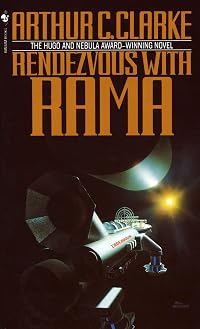
I'm probably unique in this, but to be honest this is my favorite novel by Clarke, despite it being very atypical for him. Arthur C. Clarke was my mother's favorite author. She loved the transcendental in him, the religious flavor in his futuristic science fiction. She loved to tell the story of how she took me to see 2001: A Space Odyssey in theaters when I was a toddler and ruined it for her by squalling during the psychedelic scenes--it's actually one of my oldest and most traumatic memories. But for her, that's what she loved--the idea of all of us as star children, of a apotheosis of space and the heavens. If you're looking for that Clarke, you might want to put this book down and go find Childhood's End, Rendezvous with Rama, The show more City and the Stars or 2001: A Space Odyssey, either the book or film.
So many might find this book prosaic compared to his more cosmic, ambitious works. Rather this is a suspenseful book of disaster and rescue--more The Poseidon Adventure than 2001. Twenty-two people, the passenger and crew of the tourist boat Selene, are caught in "a fall of moondust" on the Sea of Thirst. They're trapped 15 meters below the surface with no way of communicating with the outside--and time--and breathable air--is running out. The basic premise about how moondust works is dated--this was published in 1961 before the moonlandings and when there had been only a few unmanned probes of the lunar surface. But did I care? Not in the least. Great read. show less
So many might find this book prosaic compared to his more cosmic, ambitious works. Rather this is a suspenseful book of disaster and rescue--more The Poseidon Adventure than 2001. Twenty-two people, the passenger and crew of the tourist boat Selene, are caught in "a fall of moondust" on the Sea of Thirst. They're trapped 15 meters below the surface with no way of communicating with the outside--and time--and breathable air--is running out. The basic premise about how moondust works is dated--this was published in 1961 before the moonlandings and when there had been only a few unmanned probes of the lunar surface. But did I care? Not in the least. Great read. show less
Members
- Recently Added By
Lists

Survey of Classic Science Fiction
171 works; 48 members

S.F. Masterworks (Complete)
229 works; 15 members

SF Masterworks
193 works; 8 members

The Novels of Arthur C. Clarke
21 works; 2 members

Favorite Childhood Books
1,646 works; 514 members

Books Read in 2018
4,360 works; 110 members

Books Read in 2024
4,623 works; 126 members
Favorite Science Fiction
456 works; 218 members
Author Information

863+ Works 130,324 Members
Arthur C. Clarke was born in Minehead, Somerset, England, on December 16, 1917. During World War II, he served as a radar specialist in the RAF. His first published piece of fiction was Rescue Party and appeared in Astounding Science, May 1946. He graduated from King's College in London with honors in physics and mathematics, and worked in show more scientific research before turning his attention to writing fiction. His first book, Prelude to Space, was published in 1951. He is best known for his book 2001: A Space Odyssey, which was later turned into a highly successful and controversial film under the direction of Stanley Kubrick. His other works include Childhood's End, Rendezvous with Rama, The Garden of Rama, The Snows of Olympus, 2010: A Space Odyssey II, 2062: Odyssey III, and 3001: The Final Odyssey. During his lifetime, he received at least three Hugo Awards and two Nebula Awards. He died of heart failure on March 19, 2008 at the age of 90. (Bowker Author Biography) show less
Some Editions
Awards and Honors
Awards
Series
Belongs to Publisher Series
Work Relationships
Is contained in
Contains
Has the adaptation
Is abridged in
Reader's Digest Condensed Books 1961 v04: Ring of Bright Water / The Judas Tree / The Edge of Sadness / A Fall of Moondust / A Christmas Carol / Summer of Pride by Reader's Digest
Reader's Digest Condensed Books: Dunkirk to Alamein • The Winter of Our Discontent • The Day Lincoln Was Shot • A Fall of Moondust by Reader's Digest
Common Knowledge
- Canonical title
- A Fall of Moondust
- Original title
- A Fall of Moondust
- Original publication date
- 1961
- People/Characters
- Pat Harris; Sue Wilkins; Commodore Hansteen; Thomas Lawson; Tourist Commissioner Davis; Robert Lawrence (Chief Engineer) (show all 27); Chief Administrator Olsen; Robert Bryan; Irving Schuster; Nihal Jayawardene; Duncan McKenzie; Pierre Blanchard; Phyllis Morley; Karl Johansen; Myra Schuster; David Barrett; Professor Kotelnikov; Vincent Ferraro; Maurice Spencer; Captain Anson; Jules Braques; Wilfred George Radley; Mike Graham; Harding; Mrs. Williams; Mr. Williams; Hans Baldur
- Important places
- The Moon (Luna); Sea of Thirst, Sinus Roris, Moon; Sinus Roris, Moon; Port Clavius, Moon; Lagrange II satellite; Crater Lake, Sea of Thirst, Sinus Roris, Moon (show all 10); Mountains of Inaccessibility, Crater Lake, Sea of Thirst, Sinus Roris, Moon; Plato Observatory, Moon; Clavius City, Moon; Port Roris, Sinus Roris, Moon
- Dedication
- To Liz and Mike
To the memory of my twice lost friends,
Liz and Mike
(1987 edition) - First words
- To be the skipper of the only boat on the Moon was a distinction that Pat Harris enjoyed.
- Last words
- (Click to show. Warning: May contain spoilers.)Then he walked back to the controls to take Selene II on his last voyage, and her maiden one, across the Sea of Thirst.
- Original language
- English
- Canonical DDC/MDS
- 823.08762
- Disambiguation notice
- This work refers to the complete novel by Arthur C. Clarke. Please do not merge with abridged versions or radio plays adapted from it.
Classifications
Statistics
- Members
- 2,131
- Popularity
- 9,598
- Reviews
- 44
- Rating
- (3.74)
- Languages
- 11 — Czech, Dutch, English, Finnish, German, Hungarian, Italian, Polish, Swedish, Turkish, Portuguese (Portugal)
- Media
- Paper, Audiobook, Ebook
- ISBNs
- 56
- UPCs
- 1
- ASINs
- 45