

Ferdinand Magellan: Opening the Door to World Exploration (Isaac Asimov's Pioneers of Science and Exploration)
by Isaac Asimov
Asimov's Pioneers of Science and Exploration
On This Page
Description
Presents the story of the Portuguese explorer who became the first European to cross the Pacific Ocean and whose expedition completed its voyage around the world after his death en route.Tags
Recommendations

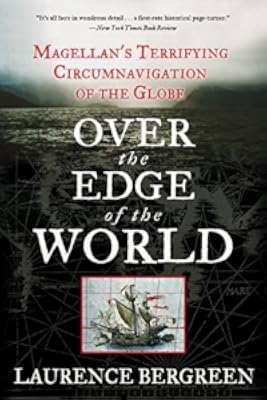



















Member Reviews
Large format and copiously illustrated with what look like rough oil paintings as well as a few photographs of original portraits and maps. Clearly Asimov wrote this one himself, although it is only 48 pages of large type.
A comparison of the size of one of Magellan's ships to a modern semi-truck is shocking. The ship was hardly longer, although more rounded and a bit bulkier.
A comparison of the size of one of Magellan's ships to a modern semi-truck is shocking. The ship was hardly longer, although more rounded and a bit bulkier.
Ratings
Members
- Recently Added By
Author Information

2,400+ Works 292,936 Members
Isaac Asimov was born in Petrovichi, Russia, on January 2, 1920. His family emigrated to the United States in 1923 and settled in Brooklyn, New York, where they owned and operated a candy store. Asimov became a naturalized U.S. citizen at the age of eight. As a youngster he discovered his talent for writing, producing his first original fiction at show more the age of eleven. He went on to become one of the world's most prolific writers, publishing nearly 500 books in his lifetime. Asimov was not only a writer; he also was a biochemist and an educator. He studied chemistry at Columbia University, earning a B.S., M.A. and Ph.D. In 1951, Asimov accepted a position as an instructor of biochemistry at Boston University's School of Medicine even though he had no practical experience in the field. His exceptional intelligence enabled him to master new systems rapidly, and he soon became a successful and distinguished professor at Columbia and even co-authored a biochemistry textbook within a few years. Asimov won numerous awards and honors for his books and stories, and he is considered to be a leading writer of the Golden Age of science fiction. While he did not invent science fiction, he helped to legitimize it by adding the narrative structure that had been missing from the traditional science fiction books of the period. He also introduced several innovative concepts, including the thematic concern for technological progress and its impact on humanity. Asimov is probably best known for his Foundation series, which includes Foundation, Foundation and Empire, and Second Foundation. In 1966, this trilogy won the Hugo award for best all-time science fiction series. In 1983, Asimov wrote an additional Foundation novel, Foundation's Edge, which won the Hugo for best novel of that year. Asimov also wrote a series of robot books that included I, Robot, and eventually he tied the two series together. He won three additional Hugos, including one awarded posthumously for the best non-fiction book of 1995, I. Asimov. "Nightfall" was chosen the best science fiction story of all time by the Science Fiction Writers of America. In 1979, Asimov wrote his autobiography, In Memory Yet Green. He continued writing until just a few years before his death from heart and kidney failure on April 6, 1992. (Bowker Author Biography) show less
All Editions
Series

Common Knowledge
- People/Characters
- Ferdinand Magellan
- Important events
- Circumnavigation of the World
Classifications
- Genre
- Nonfiction
- DDC/MDS
- 910.92 — History & geography Geography & travel modified standard subdivisions of Geography and travel Explorers & Travelers Geographers, travellers, explorers regardless of country of origin
- LCC
- G420 .M2 .A85 — Geography, Anthropology and Recreation Geography (General) Special voyages and travels
Statistics
- Members
- 35
- Popularity
- 817,426
- Reviews
- 1
- Rating
- (3.50)
- Languages
- English
- Media
- Paper
- ISBNs
- 1
