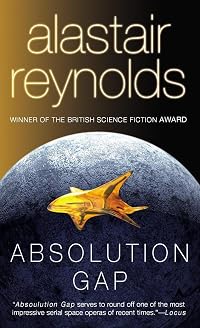
Absolution Gap
by Alastair Reynolds
Revelation Space (4), Revelation Space, chronological order (2615-3125)
On This Page
Description
The Inhibitors were designed to eliminate any life-form reaching a certain level of intelligence-and they've targeted humanity. War veteran Clavain and a ragtag group of refugees have fled into hiding. Their leadership is faltering, and their situation is growing more desperate. But their little colony has just received an unexpected visitor: an avenging angel with the power to lead mankind to safety-or draw down its darkest enemy.And as she leads them to an apparently insignificant moon show more light-years away, it begins to dawn on Clavain and his companions that to beat one enemy, it may be necessary to forge an alliance with something much worse. show lessTags
Recommendations






Member Reviews
Naves espaciales, arqueología estelar, antiguas civilizaciones, virus adoctrinadores, heroismo, sacrificio, religión, batallas, traición, armas inverosímiles... ¡Impresionante! Que una novela de más de 600 páginas te mantenga en vilo hasta el final debe significar algo, y ese algo es calidad e ideas a raudales. Si 'El arca de la redención' fue buena, su continuación, 'El desfiladero de la absolución', es mucho mejor, extraordinaria diría yo. El pulso narrativo de Alastair Reynolds no desfallece en ningún momento durante toda la historia.
Y hablando de la historia, contaré que empieza con tres hilos narrativos que terminan convirtiéndose en uno solo. Por un lado tenemos a Quaiche, que se ha metido en un buen lío con los show more ultras para los que trabaja y que cree ver esperanzas y una salida tanto para él como para su amada Morwenna, en Hela. Hela es una luna sin vida pero curiosamente posee un puente de cuarenta kilómetros de largo que cruza un desfiladero... Por otro lado, nos volvemos a encontrar con los protagonistas de la anterior novela 'El arca de la redención', Clavain, Escorpio, la Nostalgia por el infinito... que se encuentran en el planeta de los marabaristas de formas, Ararat. Y por último, tenemos, en un futuro próximo, a Rashmika, que vive en Hela, la luna antes mencionada, que ya se encuentra habitada, y cuya obsesión es saber qué le ha pasado a su hermano después de haber sido adoctrinado por los adventistas y también saber que pasó con la raza de los scuttlers, anteriores habitantes de Hela.
Cabe destacar a Escorpio, el hipercerdo, o cerdo evolucionado, que lleva gran parte de la narración y que nos permite conocerle a fondo, sus motivaciones, su manera de ser. Es un personaje que evoluciona respecto al anterior libro y al que se le coge cariño.
La novela me ha dejado muchas y grandiosas imágenes, de las cuáles mencionaré cuatro:
* La Nostalgia por el infinito, una nave posada sobre su popa en el océano, un kilómetro bajo el agua y otros tres sobre la superficie, de manera que parece una gran torre. No puedo evitar sentir fascinación por esta "nave".
* El deán Quaiche y sus ojos y su sala de espejos para observar en todo momento el planeta Haldora.
* La catedrales en su eterno viaje alrededor de Hela.
* El iceberg formado por el escape de frío de los motores crioaritméticos estropeados.
Si la calidad de las novelas de Reynolds aumenta con cada libro que escribe, no sé dónde puede llegar. Lo dicho, una novela impresionante. show less
Y hablando de la historia, contaré que empieza con tres hilos narrativos que terminan convirtiéndose en uno solo. Por un lado tenemos a Quaiche, que se ha metido en un buen lío con los show more ultras para los que trabaja y que cree ver esperanzas y una salida tanto para él como para su amada Morwenna, en Hela. Hela es una luna sin vida pero curiosamente posee un puente de cuarenta kilómetros de largo que cruza un desfiladero... Por otro lado, nos volvemos a encontrar con los protagonistas de la anterior novela 'El arca de la redención', Clavain, Escorpio, la Nostalgia por el infinito... que se encuentran en el planeta de los marabaristas de formas, Ararat. Y por último, tenemos, en un futuro próximo, a Rashmika, que vive en Hela, la luna antes mencionada, que ya se encuentra habitada, y cuya obsesión es saber qué le ha pasado a su hermano después de haber sido adoctrinado por los adventistas y también saber que pasó con la raza de los scuttlers, anteriores habitantes de Hela.
Cabe destacar a Escorpio, el hipercerdo, o cerdo evolucionado, que lleva gran parte de la narración y que nos permite conocerle a fondo, sus motivaciones, su manera de ser. Es un personaje que evoluciona respecto al anterior libro y al que se le coge cariño.
La novela me ha dejado muchas y grandiosas imágenes, de las cuáles mencionaré cuatro:
* La Nostalgia por el infinito, una nave posada sobre su popa en el océano, un kilómetro bajo el agua y otros tres sobre la superficie, de manera que parece una gran torre. No puedo evitar sentir fascinación por esta "nave".
* El deán Quaiche y sus ojos y su sala de espejos para observar en todo momento el planeta Haldora.
* La catedrales en su eterno viaje alrededor de Hela.
* El iceberg formado por el escape de frío de los motores crioaritméticos estropeados.
Si la calidad de las novelas de Reynolds aumenta con cada libro que escribe, no sé dónde puede llegar. Lo dicho, una novela impresionante. show less
If you're not into reading a whole trilogy crammed into one book then i'd suggest staying away: this book is huge. But if you've got this far you've just read two books of similar length so you're used to it by now -- dive right in.
My thoughts are that this book just doesn't come up to the same level as the previous two. I think it's because everything in this universe that we've come to know is all getting torn apart into molecules by the Inhibitors and there's not much left of life as we once knew it. It's all quite depressing really, as are some of the characters. And while i like a writer who isn't afraid to kill off a main character or several, i was a bit put out by one of them as i really wanted to hear more from show more them: i won't say which one because it would spoil the whole book.
But, this is war, this is the threatened annihilation of the human race, so we can't expect it to be all upbeat and fun -- can we?
So yeah, straight into Galactic North now and then it's a bit of a wait for Inhibitor Phase to be published on 26th August 2021. show less
My thoughts are that this book just doesn't come up to the same level as the previous two. I think it's because everything in this universe that we've come to know is all getting torn apart into molecules by the Inhibitors and there's not much left of life as we once knew it. It's all quite depressing really, as are some of the characters. And while i like a writer who isn't afraid to kill off a main character or several, i was a bit put out by one of them as i really wanted to hear more from show more them: i won't say which one because it would spoil the whole book.
But, this is war, this is the threatened annihilation of the human race, so we can't expect it to be all upbeat and fun -- can we?
So yeah, straight into Galactic North now and then it's a bit of a wait for Inhibitor Phase to be published on 26th August 2021. show less
The third in the Revelation Space series, picking up where Redemption Ark (https://www.goodreads.com/review/show/196160257) left off. I have been impressed by all the Reynolds I have read, but around the half-way mark, this one was struggling to be worth 3*. However, it redeemed itself in the last quarter, to deserve 4*.
Like many of Reynolds' books, this is a story with three main, interrelated, strands, though it is simpler than the previous two Revelation Space volumes - or perhaps that is just because there are so many familiar characters and fewer new ones.
On strand is on the Juggler planet, Ararat, where Clavain, Scorpio and others ended up in Redemption Ark. A second strand concerns ultras looking for alien relics, though this one show more joins with one of the others about half way through. The third focuses on a moon called Hela, which is home to humans, many of whom follow (in a literal sense) a cultish religion trying to observe the occasional fleeting disappearance of their sun, Haldora.
The book is plot-driven, rather than character-based, as is common with sci fi, and that is fine - until the plot stagnates, which was what I found in the middle: it became mired in too much detail of church hierarchies and infighting, without enough happening, and not even balanced by much character development. A decent editor would fix that, but perhaps Reynolds is too successful for his own good and does not need to submit to such indignities. Anyway, I'm glad I stuck with it; in the end it was definitely worth the ride.
The church caravans are rather steampunky (shades of Mortal Engines), which doesn't feel very Reynoldsy, and their obsession with blood sometimes brings vampires to mind - "the threads of blood that bound them all". Mind you, I did like the fact that the most powerful indoctrinal virus was called Deus-X.
The main themes are the related ones of life, death, extreme longevity, faith, artificial intelligence, and the nature of reality.
Imagine what it must be like to know your belief comes from virus: "the feelings it brought were too superficial... He truly felt himself to be in the presence of something sacred, but he also knew, with total clarity, that this was due to neuro-anatomy."
Reefersleep coupled with life extension becomes almost like time travel: "'I wasn't made for these times', he thought. He had been yanked from the ordinary flow of time and now he was adrift, unmoored from history." And that sort of thing affects one's attitude to mortality, "In every significant respect he approached the matter of his own demise with the bored acceptance of someone waiting to sneeze."
Technology does offer compensation, though: "The ship nurtured him, anticipating his desires with the eagerness of a courtesan... because the ship knew him so well,m he had in a sense extended himself into it."
Despite the distractions and imperfections, this does conclude the trilogy in a satisfying way, building on what has gone before as well as introducing new themes. show less
Like many of Reynolds' books, this is a story with three main, interrelated, strands, though it is simpler than the previous two Revelation Space volumes - or perhaps that is just because there are so many familiar characters and fewer new ones.
On strand is on the Juggler planet, Ararat, where Clavain, Scorpio and others ended up in Redemption Ark. A second strand concerns ultras looking for alien relics, though this one show more joins with one of the others about half way through. The third focuses on a moon called Hela, which is home to humans, many of whom follow (in a literal sense) a cultish religion trying to observe the occasional fleeting disappearance of their sun, Haldora.
The book is plot-driven, rather than character-based, as is common with sci fi, and that is fine - until the plot stagnates, which was what I found in the middle: it became mired in too much detail of church hierarchies and infighting, without enough happening, and not even balanced by much character development. A decent editor would fix that, but perhaps Reynolds is too successful for his own good and does not need to submit to such indignities. Anyway, I'm glad I stuck with it; in the end it was definitely worth the ride.
The church caravans are rather steampunky (shades of Mortal Engines), which doesn't feel very Reynoldsy, and their obsession with blood sometimes brings vampires to mind - "the threads of blood that bound them all". Mind you, I did like the fact that the most powerful indoctrinal virus was called Deus-X.
The main themes are the related ones of life, death, extreme longevity, faith, artificial intelligence, and the nature of reality.
Imagine what it must be like to know your belief comes from virus: "the feelings it brought were too superficial... He truly felt himself to be in the presence of something sacred, but he also knew, with total clarity, that this was due to neuro-anatomy."
Reefersleep coupled with life extension becomes almost like time travel: "'I wasn't made for these times', he thought. He had been yanked from the ordinary flow of time and now he was adrift, unmoored from history." And that sort of thing affects one's attitude to mortality, "In every significant respect he approached the matter of his own demise with the bored acceptance of someone waiting to sneeze."
Technology does offer compensation, though: "The ship nurtured him, anticipating his desires with the eagerness of a courtesan... because the ship knew him so well,m he had in a sense extended himself into it."
Despite the distractions and imperfections, this does conclude the trilogy in a satisfying way, building on what has gone before as well as introducing new themes. show less
I was about to state that this book is the most accessible and straightforward of the 3, then quickly realized that it also introduces 2 new alien races, brane theory, and a new religion including a doctrinal virus and giant moving cathedral with feet!
Unfortunately, the story continues to plod along at the painfully slow pace of the walking cathedral. This would be frustrating enough, but to add insult to injury some of the most compelling characters are either carelessly sidelined or wantonly killed off, and plotlines that build up over hundreds of pages across decades are casually wiped away in a sentence or two. I still had my hopes up for a bang of a finale, but alas received a whimper instead.
This easily could have been a true show more masterpiece, a brilliant trilogy among the best ever written, if only the author could have got out of his own way (or forced to hire an editor by his publisher). show less
Unfortunately, the story continues to plod along at the painfully slow pace of the walking cathedral. This would be frustrating enough, but to add insult to injury some of the most compelling characters are either carelessly sidelined or wantonly killed off, and plotlines that build up over hundreds of pages across decades are casually wiped away in a sentence or two. I still had my hopes up for a bang of a finale, but alas received a whimper instead.
This easily could have been a true show more masterpiece, a brilliant trilogy among the best ever written, if only the author could have got out of his own way (or forced to hire an editor by his publisher). show less
Absolution Gap is a decent novel on its own merits, but a disappointing conclusion to the Revelation Space series.
The best parts of the book follow Rashmika, a 17 year old girl on the frontier pilgrimage world of Hela. Hela orbits a gas giant that occasionally vanishes, revealing hints of some immense machinery inside. An entire religion has grown up on Hela, centered around moving cathedrals that keep the gas giant perpetually at zenith and the strains of an indoctrination virus floating through the population. Hela has it's own xenoarcheological paradox, a local culture of extinct scuttlers who seem to have been killed by something other than the inhibitors. Rashmika is driven to find out why the scuttlers are extinct, what's happened show more to her brother, and the true nature of the church, all of which seem to center on a immense bridge of unknown construction over a massive canyon, the titular absolution gap. Meanwhile, the survivors on Ararat are trying to make sense of their mission, as the Inhibitors and Conjoiner war catch up to them and Captain Brannigan takes over the Nostalgia for Infinity. The plot lurches along towards a conclusion that has about three simultaneous deux ex machinas.
It's a shame, because while Reynolds sets up a fascinating universe, he never quite figures out how to tell good stories in it. The paradox of the Inhibitors is that they're a lot like zombies, an unthinking horde that can be slowed but not stopped. The point of zombie movies is not the zombies, but the survivors. Who do you become in a moment of survival? Who will betray you? The paranoid BDSM war criminals who populate the Revelation Space universe would space each other with more ease than drinking a cup of tea, so there's not much depth to be found there. The universe is also populated with enigmatic hints that the Inhibitors are not as all powerful as they seem. Tinned apes, as space faring H. Sapiens are, might not have a spitting chance, but there seem to be civilizations which have foiled the Inhibitors through migration into alternate biological forms, cybernetic uploads running on exotic substrates, or para-dimensional spaces. The theme that transcendence is salvation pokes up again and again in the series, but is ultimately dropped.
Instead, survival is assured by two previously unknown hyper-powerful alien societies. Our heroes pick the 'right ones', and survive the Inhbitiors, buying a few centuries for another form of rogue terraforming mechanical life to threaten the galaxy.
These books have their moments, but those moments are buried in ideas that should have been cut in the draft. show less
The best parts of the book follow Rashmika, a 17 year old girl on the frontier pilgrimage world of Hela. Hela orbits a gas giant that occasionally vanishes, revealing hints of some immense machinery inside. An entire religion has grown up on Hela, centered around moving cathedrals that keep the gas giant perpetually at zenith and the strains of an indoctrination virus floating through the population. Hela has it's own xenoarcheological paradox, a local culture of extinct scuttlers who seem to have been killed by something other than the inhibitors. Rashmika is driven to find out why the scuttlers are extinct, what's happened show more to her brother, and the true nature of the church, all of which seem to center on a immense bridge of unknown construction over a massive canyon, the titular absolution gap. Meanwhile, the survivors on Ararat are trying to make sense of their mission, as the Inhibitors and Conjoiner war catch up to them and Captain Brannigan takes over the Nostalgia for Infinity. The plot lurches along towards a conclusion that has about three simultaneous deux ex machinas.
It's a shame, because while Reynolds sets up a fascinating universe, he never quite figures out how to tell good stories in it. The paradox of the Inhibitors is that they're a lot like zombies, an unthinking horde that can be slowed but not stopped. The point of zombie movies is not the zombies, but the survivors. Who do you become in a moment of survival? Who will betray you? The paranoid BDSM war criminals who populate the Revelation Space universe would space each other with more ease than drinking a cup of tea, so there's not much depth to be found there. The universe is also populated with enigmatic hints that the Inhibitors are not as all powerful as they seem. Tinned apes, as space faring H. Sapiens are, might not have a spitting chance, but there seem to be civilizations which have foiled the Inhibitors through migration into alternate biological forms, cybernetic uploads running on exotic substrates, or para-dimensional spaces. The theme that transcendence is salvation pokes up again and again in the series, but is ultimately dropped.
Instead, survival is assured by two previously unknown hyper-powerful alien societies. Our heroes pick the 'right ones', and survive the Inhbitiors, buying a few centuries for another form of rogue terraforming mechanical life to threaten the galaxy.
These books have their moments, but those moments are buried in ideas that should have been cut in the draft. show less
I fell into a bit of a trap with this one. i'd read quite a few of Reynolds' other books set in the 'Revelation space' universe and assumed that all his novels were stand-alone. I quickly realised on starting this book that I was wrong. This is a direct sequal to 'Redemption Ark', which i haven't yet read. Whoops!
But I fairly quickly picked up on the events and plot points of the earlier novel, so things weren't too bad. The only point where I stumbled a bit was the re-introduction of the character Remontoire, who suddenly pops into this novel about a third of the way through, and then hangs around for a while, playing a part that is both key and walk-on, before bowing out again.
I also had a bit of an issue with the hyperpig Scorpio. show more This character, a genetically enhanced pig intended to have traits closer to human, is well-drawn and a key charcacter. But I kept worrying about practicalities - and although Reynolds does the same, commenting often, for instance, on the difficulty of Scorpio's handling human artefacts with his modified trotters, a little voice inside my head kept asking difficult questions - how would this work, how would Scorpio do that?
But all these objections were overwhelmed by the MacGuffin of the plot. What makes a whole planet blink out of existence for a fraction of a second? And what are the implications for the way this miraculous event is viewed? Reynolds engages in some fascinating world-building for the world of Hela, from where the wonderful vanishing planet can be viewed. Another reviewer has compared this to Kim Stanley Robinson's Mars books, and it's a useful analogy. The mobile cathedrals that track across the surface of Hela are vividly described; and as I got closer to the end of the book, I could hardly wait to see how matters resolved themselves. Reynolds uses the mechanics of time dilation in relativistic spaceflight very precisely as a plot device which I didn't twig to until shortly before the denouement began to unwind. My excitement at finding out how the story ended more than made up for some of the issues I identify above, and despite everything, I enjoyed the book and have no hesitation at awarding it five stars. show less
But I fairly quickly picked up on the events and plot points of the earlier novel, so things weren't too bad. The only point where I stumbled a bit was the re-introduction of the character Remontoire, who suddenly pops into this novel about a third of the way through, and then hangs around for a while, playing a part that is both key and walk-on, before bowing out again.
I also had a bit of an issue with the hyperpig Scorpio. show more This character, a genetically enhanced pig intended to have traits closer to human, is well-drawn and a key charcacter. But I kept worrying about practicalities - and although Reynolds does the same, commenting often, for instance, on the difficulty of Scorpio's handling human artefacts with his modified trotters, a little voice inside my head kept asking difficult questions - how would this work, how would Scorpio do that?
But all these objections were overwhelmed by the MacGuffin of the plot. What makes a whole planet blink out of existence for a fraction of a second? And what are the implications for the way this miraculous event is viewed? Reynolds engages in some fascinating world-building for the world of Hela, from where the wonderful vanishing planet can be viewed. Another reviewer has compared this to Kim Stanley Robinson's Mars books, and it's a useful analogy. The mobile cathedrals that track across the surface of Hela are vividly described; and as I got closer to the end of the book, I could hardly wait to see how matters resolved themselves. Reynolds uses the mechanics of time dilation in relativistic spaceflight very precisely as a plot device which I didn't twig to until shortly before the denouement began to unwind. My excitement at finding out how the story ended more than made up for some of the issues I identify above, and despite everything, I enjoyed the book and have no hesitation at awarding it five stars. show less
This is perhaps the least inventive of the whole RS series, but it's still a tour-de-force in hard sf. The pro- and epllogues tie up the long future of humanity, and the consequences of the actions the characters have taken. There's still much that could be written in this universe, and Reynolds has done so with some spin out novels and short stories, but this is the conclusion to how it all ends up, and the final details of the various alien plots to stop the Inhibitors are revealed.
None of which is immediately apparent. We follow several interleaved timelines, and it requires a bit of concentration to remember what events precede each other, even without the difficulties of light limited space travel. Earliest we follow a new show more lighthugger that's found something interesting in an unremarked ice moon. Quaiche is dispatched by the triumver to go an investigate it, but he triggers an ancient sentry and nearly dies. Meanwhile Antoinette, Skorpio and Calvain are shepherding the community on the Jugglar world the Captain deposited them on. They're waiting for word from Remointoire and Ana. Lastly on the ice moon of Hella a young girl is investigationg what happened to her brother. Two of the storylines converge quite quickly, bit Skorp et al take a long time to arrive, even though their story is interleaved with the others.
It's perhaps less imaginative in world building than the previous books, there's nothing really new other than the gigantic gothic cathedrals trundling around Hella. Quiache's religiosity quickly gets annoying, but there's always a new quirk thrown our way to keep the reader interested, and then we flip back to Skorpio who's facing all sort so of new challenges. I was least impressed with the future voices, I suspect Reynolds is pushing the 'possible if unlikely' dial right to the very limits here. -Brane descriptions of the universe are certainly a known mathematical solution proposed to some of the quantum mechanical weirdness that have been observed, but even there very existence is unlikely, let alone the possibilities raised here.
It is fun though and many authors should learn from Reynolds' ability to write a definitive ending. show less
None of which is immediately apparent. We follow several interleaved timelines, and it requires a bit of concentration to remember what events precede each other, even without the difficulties of light limited space travel. Earliest we follow a new show more lighthugger that's found something interesting in an unremarked ice moon. Quaiche is dispatched by the triumver to go an investigate it, but he triggers an ancient sentry and nearly dies. Meanwhile Antoinette, Skorpio and Calvain are shepherding the community on the Jugglar world the Captain deposited them on. They're waiting for word from Remointoire and Ana. Lastly on the ice moon of Hella a young girl is investigationg what happened to her brother. Two of the storylines converge quite quickly, bit Skorp et al take a long time to arrive, even though their story is interleaved with the others.
It's perhaps less imaginative in world building than the previous books, there's nothing really new other than the gigantic gothic cathedrals trundling around Hella. Quiache's religiosity quickly gets annoying, but there's always a new quirk thrown our way to keep the reader interested, and then we flip back to Skorpio who's facing all sort so of new challenges. I was least impressed with the future voices, I suspect Reynolds is pushing the 'possible if unlikely' dial right to the very limits here. -Brane descriptions of the universe are certainly a known mathematical solution proposed to some of the quantum mechanical weirdness that have been observed, but even there very existence is unlikely, let alone the possibilities raised here.
It is fun though and many authors should learn from Reynolds' ability to write a definitive ending. show less
Members
- Recently Added By
Lists

Top Five Books of 2013
1,562 works; 721 members

Isaac Arthur’s Book Recommendations
98 works; 3 members
Author Information

141+ Works 40,095 Members
Some Editions
Awards and Honors
Awards
Distinctions
Notable Lists
Series


Work Relationships
Is contained in
Common Knowledge
- Canonical title
- Absolution Gap
- Original title
- Absolution Gap
- Original publication date
- 2003-11-27
- People/Characters
- Nevil Clavain; Skade; Rashmika Els; Quaiche; Queen Jasmina; Morwenna (show all 13); Remontoire; John Brannigan; Aura; Scorpio; Grelier; Ana Khouri; Antoinette Bax
- Important places
- Haldora; Hela; Lady Morwenna; Ararat; Nostalgia for Infinity (lighthugger ship)
- Dedication
- For my Grandparents.
- First words
- She stands alone, at the jetty's end, watching the sky.
- Last words
- (Click to show. Warning: May contain spoilers.)She slips into the sea, into the glowing green memory of Ararat.
- Original language
- English
Classifications
Statistics
- Members
- 2,850
- Popularity
- 6,374
- Reviews
- 61
- Rating
- (3.84)
- Languages
- 9 — Czech, English, Finnish, French, German, Polish, Romanian, Spanish, Swedish
- Media
- Paper, Audiobook, Ebook
- ISBNs
- 34
- UPCs
- 1
- ASINs
- 15