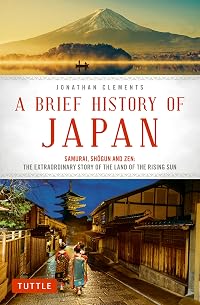
A Brief History of Japan: Samurai, Shogun and Zen: The Extraordinary Story of the Land of the Rising Sun
by Jonathan Clements
On This Page
Description
This fascinating history tells the story of the people of Japan, from ancient teenage priest-queens to teeming hordes of salarymen, a nation that once sought to conquer China, yet also shut itself away for two centuries in self-imposed seclusion. First revealed to Westerners in the chronicles of Marco Polo, Japan was a legendary faraway land defended by a fearsome Kamikaze storm and ruled by a divine sovereign. It was the terminus of the Silk Road, the furthest end of the known world, a show more fertile source of inspiration for European artists, and an enduring symbol of the mysterious East. In recent times, it has become a powerhouse of global industry, a nexus of popular culture, and a harbinger of post-industrial decline. With intelligence and wit, author Jonathan Clements blends documentary and storytelling styles to connect the past, present, and future of Japan, and in broad yet detailed strokes reveals a country of paradoxes: a modern nation steeped in ancient traditions; a democracy with an emperor as head of state; a famously safe society built on 108 volcanoes resting on the world's most active earthquake zone; a fast-paced urban and technologically advanced country whose land consists predominantly of mountains and forests. show lessTags
Recommendations








Member Reviews
22. A Brief History of Japan: Samurai, Shogun and Zen: The Extraordinary Story of the Land of the Rising Sun by Jonathan Clements
reader: Julian Elfer
OPD: 2017
format: 8:41 audible audiobook (304 pages in paperback)
acquired: audible loan listened: Apr 7-16
rating: 3½
genre/style: History theme: random audio
locations: Japan
about the author: A British author and scriptwriter, born in Leigh on Sea, Essex in 1971
Clements tells the reader up front that he really likes relaying quirky historical oddities, and the reader should take note. He's not an ideal fit for a brief history. Making history brief means making effective accurate clear summations of various things you want to cover. (This is actually very difficult.) The flip side is to show more remove the excess words, but still pile details on details in a compressed rapid form, uncooked, if you like. Clements trends a little too much to the latter form for my tastes, and it made listening challenging.
I really had trouble following the medieval and semi-feudal Japan because it's very complicated and I lost Clements's points in a confusion of names and factions and unfamiliar sounds. What I got was the power was always obscured, the Japanese emperor was traditionally a figurehead, often very young, and often the emperor would retire in an effort to establish real power, with mixed success. Shoguns were important, until they weren't. Samari had a long history of no practical military value because no one ever attacked Japan. It was largely unified enough and after the Mongol rulers of China failed in their rather poor marine invasion efforts, China never gave it another go. But I guess Japan was always ready.
I was entertained by getting a history of Edo/Tokyo, sushi, and kabuki theatre, and learning that the west and the US regret the constitutional disarming of Japan (although the constitution allows for finagling with "defense" forces). And I knew how fast Japan modernized, much faster than the other eastern countries (although China clearly tried). It took roughly 60 years from Japan's opening to its defeat of Russia. But I didn't realize how important the Korean War was to Japan's revitalization, funding the foundations of its post-war economic boom.
Anyway, while I hope there is a better brief history out there, I'm sure any readers will find something they like here.
2024
https://www.librarything.com/topic/358760#8515101 show less
reader: Julian Elfer
OPD: 2017
format: 8:41 audible audiobook (304 pages in paperback)
acquired: audible loan listened: Apr 7-16
rating: 3½
genre/style: History theme: random audio
locations: Japan
about the author: A British author and scriptwriter, born in Leigh on Sea, Essex in 1971
Clements tells the reader up front that he really likes relaying quirky historical oddities, and the reader should take note. He's not an ideal fit for a brief history. Making history brief means making effective accurate clear summations of various things you want to cover. (This is actually very difficult.) The flip side is to show more remove the excess words, but still pile details on details in a compressed rapid form, uncooked, if you like. Clements trends a little too much to the latter form for my tastes, and it made listening challenging.
I really had trouble following the medieval and semi-feudal Japan because it's very complicated and I lost Clements's points in a confusion of names and factions and unfamiliar sounds. What I got was the power was always obscured, the Japanese emperor was traditionally a figurehead, often very young, and often the emperor would retire in an effort to establish real power, with mixed success. Shoguns were important, until they weren't. Samari had a long history of no practical military value because no one ever attacked Japan. It was largely unified enough and after the Mongol rulers of China failed in their rather poor marine invasion efforts, China never gave it another go. But I guess Japan was always ready.
I was entertained by getting a history of Edo/Tokyo, sushi, and kabuki theatre, and learning that the west and the US regret the constitutional disarming of Japan (although the constitution allows for finagling with "defense" forces). And I knew how fast Japan modernized, much faster than the other eastern countries (although China clearly tried). It took roughly 60 years from Japan's opening to its defeat of Russia. But I didn't realize how important the Korean War was to Japan's revitalization, funding the foundations of its post-war economic boom.
Anyway, while I hope there is a better brief history out there, I'm sure any readers will find something they like here.
2024
https://www.librarything.com/topic/358760#8515101 show less
Six-word review: Japan sure has lots of history.
It seems to me that being Japanese must be complicated in a way that I can only dimly imagine.
Even though I never set out to study Japan, I find that my reading over the years has included a disproportionate number of Japan-related titles, from the novels of Haruki Murakami to Donald Richie's analyses of the films of Kurosawa, most of which I've seen; from Tanizaki's quiet meditation on shadows to a hefty tome on Japan's recovery from World War II; from Mr. Nakano's thrift shop to the imperial palace. I've given a thoughtful viewing to the films of Ozu and examined photos of samurai artifacts and traditional Japanese hairstyles. On a separate track, I've studied Zen Buddhism.
The more I show more read, the less I feel that I comprehend.
I thought that reading a broad-scoped history of Japan, packing fifteen or more centuries into a compact 300 pages, would give me a sense of context and place some events of lore and legend in relation to events of record. And perhaps it would have, if I had read it straight through and sustained the connections from one era to another. Unfortunately, this was the Kindle book I chose to read in waiting rooms and during down time on volunteer shifts, and so for me it was seven months from beginning to end.
I didn't manage to sustain much at all, apart from the experience of having it go on and on and on, which is pretty much what Japanese history has done. But I did gain a sense of vast complexity: of recorded deeds interwoven with myth, of tradition, of numerous strands of culture and ethnicity braided into one, of geographic smallness and military might, of privilege and poverty, humility and insuperable pride. Politics and poetry blend with cherished archetypes and deep symbolism; much is not as it seems. A reverence for delicate beauty abides with bloodthirsty ferocity. Zen and samurai, samurai and zen. I am only guessing. I know nothing.
Between the time before World War II and the emperor's surrender on August 15, 1945, the world changed.
If this book has not greatly enlarged my understanding, the book is not at fault. There is too much to know. I progress by mere inches. show less
It seems to me that being Japanese must be complicated in a way that I can only dimly imagine.
Even though I never set out to study Japan, I find that my reading over the years has included a disproportionate number of Japan-related titles, from the novels of Haruki Murakami to Donald Richie's analyses of the films of Kurosawa, most of which I've seen; from Tanizaki's quiet meditation on shadows to a hefty tome on Japan's recovery from World War II; from Mr. Nakano's thrift shop to the imperial palace. I've given a thoughtful viewing to the films of Ozu and examined photos of samurai artifacts and traditional Japanese hairstyles. On a separate track, I've studied Zen Buddhism.
The more I show more read, the less I feel that I comprehend.
I thought that reading a broad-scoped history of Japan, packing fifteen or more centuries into a compact 300 pages, would give me a sense of context and place some events of lore and legend in relation to events of record. And perhaps it would have, if I had read it straight through and sustained the connections from one era to another. Unfortunately, this was the Kindle book I chose to read in waiting rooms and during down time on volunteer shifts, and so for me it was seven months from beginning to end.
I didn't manage to sustain much at all, apart from the experience of having it go on and on and on, which is pretty much what Japanese history has done. But I did gain a sense of vast complexity: of recorded deeds interwoven with myth, of tradition, of numerous strands of culture and ethnicity braided into one, of geographic smallness and military might, of privilege and poverty, humility and insuperable pride. Politics and poetry blend with cherished archetypes and deep symbolism; much is not as it seems. A reverence for delicate beauty abides with bloodthirsty ferocity. Zen and samurai, samurai and zen. I am only guessing. I know nothing.
Between the time before World War II and the emperor's surrender on August 15, 1945, the world changed.
If this book has not greatly enlarged my understanding, the book is not at fault. There is too much to know. I progress by mere inches. show less
An excellent brief history of Japan from ancient to modern times. Each chapter covers a different era including a chapter on the post-Bubble era (i.e. 1989 to present). The author generally emphasizes political history with some discussions of cultural and literary factors. In terms of supplemental matter, there were a number of colour photos to support the text but sadly no maps. I read this book prior to my first visit to Japan and would recommend it.
Ratings
Members
- Recently Added By
Author Information

65+ Works 2,554 Members
Jonathan Clements is the author of Modern China: All That Matters, The Armchair Traveller's History of Beijing, The Art of War: A New Translation, and biographies of Confucius, Khubilai Khan, Chairman Mao, Wellington Koo and the "pirate king" Koxinga. His books on Empress Wu and the First Emperor of China have both been translated into Chinese. show more For the National Geographic Channel, he has presented Shandong: Land of Confucius and several seasons of Route Awakening, a TV series on the historical underpinnings of Chinese culture. show less
Some Editions
Common Knowledge
- Original publication date
- 2017
- Important places
- Japan
- Original language
- English
Classifications
Statistics
- Members
- 162
- Popularity
- 202,262
- Reviews
- 3
- Rating
- (3.97)
- Languages
- English
- Media
- Paper, Audiobook, Ebook
- ISBNs
- 3
- ASINs
- 3