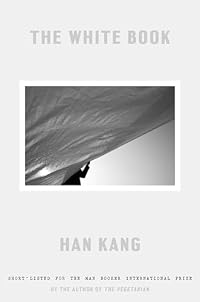
On This Page
Description
A lyrical exploration of personal grief, conveyed through the prism of the color white, finds a nameless writer grappling with a haunting family tragedy involving the infancy death of her older sister.Tags
Recommendations







Member Reviews
I swallowed this book whole in one bite. Sad, airy in a way that contradicts its sorrow. This passage at the end of page 132 (only a handful of chapters make it to the verso) struck me:
“And so there are a few things left to her:
To stop lying.
To (open her eyes and) remove the veil.
To light a candle for all the deaths and spirits she can’t remember—including her own.
“And so there are a few things left to her:
To stop lying.
To (open her eyes and) remove the veil.
To light a candle for all the deaths and spirits she can’t remember—including her own.
"Översatt från koreanskan av...", står det i början. Det är förstås en markering; Efter att först blivit kritikerälskling har Han också blivit kritiserad för sitt nära samarbete med sin engelska översättare, med argumentet att utländska läsare får läsa något helt annat än det Han ursprungligen skrev för sin koreanska publik, som om det alls vore möjligt att läsa originalverket på ett annat språk opåverkat av översättningen. (Spelar det också in att amerikaner, generellt, är ovana att alls läsa översatt litteratur och betraktar hela grejen med en viss skepsis? Inte omöjligt.) Men där hennes två förra översattes till svenska från engelska är vi alltså nu "rena" igen: direkt från koreanskan till show more svenskan, utan anglofona föroreningar.
Den vita boken handlar just om föroreningar, om översättningar, om hypotetiska opåverkade liv. Om hur "blank", "blanc" och "black" egentligen är samma ord. Om den vita snön som inte kan betraktas utan att förstöras. Men framför allt om en storasyster som dör, två timmar gammal, åratal innan berättaren själv föds, trots att hennes unga mor bönfaller henne att inte dö. I korta, poetiska kapitel som omväxlande påminner om både Tranströmer, Lispector och Paddy McAloon vandrar berättaren runt både i faktiska världar och i tänkta, betraktar Warszawas återuppbyggda centrum ovanpå ruinerna där staden utplånades 1944, och kommer slutligen in på systern - vem vore hon om hon levat? Vem vore berättaren om hennes syster levat? Låter henne konjunktiva runt i en tänkt värld, skåda hennes egna minnen ett antal år tidigare, fundera på livet, på det oförstörda som aldrig kan förbli oförstört... show less
Den vita boken handlar just om föroreningar, om översättningar, om hypotetiska opåverkade liv. Om hur "blank", "blanc" och "black" egentligen är samma ord. Om den vita snön som inte kan betraktas utan att förstöras. Men framför allt om en storasyster som dör, två timmar gammal, åratal innan berättaren själv föds, trots att hennes unga mor bönfaller henne att inte dö. I korta, poetiska kapitel som omväxlande påminner om både Tranströmer, Lispector och Paddy McAloon vandrar berättaren runt både i faktiska världar och i tänkta, betraktar Warszawas återuppbyggda centrum ovanpå ruinerna där staden utplånades 1944, och kommer slutligen in på systern - vem vore hon om hon levat? Vem vore berättaren om hennes syster levat? Låter henne konjunktiva runt i en tänkt värld, skåda hennes egna minnen ett antal år tidigare, fundera på livet, på det oförstörda som aldrig kan förbli oförstört... show less
4.25
Starkly different than her other works, the White Book is blends fiction, poetry and her personal experiences to produce this genre defying mediation on loss and grief around her relationship with the colour white. It also has scattered photographs within.
The book contains disjointed but connected pieces of thoughts and experience shared in the form of prose or/and poetry centering around a white object - white paint, breastmilk, clouds, the moon, etc. At the heart of this tale is the story that the narrator grows inside of her - the story of her older sister who passed away within 2 hours of her birth. Through this story she reflects on her own existence and mortality.
It is an extremely beautiful and imaginative piece of work. It show more reminded be of Bluets by Maggie Nelson minus the theoretical aspects. I connected with this book deeply. I enjoy such poetic stream of consciousness style of works. I enjoy (in a way) explorations of themes of loss, death and mortality. I enjoy poetry a lot. So this book seemed my type, I was very excited to read it and I'm happy to report it met and sort of exceeded my expectations. show less
Starkly different than her other works, the White Book is blends fiction, poetry and her personal experiences to produce this genre defying mediation on loss and grief around her relationship with the colour white. It also has scattered photographs within.
The book contains disjointed but connected pieces of thoughts and experience shared in the form of prose or/and poetry centering around a white object - white paint, breastmilk, clouds, the moon, etc. At the heart of this tale is the story that the narrator grows inside of her - the story of her older sister who passed away within 2 hours of her birth. Through this story she reflects on her own existence and mortality.
It is an extremely beautiful and imaginative piece of work. It show more reminded be of Bluets by Maggie Nelson minus the theoretical aspects. I connected with this book deeply. I enjoy such poetic stream of consciousness style of works. I enjoy (in a way) explorations of themes of loss, death and mortality. I enjoy poetry a lot. So this book seemed my type, I was very excited to read it and I'm happy to report it met and sort of exceeded my expectations. show less
‘’I hold nothing dear. Not the place where I live, not the door I pass through every day, not even, damn it, my life.’’’
In the beautiful, mysterious world of colours white retains an exceptional position. White is purity, light, clarity, sanctity, fragility. White is the symbol of the union between two people and the colour of mourning in East Asian culture. In Greece, white is the colour of purity and the sun. The houses in our islands are white-washed to reflect its rays. In China, white is worn in funerals to symbolize gratitude and in Korea, it symbolizes the clarity of the passage to a less troubling world. In Peru, white is associated with good health and prosperity. In the Balkan countries, white is associated with show more snow, light and the wisdom of the human race. White is the colour of peace seen in the White Flag of truce and ceasefire, the hope for the end of violence in its most terrible form, the war. White is the colour of the angels and the colour of ghosts. In Han Kang’s shuttering account, white is despair and hope, pain and winter. It is an elegy for a life taken too soon and a chance that was never granted.
‘’Snow had begun to scatter down. Outside, the alley had darkened, the street lights were not yet on. Paint tin in one hand, brush in the other, I stood unmoving, a dumb witness to the snowflakes’ slow descent, like hundreds of feathers feathering down.’’
The beauty of the snowflakes, the mystery of the fog. The white of our bones, these God-given miracles that construct our very being, so strong and yet so fragile. The white of a mother’s milk, the very essence that keeps us alive when we need it most. The moon with its white light that keeps us company during the long nights when our thoughts keep us awake and our fears acquire substance. When the face of the Man on the moon gazes at us kindly, with sympathy because he knows. The white nights in summer that protect us from the darkness. The secrets of the mysterious colour compose a haunting elegy to a stillborn sister. A symphony written in Warsaw with echoes of Seoul, beautiful cities where winter freezes everything and paints in white and grey, the colours of the ashes…
One of the most haunting, beautiful, raw books that will ever grace our world…
‘’In this city of severe winters, a December night unspools itself around her. The darkness outside the window has no moon to soften it. In the small workshop to the rear of the building, presumably as a security measure, a dozen electric lights are left on all through the night. She looks at the patches of illumination, scattered and isolated amid the black.’’
My reviews can also be found on https://theopinionatedreaderblog.wordpress.com show less
In the beautiful, mysterious world of colours white retains an exceptional position. White is purity, light, clarity, sanctity, fragility. White is the symbol of the union between two people and the colour of mourning in East Asian culture. In Greece, white is the colour of purity and the sun. The houses in our islands are white-washed to reflect its rays. In China, white is worn in funerals to symbolize gratitude and in Korea, it symbolizes the clarity of the passage to a less troubling world. In Peru, white is associated with good health and prosperity. In the Balkan countries, white is associated with show more snow, light and the wisdom of the human race. White is the colour of peace seen in the White Flag of truce and ceasefire, the hope for the end of violence in its most terrible form, the war. White is the colour of the angels and the colour of ghosts. In Han Kang’s shuttering account, white is despair and hope, pain and winter. It is an elegy for a life taken too soon and a chance that was never granted.
‘’Snow had begun to scatter down. Outside, the alley had darkened, the street lights were not yet on. Paint tin in one hand, brush in the other, I stood unmoving, a dumb witness to the snowflakes’ slow descent, like hundreds of feathers feathering down.’’
The beauty of the snowflakes, the mystery of the fog. The white of our bones, these God-given miracles that construct our very being, so strong and yet so fragile. The white of a mother’s milk, the very essence that keeps us alive when we need it most. The moon with its white light that keeps us company during the long nights when our thoughts keep us awake and our fears acquire substance. When the face of the Man on the moon gazes at us kindly, with sympathy because he knows. The white nights in summer that protect us from the darkness. The secrets of the mysterious colour compose a haunting elegy to a stillborn sister. A symphony written in Warsaw with echoes of Seoul, beautiful cities where winter freezes everything and paints in white and grey, the colours of the ashes…
One of the most haunting, beautiful, raw books that will ever grace our world…
‘’In this city of severe winters, a December night unspools itself around her. The darkness outside the window has no moon to soften it. In the small workshop to the rear of the building, presumably as a security measure, a dozen electric lights are left on all through the night. She looks at the patches of illumination, scattered and isolated amid the black.’’
My reviews can also be found on https://theopinionatedreaderblog.wordpress.com show less
This is the fourth Han Kang book I've read, and so far my favorite of hers. All her books have been poetic, but The White Book, translated by Deborah Smith, comes across to me as more so. The chapters are short, many are a single page, many invite me to reread, make me want to have my own copy of this book.
Everything is cast in terms a lost older sister, a first baby who died less than two hours after being born. The unnamed narrator uses white things for each chapter title, snow, swaddling clothes, more. Some of these white things are described in first person, some in third.
All the white things are described succinctly, carefully, physically, emotionally, and well.
Everything is cast in terms a lost older sister, a first baby who died less than two hours after being born. The unnamed narrator uses white things for each chapter title, snow, swaddling clothes, more. Some of these white things are described in first person, some in third.
All the white things are described succinctly, carefully, physically, emotionally, and well.
It has taken me a while to finish. Rather like a good book of poetry, each piece needs to be savored before one moves on. Written while the author was at a writer's retreat in Warsaw, it has been described as a meditation on white, and that is as good a description as any. Looking at it from this angle, it seems very much like a writing exercise. Each short piece--some only a paragraph, the longest a few pages--observes and reflects on something white: a dog, snow, wings, breast milk, lace curtains, a shroud, paper, etc. Underlying many of these meditations is a sense of loss, of mourning for the older sister who died only a few hours after her premature birth.
It was useful to look up the symbolism of the color white in Korean culture: show more "White is the most commonly used color in Korea. Koreans were sometimes referred to as the white clad people. Historically, commoners wore white hanboks, a traditional Korean form of attire. Only royalty and the upper class were permitted to wear colorful hanboks. White is still worn for weddings, new years celebrations and funerals to celebrate the journey to the afterlife, the color white symbolizes purity, innocence, peace and patriotism. Traditionally, white represents the element metal and the direction West." (I expected that, as in Japanese culture, white was the color of death; it is not.) There are some obvious connections to the meditations as Han Kang reflects on the innocent life lost, on mourning, and on healing.
If you are familiar this author's other books, The Vegetarian and Human Acts, expect the same beautiful writing, minus the violence, in condensed form. Don't expect a strong linear plot or a political message, and give each piece time to do its work. Accept the book for what it is, a meditation and an opening of the heart and mind. show less
It was useful to look up the symbolism of the color white in Korean culture: show more "White is the most commonly used color in Korea. Koreans were sometimes referred to as the white clad people. Historically, commoners wore white hanboks, a traditional Korean form of attire. Only royalty and the upper class were permitted to wear colorful hanboks. White is still worn for weddings, new years celebrations and funerals to celebrate the journey to the afterlife, the color white symbolizes purity, innocence, peace and patriotism. Traditionally, white represents the element metal and the direction West." (I expected that, as in Japanese culture, white was the color of death; it is not.) There are some obvious connections to the meditations as Han Kang reflects on the innocent life lost, on mourning, and on healing.
If you are familiar this author's other books, The Vegetarian and Human Acts, expect the same beautiful writing, minus the violence, in condensed form. Don't expect a strong linear plot or a political message, and give each piece time to do its work. Accept the book for what it is, a meditation and an opening of the heart and mind. show less
A short and intensely personal and poetic meditation but a very difficult one to encapsulate in a review.
The starting point is a simple list of white things but the book is haunted by many darker undertones. I am not sure how much I understood but it felt profoundly human, spare and elegant, every word charged.
This is my second book from the Man Booker International longlist (I had already read [b:Die, My Love|36098957|Die, My Love|Ariana Harwicz|https://images.gr-assets.com/books/1507922567s/36098957.jpg|23858652] and bought this one before it was announced).
The starting point is a simple list of white things but the book is haunted by many darker undertones. I am not sure how much I understood but it felt profoundly human, spare and elegant, every word charged.
This is my second book from the Man Booker International longlist (I had already read [b:Die, My Love|36098957|Die, My Love|Ariana Harwicz|https://images.gr-assets.com/books/1507922567s/36098957.jpg|23858652] and bought this one before it was announced).
Members
- Recently Added By
Lists

Books Read in 2019
4,052 works; 110 members

Korean literature
68 works; 5 members

2026
17 works; 1 member
Author Information

Some Editions
Awards and Honors
Series

Common Knowledge
- Canonical title
- The White Book
- Original title
- 흰
- Alternate titles*
- Hŭin
- Original publication date
- 2017 (English translation) (English translation); 2016
- Important places
- Korea; Seoul, South Korea; Warsaw, Poland; Sweden
- First words
- In the spring, when I decided to write about white things, the first thing I did was make a list.
- Last words
- (Click to show. Warning: May contain spoilers.)Within that white, all of those white things, I will breathe in the final breath you released.
- Blurbers
- McInerney, Lisa; McBride, Eimear
- Original language
- Korean
*Some information comes from Common Knowledge in other languages. Click "Edit" for more information.
Classifications
- Genres
- Fiction and Literature, General Fiction
- DDC/MDS
- 895.735 — Literature & rhetoric Asian Literature Literatures of East and Southeast Asia Korean Korean fiction 2000–
- LCC
- PL992.26 .K36 .H8413 — Language and Literature Languages and literatures of Eastern Asia, Africa, Oceania Languages of Eastern Asia, Africa, Oceania Korean language and literature Korean literature Individual authors and works
- BISAC
Statistics
- Members
- 933
- Popularity
- 28,409
- Reviews
- 37
- Rating
- (3.87)
- Languages
- 16 — Catalan, Chinese, Danish, Dutch, English, Finnish, German, Italian, Korean, Norwegian (Bokmål), Polish, Portuguese, Romanian, Spanish, Swedish, Turkish
- Media
- Paper, Audiobook, Ebook
- ISBNs
- 36
- ASINs
- 9