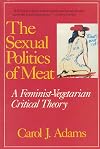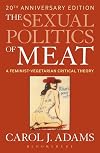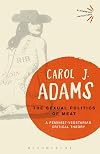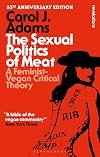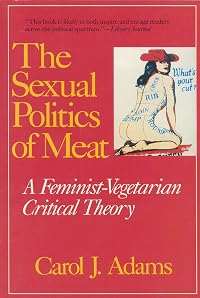
The Sexual Politics of Meat: A Feminist-Vegetarian Critical Theory
by Carol J. Adams
On This Page
Description
"The Sexual Politics of Meat is Carol Adams' inspiring and controversial exploration of the interplay between contemporary society's ingrained cultural misogyny and its obsession with meat and masculinity. First published in 1990, the book has continued to change the lives of tens of thousands of readers into the second decade of the 21st century. Published in the year of the book's 25th anniversary, the Bloomsbury Revelations edition includes a substantial new afterword, including more than show more 20 new images and discussions of recent events that prove beyond doubt the continuing relevance of Adams' revolutionary book."-- show lessTags
Recommendations
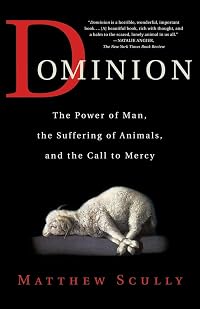
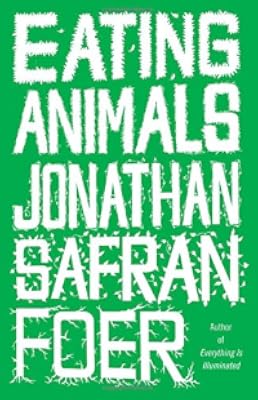
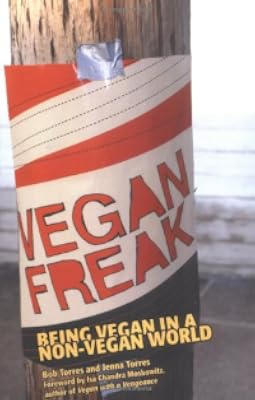
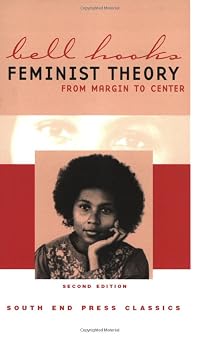





Member Recommendations
Member Reviews
Highly recommended. The title says it all.
Among a whole lot of ‘worth mentioning’, I’ll mention the reference to Irving Fisher’s study (p.43) involving meat-eating athletes, vegetarian athletes, and vegetarian non-athletes. Vegetarians, whether athletes or not, had the greatest endurance (as measured by three strength tests). “Even the maximum record of the flesh-eaters was barely more than have the average for the flesh-abstainers.”
And it got me thinking again about why men suddenly do the cooking when it involves barbecue. I’d thought simply it was because one barbecues outdoors. Women=indoors. Men=outdoors. But now, I’m seeing too it’s fire. Danger! And, of course, meat. Status. A perfect trinity.
Among a whole lot of ‘worth mentioning’, I’ll mention the reference to Irving Fisher’s study (p.43) involving meat-eating athletes, vegetarian athletes, and vegetarian non-athletes. Vegetarians, whether athletes or not, had the greatest endurance (as measured by three strength tests). “Even the maximum record of the flesh-eaters was barely more than have the average for the flesh-abstainers.”
And it got me thinking again about why men suddenly do the cooking when it involves barbecue. I’d thought simply it was because one barbecues outdoors. Women=indoors. Men=outdoors. But now, I’m seeing too it’s fire. Danger! And, of course, meat. Status. A perfect trinity.
I read this sometime between undergrad and grad school and recall being struck by it, almost like being bludgeoned. But it was passionate, vital even. It impacted me in ways I still can't define and all these years later, I don't know if I have yet to come up with a definitive view of the book's thesis. Nonetheless, I think most people should be exposed to this, so recommended.
Well researched and pretty comprehensive. Some pretty strong arguments. Adams makes some pretty compelling arguments linking the oppression of women to domination of animals. Some of the book was theoretically light: could use a stronger theory of subjectivity and felt at times a bit simplistic/essentialist. Decent and quick read. Accessible.
An absolutely fascinating book. Carol J. Adams outlines in detail the intricacies that connect feminism and vegetarianism. She makes many strong arguments. Very well planned and thought-out. An enlightening volume.
Experiments in Reading
Experiments in Reading
A bit of a polemic, but nevertheless quite good and thought provoking. I read this a long time ago; I think in 1992, and it had big effect on me. I had been a vegetarian already for 4 years, but this book helped me better articulate some of the reasons behind my decision.
made me think about and consider many things i hadn't before--very interesting though i'm not sure all her views are entirely valid.
"What do you want with the tinder box?" asked the soldier.
"That's got nothing to do with you!" said the witch. "You've got your money all right. Just give me the tinder box."
"Fiddlesticks!" said the soldier. "You tell me straight off what you mean to do with it, or I'll out with my sword and cut your head off."
"No!" said the witch.
So the soldier cut her head off. There she lay! But he tied up all his money in her apron, shoved the tinder box into his pocket and went straight to the town.
— Hans Christian Andersen, The Tinderbox (1835)
On the Uses of Hysteria
The animal servants of fairytale fame are always available at the strike-of-a-match. I'm thinking specifically of Hans Christian Andersen's The Tinderbox (1835) in which show more impeccably-trained dogs pop into existence on command. We imagine such servants still exist even when we cannot see them. In fact it's plausible that, being dismissed, they remain with us — at our ease — invisible.
The protagonists of these stories, invariably a young man, nouveau riche, can expect to find himself caught in a narrative convention: at the pivotal moment he will find himself deprived of the invisible aid upon which he has come to depend. At the height of tension — if this moment is given space to breathe — we will discover him becoming hysterical, crying out for reprieve so fantastic that, were it to exist, could only be invisible.
In such scenes, young men become in fact the spitting image of the so-called hysterical feminist-slash-animal-activist. For her, the problem is that, though she spits facts, she cannot make her interlocuter see the reality he [sic] finds highly implausible, and which also brushes against the grain of his own self-interest. (Nota Bene, The major difference is that in the scene to follow, with his command of animals restored, the fairy tale prince has his tormenters torn to shreds. Our activist, if she is fortunate, merely has the last laugh.) So the familiar taunt, "Is the patriarchy in the room with us right now?" Well yes, it is. Can't you see it.
When dogs don't come when they're called, that's a failed doordash delivery — women who could have given themselves to us (but chose not to) — in short, a crisis for a fairy tale. The feminist has rarer success: When has patriarchy ever been called to account — and actually made an appearance. In fact, she has never been able to make patriarchy appear in visible form, even for herself. (This seems to be the source of rankles for that so-called "white-feminism" — the pioneers, albeit unfortunately insufficiently intersectional. Were the patriarchy called up for inspection — presenting himself well-shod and gorged on so-called third-world capital — certainly we imagine them clever enough to inquire after who made the leather in those boots. . .)
The task for the animal-activist, a similar case, is to cover — over ground of a different topography — problems of the field of holocaust studies. She must communicate, across space and time, the reality of something — a killing — happening elsewhere. She shares her project with an unlikely ally: the literary-writer-for-boys. E.g. Cormac McCarthy, whose brutal scenes, so well-centered on the page, are nevertheless always engaged in a losing struggle. Whether early efforts in purple prose (Blood Meridian, 1985) or his later pared-down paragraphs (The Road, 2006) the author finds that, despite his powers, he cannot make the act of killing appear on the page.
There is a "constituting" absence at the center of discourse. The problem for The Sexual Politics of Meat (1990) is that it takes this as a new problem for feminism-slash-animal-activism, "Behind every meal of meat is an absence: the death of the animal whose place the meat takes. The 'absent referent' is that which separates the meat eater from the animal and the animal from the end product [. . .] Once the existence of meat is disconnected from the existence of an animal who was killed to become that "meat," meat becomes unanchored by its original referent (the animal), becoming instead a free-floating image, used often to reflect women's status as well as animals " (25). The "absent referent", as elaborated by Adams here, differs from the approaches of Marx's "Labor Power," Foucault's "Power," Agamben's "Homo Sacer" (not yet written), in the sense that it always demands (perhaps prematurely) a call to action, an unmasking. Specifically, the "absent referent," always demands that the "death of the animal" be made visible (across time and space). Of course, the nature of discourse is that this cannot be done (you can't put killing on the page), but we'll see it try. “When referring to animal suffering and death caused by human action, use painfully explicit words that reveal the true facts. "Euthanize," "put to sleep," [. . .] "cull," and "thin the herd" are favorites of hunters, trappers, and their ilk. These words mean kill, so say kill" (100). The phrase "killing animals" perhaps gets you closer to where Adams wants than the old euphemisms did, but this remains, in Anne Carson's phrase, "a long trip on a slow road" (Antigone, 2015). Along this path animal activism finds itself in same (ironic) situation as exorcisms and holocaust-studies. In order to end the killing, to banish the demon, to make certain it never happens again, first she must call into existence precisely what she wants to extirpate. Not even the "hunter, trapper, and their ilk" want to re-live the death of the animal. He finds it vulgar that it's all she wants to talk about. The die-hard antisemite, like the bad lay, only cares about the end. He's not interested in "process." The exorcist gets a drubbing from the other members of the clergy; just being good is hard enough — and now we have to deal with these demons!
So the "absent referent" isn't like the scientific "missing link," which pops into existence when its hiding place is discovered, helping to solve the thorny taxonomy. In fact, it's more like the "missing link" in the evangelical religious sense: A telescoping argument in which every new piece of evidence in the fossil record merely establishes the empty space the next "missing link" must fill in the qualitative (read: unbridgeable) gap between animals and humans. Evidence caught in this trap finds itself silenced the moment it makes an appearance. The "absent referent" becomes something like the untouchable Lacanian "real" in the process of triangulation by strategies of the "imaginary" and "symbolic." (And certainly this paper is always being written. . .)
It would be more productive, perhaps, to investigate the similarities this bind shares with the condition of "hysteria." As Irigaray elaborates, the hysteric is someone who has "disappeared into nature," who speaks, but only in the mode of the incommunicable, "Does the hysteric speak? Isn't hysteria a privileged place for preserving — but "in latency" — that which does not speak? [. . .] Those aspects of women's desires that find themselves reduced to silence in terms of a culture that does not allow them to be expressed. A powerlessness to "say," it speaks in the mode of a paralyzed gestural faculty, of an impossible and also a forbidden speech.” (Luce Irigaray, The Sex Which is Not One, 1977). In retrospect, it appears as a major lapse that The Sexual Politics of Meat (1990), ostensibly situated at the intersection between feminist studies and animal studies, isn't exploiting the "hysterical" for ammunition. (I count a single mention of the term in my perusal (read: word search) of the entire text.) On the subject of the "absent referent," the hysterical-bind is precisely the fix in which the text finds itself i.e. tasked with "an impossible and also a forbidden speech." (Can the subaltern hysteric speak — if a[n] lion hysteric could speak, we could not understand her.) We expect accusations of hysteria to confront Adams's critique of killing animals. On the feminist angle it goes without saying. The point isn't that she should argue, "you say we're hysterical but we're not." The point is to ask the question, "what is this 'hysterical' you are talking about?"
Were this text tuned to the (subsonic) resonances of hysteria perhaps it would have scented out the sites where the "sexual politics of meat" has its source. We think the problem goes deeper than the specimen cases featured in this text, i.e. adverts juxtaposing the sensualized female body and the animal product, or the anthropomorphized-slash-feminized-animal — a sexy shrimp in lipstick — which appears to delight in her own consumption. Deborah Levy's playful Diary of a Steak (1997), written during an outbreak of real mass-hysteria (Bovine Spongiform Encephalopathy i.e. Mad Cow Disease) in the United Kingdom, is much more serious on this subject.
above all: She liked her anorexic condition.Are Mad Cows hysterical, well technically yes and technically no. They behave hysterically, and it's catching. Perhaps they could benefit from psychotherapy. No one has tried this. And there is an hereditary component, no? Your mother had it, well good luck. Electroconvulsive therapy, that effective treatment for hysterical depression, has its analog in the bovine stun-gun. Her body, not her choice. Diary (1997) goes beyond the pictorial juxtapositions of Adams's text to investigate the cathected spaces in which sexuality and the consumption of meat intersect. Do men eat meat for muscles, is steak a reasonable meal for a man, does steak taste good, do you taste good — the answers to these questions, which men hold to be self-evident, only sound reasonable in the social context in which meat has been normalized. For the state in which steak cannot be eaten (briefly, the U.K.), an answer to these questions sounds hysterical.
Case History, (for the distinguished gentlemen)
Name: Aberdeen Augustine
Age: Under 30 months.
Symptoms: d d d insistence that language directly expresses the physical human being.
Place of Birth: East Grinstead/Scotland.
Gestures: Shit anywhere.
Appearance: Pierced ears, big boned, mixed
parentage - black and white.
Diet: ether, chloroform.
Mother was an eating machine. Father [. . .] copulated with a large leather mock up of Mother and his semen was transferred via a glass tube [. . .] I think I was a Friesian Hereford cross, with plentiful width. Mother showed me how to do it. Hysteria. I learnt all I know from her milk. She taught me everything. Perfected my falls. Rolled my eyes. She made me do it again and again. I have made a career out of melancholy and mania. Please gentlemen: I would like to perform for you my erotic music. It's a sort of unconscious reverie in which I give expression to my
d d d
double d cups
— Deborah Levy Diary of a Steak (1997)
The meat-eater only barely masks his (latent) hysteria. With his declamation that vegetables are "rabbit food," doesn't he insinuate a moment of becoming-animal. Trans-substantiated into a hare yourself, you forfeit your Human Rights — ultimately you will be shot [if you're game]. His concern about getting enough protein — Doesn't this speak to an obsession over stunted growth, the loss of labor power, forfeiting class stability, becoming a ward of the state, subsequently emasculated and-slash-or decapitated (both of which, to him, are the same thing). His argument that he just likes the taste — Doesn't this refusal to engage with the question incidentally appropriate for himself the ethical position of an animal which cannot be judged for its instincts. Doesn't this speak to the fear that he has lived his whole life in error, and remains in the error-process. Doesn't his interlocutor seem to become, in this moment, something like his father who stands in judgment, and whom he repudiates so strongly with feelings he didn't know he had — "Am I a good person or no."
It's the double-bind of hysteria that, in order for the hysteric to be capable of giving voice to these questions in earnest, he must long-ago have thought out their answers. So the famous masculine silence. The soldier of The Tinderbox (1835) decapitates (read: emasculates) the witch of the fairy tale (and gets away with it!) because he perceives as insult the silence in which he sees himself reflected. In such stories the insulting silence is itself a deadly threat. So violence is, after all, only self-preservation for a chief character who never dies. The immortal soldier who tricks death in a fairy tale, cutting off its wick, does what the listener wants to do in reality, which is to slay death in a fantasy. To encounter the opposition against which one has absolutely no chance of success, to run from it indefinitely, and finally to reason that even though such a thing exists, it in fact does not; this is precisely the relation of anxiety towards the inevitability of death. This is also man's relation to the question of killing animals: he is certainly in the wrong, but in fact is not. Man has long felt himself exposed here, and seems to have felt this in his earliest texts. Perhaps this is why the Bible is so quick to declare the right of domination. (Nota Bene, Genesis 1:26 is one of the first recorded cases of premature-creation. It justifies the domination of animals by a mankind which does not even exist until the following line, Genesis 1:27.) Was the tree of knowledge, then, a sheep — the nakedness of the biblical-shepherd only becomes self-conscious — in need of a cover-story — when he takes up the idea of killing the animal he has known so intimately.
It's the double-bind of the "absent referent," that, were it ever to succeed in its object — making an explicit connection between the living and the dead — this would still be a form of failure. The "absent referent" cannot make the killing appear, and moreover, it cannot make the killing have an effect. It seems that the conviction to not eat animals comes first, then the reason follows. Little girls refuse to eat lamb, then in college they figure out good reasons why. This has long been the predicament for animal studies. We have observed this no less in contemporary feminisms: Who wants to "solicit" gender the way Judith Butler lays it out in Gender Trouble (1989); well, those who have already found it necessary to do so. What The Sexual Politics of Meat (1990) gets from admonishment, then, is something other than what it thinks:
"Him: I can't go to Italian restaurants with you anymore because i can't order my favorite meal: veal Parmesan.It is an error to assumes that what affects her — the killing of animals — should also affect him. The meat eater says "yes". He finds himself totally capable of braining the baby calf, and moreover — though he has always been hysterical — he finds it has no effect. The emphasis lies elsewhere: As Adams' example shows, he doesn't eat veal anymore, not because he has been convinced, but by force of habit. He has always been susceptible to displays of hysteria, which touch the part of him he has disavowed. She always remains capable of creating an hysterical scene, which, frankly, is her power. show less
Her: Would you order it if it were called pieces of butchered, anemic baby calves” (102).
Members
- Recently Added By
Lists

Bloomsbury Publishing
37 works; 2 members

Favorite Animal Non-Fiction
293 works; 144 members

Stuff from Bard
70 works; 1 member
Author Information

32+ Works 1,579 Members
Carol J. Adams is a nationally known writer and lecturer on the vegetarian lifestyle, constantly speaking at conferences an academic meetings and on college campuses across the country. Her landmark book "The Sexual Politics of Meat" was recently reissue on its 10th anniversary. She also authored the "Inner Art of Vegetarianism" series. Adams show more lives in Texas. (Bowker Author Biography) show less
Series
Belongs to Publisher Series
Common Knowledge
- Original title
- The Sexual Politics of Meat
- Original publication date
- 1990
Classifications
- Genres
- Nonfiction, Sexuality and Gender Studies, General Nonfiction, Philosophy, Literature Studies and Criticism
- DDC/MDS
- 179.3 — Philosophy & psychology Ethics Other ethical norms Treatment of animals
- LCC
- HV4708 .A25 — Social sciences Social pathology. Social and public welfare. Criminology Social pathology. Social and public welfare. Protection, assistance and relief Protection of animals. Animal rights. Animal
- BISAC
Statistics
- Members
- 699
- Popularity
- 40,781
- Reviews
- 7
- Rating
- (3.81)
- Languages
- 6 — English, French, German, Italian, Portuguese, Spanish
- Media
- Paper, Audiobook, Ebook
- ISBNs
- 20
- UPCs
- 1
- ASINs
- 12