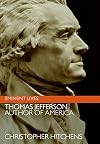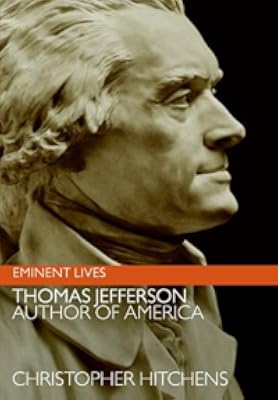
Thomas Jefferson: Author of America
by Christopher Hitchens
On This Page
Description
Hitchens brings the character of Jefferson to life as a man of his time and also as a symbolic figure beyond it. Conflicted by power, Jefferson wrote the Declaration of Independence and acted as Minister to France yet yearned for a quieter career in the Virginia legislature. Predicting that slavery would shape the future of America's development, this professed proponent of emancipation continued to own human property. He negotiated the Louisiana Purchase with France, doubling the size of show more the nation, and authorized the Lewis and Clark expedition, opening up the American frontier. The Barbary War, a lesser-known chapter of his political career, led to the building of the U.S. Navy and the fortification of America's reputation regarding national defense. In the background is the fledgling nation's struggle for independence, formed in the crucible of the eighteenth-century Enlightenment, and, in its shadow, the deformation of that struggle in the excesses of the French Revolution. --From publisher description. show lessTags
Recommendations






Member Reviews
A short and astute biography of one of history's most important figures, Thomas Jefferson. Essayist Christopher Hitchens has always been engaging on Enlightenment principles and the founding of independent America, and he is in his element here in discussing "the only revolution that still retains any power to inspire" (pg. 188).
His thesis is that the United States' third president, and the primary author of its Declaration of Independence, can be said to be the 'author of America'. The man oversaw the country's development "from colonial settlement to continental nationhood" (pg. 168), and amongst Jefferson's many achievements, Hitchens pinpoints the war on the Barbary states, the Louisiana Purchase and the Lewis and Clark expedition show more as evidence of his unimpeachable influence. It is a heady argument and one well-made by Hitchens. Primarily an essayist, commentator and polemicist, Hitchens is rarely at his best in historian mode, but this book is perhaps the finest of his histories.
If there is one flaw, it is that Jefferson's political development over the years on sore subjects (such as slavery) is told rather than shown, and despite Hitchens' best efforts it is still hard to get the measure of his subject. The famous stark contrast between Jefferson the rationalist and author of independence, and Jefferson the slave-owner, remains as stubbornly unresolved as ever. Hitchens does very well to address the slavery and Sally Hemings questions, but who Jefferson was, in all his 'multitudes' (pg. 188), remains elusive.
The somewhat-unspoken conclusion Hitchens makes comes from his focus on Jefferson's role as prescient nation-builder. Even as he criticises the famous line that 'if Jefferson was wrong, America is wrong; and if America is right, Jefferson is right' (pg. 186), Hitchens seems to acknowledge that the two are inextricably linked. The American experiment is Jefferson's experiment. So what drives this ambition? What drives this country of pastoral settlers to dominate a vast continent and, from 1945 onwards, the world? What makes a country founded on secular and rationalist lines indulge in piety and racial policy? And what makes a man motivated by principled opposition to tyranny maintain and defend his right to slaveholdings? What makes a lawyer, keen to administer his Virginian estate, even join the fight against the British Empire? The hypocrisies and contradictions of America can also be found in Jefferson, its author, just as its many achievements. Perhaps the most apposite image in Hitchens' book is of Jefferson's famed Monticello estate. Built with windows that minimise the view of slaves on the grounds, the house yet faces ever westward, into the country's future. show less
His thesis is that the United States' third president, and the primary author of its Declaration of Independence, can be said to be the 'author of America'. The man oversaw the country's development "from colonial settlement to continental nationhood" (pg. 168), and amongst Jefferson's many achievements, Hitchens pinpoints the war on the Barbary states, the Louisiana Purchase and the Lewis and Clark expedition show more as evidence of his unimpeachable influence. It is a heady argument and one well-made by Hitchens. Primarily an essayist, commentator and polemicist, Hitchens is rarely at his best in historian mode, but this book is perhaps the finest of his histories.
If there is one flaw, it is that Jefferson's political development over the years on sore subjects (such as slavery) is told rather than shown, and despite Hitchens' best efforts it is still hard to get the measure of his subject. The famous stark contrast between Jefferson the rationalist and author of independence, and Jefferson the slave-owner, remains as stubbornly unresolved as ever. Hitchens does very well to address the slavery and Sally Hemings questions, but who Jefferson was, in all his 'multitudes' (pg. 188), remains elusive.
The somewhat-unspoken conclusion Hitchens makes comes from his focus on Jefferson's role as prescient nation-builder. Even as he criticises the famous line that 'if Jefferson was wrong, America is wrong; and if America is right, Jefferson is right' (pg. 186), Hitchens seems to acknowledge that the two are inextricably linked. The American experiment is Jefferson's experiment. So what drives this ambition? What drives this country of pastoral settlers to dominate a vast continent and, from 1945 onwards, the world? What makes a country founded on secular and rationalist lines indulge in piety and racial policy? And what makes a man motivated by principled opposition to tyranny maintain and defend his right to slaveholdings? What makes a lawyer, keen to administer his Virginian estate, even join the fight against the British Empire? The hypocrisies and contradictions of America can also be found in Jefferson, its author, just as its many achievements. Perhaps the most apposite image in Hitchens' book is of Jefferson's famed Monticello estate. Built with windows that minimise the view of slaves on the grounds, the house yet faces ever westward, into the country's future. show less
There are Hitchens books strewn all over my father's house. "Hitchens makes me remember how little I know," he says. He thrust this book into my hands a while ago when I was visiting. God, another Thomas Jefferson book? I tried to beg off, but it didn't work. And since I feel compelled to read every book my father recommends, I read this one. And I, too, now find Hitchens an intriguing author. This is a crisp, short biography (more of an essay, really) on Jefferson, and its focus is less on the tawdry details of the man's life but more on the small political and personal pieces that made up the man. I was particularly interested in the section on Jefferson's handling of the Barbary pirates. You don't see that treated in popular bios of show more Jefferson. show less
Hitchens' well-written, lucid biography of the US statesman is certainly no whitewash; the portrait he paints shows Jefferson as a flawed figure who shaped the United States both through his drive and enlightenment principles but also through his willingness to sometimes ignore those principles to achieve his goals, occasionally goals that were pure self interest.
Most interestingly, Hitchens successfully places the man and his beliefs in the context of his era. In almost every respect Jefferson was a man ahead of his time, but more so in some ways than others. For instance, while he detested slavery, he in no way believed that blacks were the equals of whites, or that the two 'races' were capable of living together.
This is also a book show more about the American experiment. As Hitchens notes in the closing pages, the American revolution is perhaps the only revolution that has not ultimately consumed itself. But mostly a reminder that, however visionary and revolutionary, it is impossible for anyone to not be a product of their time. As he says in closing, this is "a reminder that history is a tragedy and not a morality tale." show less
Most interestingly, Hitchens successfully places the man and his beliefs in the context of his era. In almost every respect Jefferson was a man ahead of his time, but more so in some ways than others. For instance, while he detested slavery, he in no way believed that blacks were the equals of whites, or that the two 'races' were capable of living together.
This is also a book show more about the American experiment. As Hitchens notes in the closing pages, the American revolution is perhaps the only revolution that has not ultimately consumed itself. But mostly a reminder that, however visionary and revolutionary, it is impossible for anyone to not be a product of their time. As he says in closing, this is "a reminder that history is a tragedy and not a morality tale." show less
A great biography by an outside but not unsympathetic Briton. Christopher Hitchen's style of analyzing people, events, and places within a historical context, tying them to events that came before or come after their passing gives it not only a relevance but a fresh take on what can usually be a stale piece on a Founding Father, and Hitchens' acerbic wit makes you want to read it simply to hear his opinions interwoven into the text ("The Declaration of Independence was one of the only poetically powerful documents to ever emerge from a committee.") Special commentary is given to Jefferson's original draft of the Declaration of Independence and its mention of slavery, a refutation of the classical take on Sally Hemmings, and Jefferson's show more involvement with French revolutionary politics. show less
In this unique biography of Thomas Jefferson, leading journalist and social critic Christopher Hitchens offers a startlingly new and provocative interpretation of our Founding Father. Situating Jefferson within the context of America's evolution and tracing his legacy over the past two hundred years, Hitchens brings the character of Jefferson to life as a man of his time and also as a symbolic figure beyond it. Conflicted by power, Jefferson wrote the Declaration of Independence and acted as Minister to France yet yearned for a quieter career in the Virginia legislature. Predicting that slavery would shape the future of America's development, this professed proponent of emancipation elided the issue in the Declaration and continued to show more own human property. An eloquent writer, he was an awkward public speaker; a reluctant candidate, he left an indelible presidential legacy. Jefferson's statesmanship enabled him to negotiate the Louisiana Purchase with France, doubling the size of the nation, and he authorized the Lewis and Clark expedition, opening up the American frontier for exploration and settlement. Hitchens also analyzes Jefferson's handling of the Barbary War, a lesser-known chapter of his political career, when his attempt to end the kidnapping and bribery of Americans by the Barbary states, and the subsequent war with Tripoli, led to the building of the U.S. navy and the fortification of America's reputation regarding national defense. In the background of this sophisticated analysis is a large historical drama: the fledgling nation's struggle for independence, formed in the crucible of the eighteenth-century Enlightenment, and, in its shadow, the deformation of that struggle in the excesses of the French Revolution. This artful portrait of a formative figure and a turbulent era poses a challenge to anyone interested in American history -- or in the ambiguities of human nature. show less
Having just visited Monticello and gone on the "extended tour", I was again intrigued by TJ. Picking up Hitchens (short, though compact) review of Jefferson's political career and his driving philosophies (as well as his personal deviances from these), was an interesting though incomplete and opinionated view of an incredible and flawed man. It primarily focuses on his (reluctant) political career from the drafting of the Declaration of Independence, his representation in France as the American Minister, his tenure as Secretary of State, and his Presidency. It is a great rambling summary of his political leanings (Republican as opposed to Federalist) and his interactions with his political adversaries and his great friends. Hitchens show more picks certain achievements as "America changing" and argues why. I was less familiar with his decision about the Barbary pirates and the creation of the US Navy and enjoyed learning this. While I've long been a fan of TJ and especially his focus on education, reading this only made me re-realize how human and brilliant and focused he was in so many directions. Not a perfect man, in many respects, but definitely one worthy of study and appreciation. Now onto his book on Gardening... show less
Having just visited Monticello and gone on the "extended tour", I was again intrigued by TJ. Picking up Hitchens (short, though compact) review of Jefferson's political career and his driving philosophies (as well as his personal deviances from these), was an interesting though incomplete and opinionated view of an incredible and flawed man. It primarily focuses on his (reluctant) political career from the drafting of the Declaration of Independence, his representation in France as the American Minister, his tenure as Secretary of State, and his Presidency. It is a great rambling summary of his political leanings (Republican as opposed to Federalist) and his interactions with his political adversaries and his great friends. Hitchens show more picks certain achievements as "America changing" and argues why. I was less familiar with his decision about the Barbary pirates and the creation of the US Navy and enjoyed learning this. While I've long been a fan of TJ and especially his focus on education, reading this only made me re-realize how human and brilliant and focused he was in so many directions. Not a perfect man, in many respects, but definitely one worthy of study and appreciation. Now onto his book on Gardening... show less
Members
- Recently Added By
Author Information

89+ Works 29,944 Members
Christopher Hitchens was born in Portsmouth, England on April 13, 1949. He was a contributing editor to Vanity Fair and wrote for numerous other publications throughout his lifetime. He was the author of numerous books including No One Left to Lie To, For the Sake of Argument, Prepared for the Worst, God Is Not Great, Hitch-22: A Memoir, and show more Arguably. He died due to complication from esophageal cancer on December 15, 2011 at the age of 62. (Bowker Author Biography) show less
Series
Belongs to Publisher Series
Work Relationships
Common Knowledge
- Canonical title
- Thomas Jefferson: Author of America
- People/Characters
- Thomas Jefferson
- Dedication
- For Brian Lamb: a great Virginian and a great American, a fine democrat as well as a good republican, who has striven for an educated electorate.
Classifications
- Genres
- History, Nonfiction, Biography & Memoir, General Nonfiction
- DDC/MDS
- 973.46092 — History & geography History of North America United States Constitutional period (1789-1809) XYZ Affair, Quasi-War, Alien and Sedition Acts Biographies
- LCC
- E332 .H66 — History of the United States United States Revolution to the Civil War, 1775/1783-1861 By period 1789-1809. Constitutional period Jefferson's administrations, 1801-1809
- BISAC
Statistics
- Members
- 798
- Popularity
- 34,876
- Reviews
- 14
- Rating
- (3.77)
- Languages
- English
- Media
- Paper, Ebook
- ISBNs
- 8
- ASINs
- 4