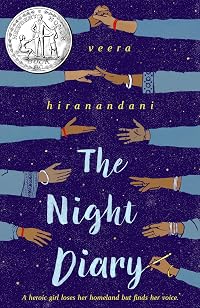
The Night Diary
by Veera Hiranandani
On This Page
Description
Shy twelve-year-old Nisha, forced to flee her home with her Hindu family during the 1947 partition of India, tries to find her voice and make sense of the world falling apart around her by writing to her deceased Muslim mother in the pages of her diary.Tags
Recommendations




Member Reviews
I was very impressed with the writing on this middle grade historical fiction about the 1947 Partition of India. The children Hiranandani wrote felt absolutely real to me. We often think about childhood as this simple, blissful time, and while that is sometimes the case, being a child is utterly bewildering. So much that happens to you is completely outside of your control, and the world moves according to rules you are not remotely equipped to understand, especially in times of conflict. Hiranandani captures this so well. Nisha has many thoughts and many actions that seem crazy through adult eyes, but Nisha doesn't have those. Everything she knows about the world is unraveling, and adults are behaving in dangerous ways that would have show more been crazy the month before, and she is being taxed in physical and emotional ways that the even the adults around her are failing to cope with. She is carrying trauma, and the writing felt like the way a child would try to make sense of it.
I adored Nishi's imperfect but loving family, and appreciate the way this book helped me take the bare facts I already knew about partition and feel it in my bones. show less
I adored Nishi's imperfect but loving family, and appreciate the way this book helped me take the bare facts I already knew about partition and feel it in my bones. show less
The Partition of India in 1947 turned into a brutal bloodbath with everlasting consequences for Hindus living in what is now Pakistan and for Muslims, Sikhs, and Christians from what is now India. This novel tells the traumatic story of the consequences for a doctor's family forced to leave Mirpur Khas and journey to Jodphur in the midst of the violent struggle. Father is raising twelve year old twins Nisha and Amil with help from his mother and their cook Kazi. Amil is always in trouble and Nisha rarely speaks, possibly the result of losing their mother, a Muslim, in childbirth. The narrative is Nisha's diary, and she shares every brief joy and the family's almost fatally long journey. The reader realizes that this is a privileged show more family, and so the oppression of working class and poor people must have been unbearable. Nisha has a strong, sensitive voice and the novel is both brutal and tragic, with small shining glimmers of hope. It's classified as YA but perhaps only to encourage other twelve year olds to try it. A most rewarding read. show less
n 1947, Nisha’s beloved country is being torn apart—and so is her family.
Nisha and her twin brother, Amil, celebrate their 12th birthday in their beloved town of Mirpur Khas, India, a month before their country receives independence from the British and splits into India and Pakistan. Painfully shy, Nisha, who lost her mother in childbirth and feels distant from her stern father and her elderly grandmother, is only able to speak freely with the family cook, a Muslim man named Kazi. Although Nisha’s mother was Muslim, her family is Hindu, and the riots surrounding Partition soon make it impossible for them to live in their home safely despite their mixed faith. They are forced to leave their town—and Kazi. As Nisha and her family show more make their way across the brand-new border, Nisha learns about her family history, not to mention her own strength. Hiranandani (The Whole Story of Half a Girl, 2013) compassionately portrays one of the bloodiest periods in world history through diary entries Nisha writes to her deceased mother. Nisha’s voice is the right mix of innocence and strength, and her transformation is both believable and heartbreaking. Nisha’s unflinching critiques of Gandhi, Nehru, and Jinnah are particularly refreshing in their honesty.
A gripping, nuanced story of the human cost of conflict appropriate for both children and adults. (Historical fiction. 11-adult)
-Kirkus Review show less
Nisha and her twin brother, Amil, celebrate their 12th birthday in their beloved town of Mirpur Khas, India, a month before their country receives independence from the British and splits into India and Pakistan. Painfully shy, Nisha, who lost her mother in childbirth and feels distant from her stern father and her elderly grandmother, is only able to speak freely with the family cook, a Muslim man named Kazi. Although Nisha’s mother was Muslim, her family is Hindu, and the riots surrounding Partition soon make it impossible for them to live in their home safely despite their mixed faith. They are forced to leave their town—and Kazi. As Nisha and her family show more make their way across the brand-new border, Nisha learns about her family history, not to mention her own strength. Hiranandani (The Whole Story of Half a Girl, 2013) compassionately portrays one of the bloodiest periods in world history through diary entries Nisha writes to her deceased mother. Nisha’s voice is the right mix of innocence and strength, and her transformation is both believable and heartbreaking. Nisha’s unflinching critiques of Gandhi, Nehru, and Jinnah are particularly refreshing in their honesty.
A gripping, nuanced story of the human cost of conflict appropriate for both children and adults. (Historical fiction. 11-adult)
-Kirkus Review show less
Nisha lives in India with her father, Dadi (grandmother), twin brother Amil, and their cook, Kiza. When the partition of India makes the area she's living in part of Pakistan, prompting her family to move and leave their Muslim cook behind, she begins writing in a diary addressed to her dead mother, also a Muslim, about the confusion and chaos of her life.
Diary narratives are hard to pull off, and this one does it really well. The places where Nisha doesn't write about events right away make sense, and the writing allows her to develop a voice - quite literally, as Nisha is shy and barely speaks to those around her. The hardships of being a refugee in one's own country are portrayed truthfully and sensitively. Though not always fun to show more read, it was a good book and ended on a hopeful note. show less
Diary narratives are hard to pull off, and this one does it really well. The places where Nisha doesn't write about events right away make sense, and the writing allows her to develop a voice - quite literally, as Nisha is shy and barely speaks to those around her. The hardships of being a refugee in one's own country are portrayed truthfully and sensitively. Though not always fun to show more read, it was a good book and ended on a hopeful note. show less
I've never had a diary before. When Kazi gave it to me, he said it was time to start writing things down, and that I was the one to do it. He said someone needs to make a record of the things that will happen because the grown-ups will be too busy. I'm not sure what he thinks is going to happen, but I've decided I'm going to write in it every day if I can.
The Night Diary is a beautifully written, heartbreaking book, and one of the best I've read this summer. My last read was Ahimsa, a middle grade novel that shows one family's struggle during the Indian independence movement, and how religious and ethnic tensions and violence can flare up seemingly out of nowhere. The Night Diary is set in 1947 just as India is granted independence from show more Britain, but political leaders of the major stakeholders have decided to partition the country: Muslims are to live in the newly-created Pakistan, and Hindus, Sikhs, and other religions will live in India. 12 year-old Nisha and her family are caught between both sides. Her father and grandmother are Hindus, which makes Nisha and her twin brother Amil Hindus. Yet their mother, who died in childbirth, was Muslim, and their home is in Mirpur Khas, which has always been in India. But on August 14, 1947, when India gained independence from the British, and faraway leaders decided that Mirpur Khas was now Pakistan. Nisha and her family are now refugees in their own homeland, and are forced to leave everything behind to make the long, dangerous journey across the new border to India. They join 14 million people also forced to move, in what is the world's largest mass migration. Throughout, Nisha records their hardships, her confused feelings, and her innermost heart in her diary, in which she writes to her much missed mother.
So as of today, the ground I'm standing on is not India anymore. And Kazi is supposed to live in one place and we're supposed to leave and find a new home. Is there a Muslim girl sitting in her house right now who has to leave her home and go to a new country that's not even called India? Does she feel confused and scared, too? show less
The Night Diary is a beautifully written, heartbreaking book, and one of the best I've read this summer. My last read was Ahimsa, a middle grade novel that shows one family's struggle during the Indian independence movement, and how religious and ethnic tensions and violence can flare up seemingly out of nowhere. The Night Diary is set in 1947 just as India is granted independence from show more Britain, but political leaders of the major stakeholders have decided to partition the country: Muslims are to live in the newly-created Pakistan, and Hindus, Sikhs, and other religions will live in India. 12 year-old Nisha and her family are caught between both sides. Her father and grandmother are Hindus, which makes Nisha and her twin brother Amil Hindus. Yet their mother, who died in childbirth, was Muslim, and their home is in Mirpur Khas, which has always been in India. But on August 14, 1947, when India gained independence from the British, and faraway leaders decided that Mirpur Khas was now Pakistan. Nisha and her family are now refugees in their own homeland, and are forced to leave everything behind to make the long, dangerous journey across the new border to India. They join 14 million people also forced to move, in what is the world's largest mass migration. Throughout, Nisha records their hardships, her confused feelings, and her innermost heart in her diary, in which she writes to her much missed mother.
So as of today, the ground I'm standing on is not India anymore. And Kazi is supposed to live in one place and we're supposed to leave and find a new home. Is there a Muslim girl sitting in her house right now who has to leave her home and go to a new country that's not even called India? Does she feel confused and scared, too? show less
Absolutely stellar story of the partition from a child's point of view -- beautifully written -- brings the setting to life and eloquently conveys the heartbreak and confusion of the time without being so graphic as to cause nightmares. Hiranandani creates characters to care deeply about, in all their flaws and humanity, and yet keeps the plot moving and the hardships relocatable. Like many effective war novels, this one is in diary format. There are so many really wonderful war books set in Europe or America. It's wonderful to see someone bring that light to the history of the partition. I hope the Newbery committee is paying attention to this one.
I'm surprised to discover that I love war books -- not because I like war at all, but show more because they remind us of the worst, so that we can appreciate the good in our lives and guard against returning to the depths that history reminds us of. show less
I'm surprised to discover that I love war books -- not because I like war at all, but show more because they remind us of the worst, so that we can appreciate the good in our lives and guard against returning to the depths that history reminds us of. show less
Shy Nisha receives a diary for her twelfth birthday and starts writing updates in it to her mother who passed away when Nisha and her twin brother Amil were born. Within a few weeks of Nisha's and Amil's birthday, India declares its independence from Great Britain. However, this historic events also creates a partition between India and Pakistan, and their Hindu family must flee from their home as it now part of Pakistan ... and also because violence is breaking out between people of different religions who formerly co-existed peacefully.
This book is beautifully written and features a lovely cast of characters who are so human -- flawed but ultimately likable. Nisha in particular is an endearing character, but so are the other members show more of her family. The drama and tension is real (understandably, because it is partially based on actual events) but Hiranandani walks a fine line of realistically explaining the conflict without being overly gratuitous in the violent scenes.
In terms of diversity, Hiranandani showcases characters who are Hindu, Muslim, and Sikh (in addition to Nisha and Amil who actually have one Hindu parent and one Muslim parent) while showing all of the different religious adherents are humane but merely caught up in a larger conflict. Also, it's clear to an adult reader that Amil has dyslexia, although that is not explicitly described using that word in the text. The twins also meet a formerly estranged uncle who has a severe cleft palate, which results in him being unable to speak. show less
This book is beautifully written and features a lovely cast of characters who are so human -- flawed but ultimately likable. Nisha in particular is an endearing character, but so are the other members show more of her family. The drama and tension is real (understandably, because it is partially based on actual events) but Hiranandani walks a fine line of realistically explaining the conflict without being overly gratuitous in the violent scenes.
In terms of diversity, Hiranandani showcases characters who are Hindu, Muslim, and Sikh (in addition to Nisha and Amil who actually have one Hindu parent and one Muslim parent) while showing all of the different religious adherents are humane but merely caught up in a larger conflict. Also, it's clear to an adult reader that Amil has dyslexia, although that is not explicitly described using that word in the text. The twins also meet a formerly estranged uncle who has a severe cleft palate, which results in him being unable to speak. show less
Members
- Recently Added By
Lists

Best Newbery Honor Books
257 works; 32 members

Best middle grade books
130 works; 24 members

Newbery Honor Books By year - II - 1981-2035
143 works; 4 members

Childhood: Books for or about children in different cultures around the wor
345 works; 17 members

BBA Potential: Junior Readers
32 works; 1 member

Youth: Sexuality & Gender
119 works; 1 member

Beautiful Feet Books
304 works; 7 members

Books Read in 2024
4,623 works; 126 members
Author Information

14+ Works 2,607 Members
Some Editions
Awards and Honors
Awards
Distinctions
Notable Lists
Common Knowledge
- Original publication date
- 2018-03-06
- People/Characters
- Nisha; Amil
- Important places
- India; Pakistan
- Important events
- Partition of India
- Dedication
- For my dad
- Publisher's editor
- Tripathi, Namrata
- Blurbers
- Howe, James; Bradley, Kimberly Brubaker; Watson, Renée
Classifications
- Genres
- Kids, Tween, Children's Books, Fiction and Literature
- DDC/MDS
- 813.6 — Literature & rhetoric American literature in English American fiction in English 2000-
- LCC
- PZ7 .H5977325 .N — Language and Literature Fiction and juvenile belles lettres Fiction and juvenile belles lettres Juvenile belles lettres
- BISAC
Statistics
- Members
- 1,237
- Popularity
- 19,938
- Reviews
- 42
- Rating
- (4.17)
- Languages
- 5 — Chinese, English, French, Korean, Portuguese (Portugal)
- Media
- Paper, Audiobook, Ebook
- ISBNs
- 29
- ASINs
- 3