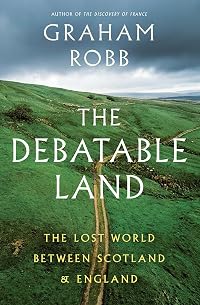
The Debatable Land: The Lost World Between Scotland and England
by Graham Robb
On This Page
Description
Explores the history of the Debatable Land, the former buffer between Scotland and England and once upon a time the bloodiest region in the country.Tags
Recommendations









Member Recommendations
Member Reviews
This is an unexpected gem - set in the borders of Scotland and England, the author tells the history of the area, while he rides around it on a bicycle in appalling weather!
This is the "borders" made famous by Walter Scott's "historical" novels set in the area. Robb makes clear that this "wild west" period was an aberration, and that the area had a much more interesting story to tell.
The "debatable" land was not debatable in the sense of being contentious - the root of the word "batable" meant "fattening" - this was an area for fattening stock. For many centuries, by common agreement, it was used for that purpose. No one lived there, but many used the land as a free agistment paddock.
Then in the 1500s, rivalry between monarchs in show more London and Edinburgh led to outside stoking of wild behaviour. Think Afghanistan. The wild and lawless period then raged, and only died down in the 1600s. The wildness was later captured in highly inaccurate ballads and poems and immortalised. Thus to Walter Scott.
The author then covers early mapping of the area, and UK generally, and highlights the extraordinary accuracy of maps by Ptolemy almost 2,000 years ago.
And then there is a short but convincing foray into the possibility that the original King Arthur may have fought, and died, in this part of the world. show less
This is the "borders" made famous by Walter Scott's "historical" novels set in the area. Robb makes clear that this "wild west" period was an aberration, and that the area had a much more interesting story to tell.
The "debatable" land was not debatable in the sense of being contentious - the root of the word "batable" meant "fattening" - this was an area for fattening stock. For many centuries, by common agreement, it was used for that purpose. No one lived there, but many used the land as a free agistment paddock.
Then in the 1500s, rivalry between monarchs in show more London and Edinburgh led to outside stoking of wild behaviour. Think Afghanistan. The wild and lawless period then raged, and only died down in the 1600s. The wildness was later captured in highly inaccurate ballads and poems and immortalised. Thus to Walter Scott.
The author then covers early mapping of the area, and UK generally, and highlights the extraordinary accuracy of maps by Ptolemy almost 2,000 years ago.
And then there is a short but convincing foray into the possibility that the original King Arthur may have fought, and died, in this part of the world. show less
The Debatable Land makes up part of the border between Scotland and England. At just 13 miles long and 8 miles wide, the territory was initially a sort of no-man’s-land between the two countries, and uninhabited. But from the 13th to 16th centuries, the land was occupied by reivers, clans that seized claim to land, stole cattle and killed anyone who got in their way. Historian Graham Robb traces the development of the Debatable Land and its people, from its earliest days to the present. He examines how people once identified more with a clan than a nationality, despite borders that partitioned the land between the two countries. Even today, the nature of the landscape maintains the Debatable Land’s insular culture.
For me, one of the show more most interesting aspects of the book was Robb’s use of Ptomely’s ancient maps to trace the history of the Debatable Land back to Roman times, which led to a few breakthrough findings about the development of the Debatable Land over the centuries. Then, towards the end of the book Robb discusses the 2014 Scottish independence referendum, which was defeated, and the 2016 Brexit vote, which was not, and the uncertainty cast upon the region and its people. While the Debatable Land no longer exists as a defined territory, it continues to cast a long shadow. show less
For me, one of the show more most interesting aspects of the book was Robb’s use of Ptomely’s ancient maps to trace the history of the Debatable Land back to Roman times, which led to a few breakthrough findings about the development of the Debatable Land over the centuries. Then, towards the end of the book Robb discusses the 2014 Scottish independence referendum, which was defeated, and the 2016 Brexit vote, which was not, and the uncertainty cast upon the region and its people. While the Debatable Land no longer exists as a defined territory, it continues to cast a long shadow. show less
As the title of this book suggests, there’s a pocket of the border between Scotland and England that is considered “debatable land”. Situated between Dumfries & Galloway and Cumbria, this land changed hands several times over its history and its actual boundaries are shrouded in mystery. Robb buys a house that has the border as half its property line, and he decides to look into the history of this area. Along the way he navigates the challenges of living in a deeply rural area without a car and highlights the importance of reliable public transit networks. (As someone who doesn’t drive, I found this thread of the story particularly illuminating, even if it’s not the main focus.)
I liked the idea of this book, but something show more about the writing wasn’t clicking for me. There are rich details, but the writing felt distant. I’d have to read every page about twice; it was the sort of book that I felt should rattle under my eyes like a train on a straight track, but instead it was more like going through Toronto on the 401: stop and go and stop and go.
Perhaps this fussiness could be down to my mood: it might not be the best book to read in the heat of summer. I would therefore still recommend this book if it interests you, because there’s a lot going for it. show less
I liked the idea of this book, but something show more about the writing wasn’t clicking for me. There are rich details, but the writing felt distant. I’d have to read every page about twice; it was the sort of book that I felt should rattle under my eyes like a train on a straight track, but instead it was more like going through Toronto on the 401: stop and go and stop and go.
Perhaps this fussiness could be down to my mood: it might not be the best book to read in the heat of summer. I would therefore still recommend this book if it interests you, because there’s a lot going for it. show less
If you are a Dorothy Dunnett fan this is a must-read. Also if you have a 'Romans in Britain' thing. And perhaps are a bit of a sucker for Arthur speculations. I have them all. The 'debatable land' is a little area on the west side of Great Britain that has been a 'border' and neutral land since humans formed tribes. The very word 'debatable' has no origin in squabbling about whose land it was, but from the word 'batable' which means 'good for grazing'. And from that tidbit on the delights are endless. Robb debunks the reiver mythology, but in a kindly way. Ptolemy all the way in Alexandria makes a map that is insanely accurate and helps open solutions to mysterious references to King Arthur . . . . Robb and his wife move to a little show more house on the English side of the border and he becomes fascinated with everything about this strange little area, now under siege by power companies etc and all those who can't bear to see land sitting idle. **** show less
This book is in many ways a small treasure, discovering and presenting for our delectation the unseen which exists there under our noses but unremarked. It’s full of wide-ranging serendipity, and I’ve already discovered there the solutions to two thorny lexicographical problems.
That said, caveat emptor. The author’s chapter on ancient cartography seems to me hugely unconvincing, more akin to pyramidology and ley lines. “I’ve found the key that unlocks the map!” – Beware.
That said, caveat emptor. The author’s chapter on ancient cartography seems to me hugely unconvincing, more akin to pyramidology and ley lines. “I’ve found the key that unlocks the map!” – Beware.
It may be a really interesting exploration of various aspects of Roman-to-medieval Britain, but I didn't get past about 150 pages.
My greatest difficulty was the author's inability to keep his narrative flowing smoothly. There would be an interesting start to a little anecdote or a piece of history which then was left dangling, never to be referred to further in the following pages. I discovered this tendency right in the beginning when Robb is describing the train station where some poor fellow stuck his head out the window and was decapitated as the train picked up speed past a signal post. And this is told us with no raison d'être, no follow up. What the heck??!!
I did expect to have all sorts of 'myths' exposed as mere tales by show more imaginative inhabitants, but my ability to follow this aspect of the narrative was depressingly foiled. Some of the descriptive passages about the countryside were wonderful reading. Unfortunately, these details didn't clarify the story's theme (which I thought I was following), so my understanding was repeatedly derailed. It may have been my fault as much as the author's style. Nevertheless, I did rate it as 3-stars even though it was a DNF. show less
My greatest difficulty was the author's inability to keep his narrative flowing smoothly. There would be an interesting start to a little anecdote or a piece of history which then was left dangling, never to be referred to further in the following pages. I discovered this tendency right in the beginning when Robb is describing the train station where some poor fellow stuck his head out the window and was decapitated as the train picked up speed past a signal post. And this is told us with no raison d'être, no follow up. What the heck??!!
I did expect to have all sorts of 'myths' exposed as mere tales by show more imaginative inhabitants, but my ability to follow this aspect of the narrative was depressingly foiled. Some of the descriptive passages about the countryside were wonderful reading. Unfortunately, these details didn't clarify the story's theme (which I thought I was following), so my understanding was repeatedly derailed. It may have been my fault as much as the author's style. Nevertheless, I did rate it as 3-stars even though it was a DNF. show less
A few miles inland from the western coast at the northern edge of England a thick splinter of land 13 miles long is Robb's key to examining not only it's history, but several other misplaced misappropriated bits of British history. If you like your English or Scottish tales to retain their Victorian or even medieval contours, this book disrespects those preferences wholesale.
Members
- Recently Added By
Published Reviews
ThingScore 75
Sorting out the fact from the fiction in this history is one of Robb’s tasks. He tackles some serious misconceptions about the borderland; the notion, for example, that a borderer must have been, at heart, either English or Scottish; and that the Debatable Land was “the unviable remnant of an otherwise extinct world”. In fact, the border clans such as the Armstrongs and the Grahams were show more far from proto-nationalists; they were brigands and cattle thieves loyal only to themselves and their surname. And yet neither were they savages held in check by two nations: they had in the middle ages what Robb calls a “fully developed, indigenous legal system” distinct from the laws passed in Edinburgh and London. show less
added by SnootyBaronet
A book worth reading
added by DouglasAtEik
Lists


Author Information

17+ Works 4,758 Members
Graham Robb's two previous books, "Victor Hugo" & "Balzac," were "New York Times" Notable Books. He lives in Oxford, England. (Bowker Author Biography)
Some Editions
Awards and Honors
Awards
Distinctions
Common Knowledge
- Important places
- England, UK; Scotland, UK
- Dedication
- TO GILL COLERIDGE
AND IN AFFECTIONATE MEMORY OF
DEBORAH ROGERS AND DAVID MILLER - First words
- Early one evening in the autumn of 2010, my wife Margaret and I stood in front of Carlisle railway station in the far north-west of England with two loaded bicycles and a one-way ticket from Oxford.
- Last words
- (Click to show. Warning: May contain spoilers.)For the rest of that month, it rained, sometimes quite heavily, and by the time I completed this book a few days later, I knew that, once the river was calm again and falling, the shingle beach and the flower-covered banks would be quite transformed.
Classifications
Statistics
- Members
- 234
- Popularity
- 139,247
- Reviews
- 10
- Rating
- (3.63)
- Languages
- English
- Media
- Paper, Audiobook, Ebook
- ISBNs
- 10
- ASINs
- 3