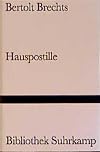
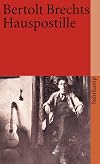
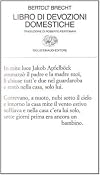
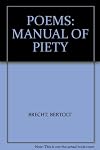
Manual of Piety
by Bertolt Brecht
On This Page
Description
Book jacket: Known primarily as a dramatist, Bertolt Brecht was also a gifted poet. These fifty poems--among them many ballads that later became part of The Threepenny Opera, Mahagonny, and Baal--reveal the tremendous range and versatility of Brecht's expression. His first and best book of poetry, Manual of Piety uses the traditional form of devotional literature to provide both an irreverant spoof and a serious critique of the post-World War I European (and more specifically, German) show more culture that gave rise to fascism. His characteristically sly wit combines with mordant social commentary to make Manual of Piety Brecht at his most hilarious--and also his most brutally incisive. show lessTags
Recommendations






















Member Reviews
Però più di una poesia è da cinque stelle...
Ratings
Members
- Recently Added By
Author Information

Bertolt Brecht was born on February 10, 1898 in Augsburg, Bavaria, and died on August 14, 1956. He was a German playwright, theatre director and Marxist. The modest house where he was born is today preserved as a Brecht Museum. Brecht formed a writing collective which became prolific and very influential. He wrote many lyrics for musicals and show more collaborated with Kurt Weill to create Die Dregroschenoper -- the biggest hit in 1920s Berlin. Brecht experimented with his own theater and company -- the Berliner Ensemble -- which put on his plays under his direction and which continued after his death with the assistance of his wife. Brecht aspired to create political theater, and it is difficult to evaluate his work in purely aesthetic terms. Brecht died in 1956. (Bowker Author Biography) show less
Some Editions
Series
Belongs to Publisher Series
Common Knowledge
- Canonical title
- Manual of Piety
- Original publication date
- 1927
- Epigraph*
- Zweites Kapitel der fünften Lektion (Von den verführten Mädchen):
Zum Dank dafür, dass die Sonne sie bescheint, werfen die Dinge Schatten. - Dedication*
- Erstes Kapitel der fünften Lektion dient der Erinnerung an den Lyriker Joseph Baal aus Pfersee. Das vierte Kapitel der fünften Lektion ist gewidmet dem Andenken an das Liebespaar Franz Diekmann und Frieda Lang aus Augsburg.... (show all) Das fünfte Kapitel der fünften Lektion ist zum Gedächtnis des Infanteristen Christian Grumbeis aus Aichach. Der Anhang ist gewidmet George Pfanzelt, Caspar Neher und Otto Müllereisert, sämtliche aus Augsburg.
*Some information comes from Common Knowledge in other languages. Click "Edit" for more information.
Classifications
Statistics
- Members
- 149
- Popularity
- 220,272
- Reviews
- 1
- Rating
- (3.29)
- Languages
- English, German, Italian
- Media
- Paper
- ISBNs
- 13
- ASINs
- 8