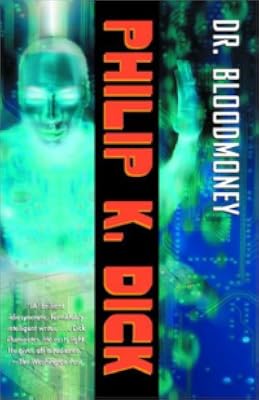
Dr. Bloodmoney
by Philip K. Dick
On This Page
Description
A Nebula Award nominee, Dr. Bloodmoney is Hugo Award-winner Philip K. Dick's darkly comic riff on Stanley Kubrick's Cold War black comedy, Dr. Strangelove, a look at how humanity gets along after the end of the world. What happens after the bombs drop? This is the troubling question Philip K. Dick addresses with Dr. Bloodmoney, or How We Got Along After the Bomb. It is the story of a world reeling from the effects of nuclear annihilation and fallout, a world where mutated humans and animals show more are the norm, and the scattered survivors take comfort from a disc jockey endlessly circling the globe in a broken-down satellite. And hidden among the survivors is Dr. Bloodmoney himself, the man responsible for it all. This bizarre cast of characters cajole, seduce, and backstab in their attempts to get ahead in what is left of the world, consequences and casualties be damned. A sort of companion to Dr. Strangelove an unofficial and unhinged sequel Dick's novel is just as full of dark comedy and just as chilling. show lessTags
Recommendations







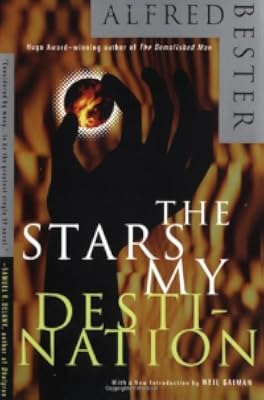
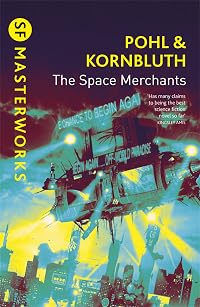
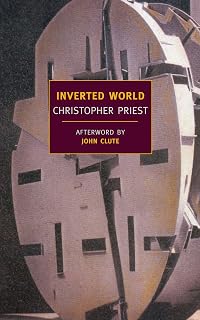
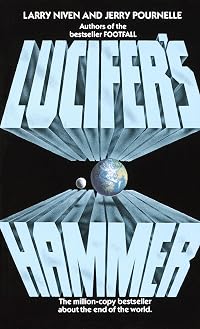















Member Recommendations

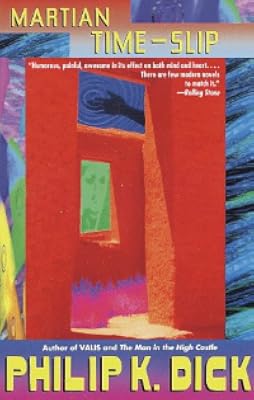
sturlington Amnesia Moon is an homage to PKD and references this novel.
30
Member Reviews
One of Dick's most disturbing and funny and poignant novels. This is not your typical post-apocalyptic story. Feels like a religious allegory that holds nothing but contempt for religious allegories. As Californians struggle to rebuild the old civilization after armageddon, they are faced with creatures, beings and states of consciousness that are completely new. Rats have learned how to use carts. Dogs can talk. Humans are living inside of other humans. Yet, in Dick's deft hands, it is not only plausible, but proper.
A very enjoyable post-apocalyptic novel. Dick is especially interested here in the ole mind/body conundrum. There’s no central character, the POV conveniently flitting from one to another, but the best-developed is the limbless Hoppy Harrington, “the first phocomelus”, whose “phocomobile” and mechanical manipulators allow him more agency than the whole-bodied characters — and on top of this, Hoppy has precognition as well as telekinetic and other psychic powers. Then there’s seven year old Edie Keller, whose twin brother Bill is a homunculus inhabiting her inguinal cavity. Bill too is capable of projecting himself beyond his physical confinement, briefly co-opting the body of a worm (to his great disappointment) and ending show more up in a wild power struggle with the increasingly megalomaniacal Hoppy. Finally we have Walt Dangerfield, whose mission to Mars is curtailed in low earth orbit by the nuclear dingdong, and finds himself circling the irradiated earth as humanity’s only common referent, playing songs over the radio by request and reading Of Human Bondage to keep peoples’ spirits up (ha ha). Another mind confined, straining to connect, to loose the bonds of flesh.
There’s a certain amount of horror in this brutalized California — raw rat, yum yum — but also aspects of anarcho-utopia, especially out in West Marin where society is gradually reorganizing along cooperative agrarian lines. The title character, the Dr Strangelove figure responsible for the whole damn mess, ranches sheep in pseudonymous retirement until his sins catch up with him. Featuring an adorable talking dog who talks exactly like you imagine a dog would talk, homeostatic vermin traps, and a whole lot more delightful Dickian idiosyncrasies, this is almost up there with his best work imo. show less
There’s a certain amount of horror in this brutalized California — raw rat, yum yum — but also aspects of anarcho-utopia, especially out in West Marin where society is gradually reorganizing along cooperative agrarian lines. The title character, the Dr Strangelove figure responsible for the whole damn mess, ranches sheep in pseudonymous retirement until his sins catch up with him. Featuring an adorable talking dog who talks exactly like you imagine a dog would talk, homeostatic vermin traps, and a whole lot more delightful Dickian idiosyncrasies, this is almost up there with his best work imo. show less
Dreaming of Nuclear Destruction
When Philip K. Dick wrote Dr. Bloodmoney, nuclear holocaust was a real possibility, a real fear, as evidenced by the effectiveness of "Daisy," the Johnson TV ad, run once, playing on the fear of Goldwater’s extremism writ large in a giant fireball seen in the eye of a little girl. Those were the days of mutually assured destruction, the idea of the two world powers equally armed to the point that neither could win an all out nuclear war. However, some may not be aware that military planners had conceived of another type of nuclear use: battlefield tactical. Here they would employ lower variable yield bombs and artillery shells that would cripple enemy troops but spare general populations from total show more annihilation. These tactical weapons comprised a good portion of U.S. and Russian nuclear arsenals. And as some may also know this idea of limited nuclear engagement has reached the public forum again. Which in an oddly prophetic way makes Dick’s novel as relevant now as it was in 1965.
In Dr. Bloodmoney, we get a glimpse of a post nuclear war world that hasn’t been entirely destroyed, just blown back into the early 19th century. Harnessed electricity is scarce. Cities lie in ruins. Barter economies prevail. Horses make a comeback as the sole means of land locomotion, apart from walking. And there’s an added feature: mutated humans and animals, like talking dogs, intelligent rats, and the like, as well as psychic humans. It might be a Dick amphetamine fired nightmare, but it has the ring of veracity to it.
In the future, 1972, a Livermore scientist, Bruno Bluthgeld (blood-money in German), initiates a high altitude nuclear test that goes horribly wrong. It blankets much of the world in radiation. Suffering from self-hatred and hated by everyone, Bluthgeld carries on under the name Jack Tree, settling in West Marin, where he, with the help of Bonny Keller, seeks psychiatric help from Dr. Stockstill. In town resides a collection of characters who surface from time to time as the novel progresses. Most important of them are the phocomelus (congenital deformity of the limbs) Hoppy Harrington, child Edie Keller, Bonny’s daughter, and Walt Dangerfield. Hoppy uses artificial limb extenders to accomplish tasks, both ordinary and extraordinary. Edie converses with her unborn twin resident in the area of her appendix. Walt Dangerfield and his wife circle Earth in a capsule on their way to start a settlement on Mars. Aside from the effects of radiation poisoning, life is fairly normal in 1981, when the novel opens. Then bombs begin falling and the world is reduced to ruble. The novel fast forwards to the end of the decade, where we see how people live in the post-holocaust world that appears to have been created by limited nuclear warfare.
This is an odd world, where people gather round a radio to hear stranded Walt read to them, almost as if hearing the word of God, or the word of the way it was. It’s also a world where the once weak, Hoppy in particular, acquire frightening power, and where a girl and never born child must bring him down. It’s also a world where normal life and commerce emerge from the destruction, where there is yet hope for a better future. (Of course, it would be much better for all if we could control ourselves and not blow up the world we have, imperfect as it may be. Something to thing about when pundits spout off about tactical nuclear strikes, as they have been lately on news shows.)
Dick fans, if they haven’t already read it, will like it. Others who wish to discover why people like Dick so much might be better served by starting with The Man in the High Castle, A Scanner Darkly, or Do Androids Dream of Electric Sheep?, three of his best known works, each filmed, as well. show less
When Philip K. Dick wrote Dr. Bloodmoney, nuclear holocaust was a real possibility, a real fear, as evidenced by the effectiveness of "Daisy," the Johnson TV ad, run once, playing on the fear of Goldwater’s extremism writ large in a giant fireball seen in the eye of a little girl. Those were the days of mutually assured destruction, the idea of the two world powers equally armed to the point that neither could win an all out nuclear war. However, some may not be aware that military planners had conceived of another type of nuclear use: battlefield tactical. Here they would employ lower variable yield bombs and artillery shells that would cripple enemy troops but spare general populations from total show more annihilation. These tactical weapons comprised a good portion of U.S. and Russian nuclear arsenals. And as some may also know this idea of limited nuclear engagement has reached the public forum again. Which in an oddly prophetic way makes Dick’s novel as relevant now as it was in 1965.
In Dr. Bloodmoney, we get a glimpse of a post nuclear war world that hasn’t been entirely destroyed, just blown back into the early 19th century. Harnessed electricity is scarce. Cities lie in ruins. Barter economies prevail. Horses make a comeback as the sole means of land locomotion, apart from walking. And there’s an added feature: mutated humans and animals, like talking dogs, intelligent rats, and the like, as well as psychic humans. It might be a Dick amphetamine fired nightmare, but it has the ring of veracity to it.
In the future, 1972, a Livermore scientist, Bruno Bluthgeld (blood-money in German), initiates a high altitude nuclear test that goes horribly wrong. It blankets much of the world in radiation. Suffering from self-hatred and hated by everyone, Bluthgeld carries on under the name Jack Tree, settling in West Marin, where he, with the help of Bonny Keller, seeks psychiatric help from Dr. Stockstill. In town resides a collection of characters who surface from time to time as the novel progresses. Most important of them are the phocomelus (congenital deformity of the limbs) Hoppy Harrington, child Edie Keller, Bonny’s daughter, and Walt Dangerfield. Hoppy uses artificial limb extenders to accomplish tasks, both ordinary and extraordinary. Edie converses with her unborn twin resident in the area of her appendix. Walt Dangerfield and his wife circle Earth in a capsule on their way to start a settlement on Mars. Aside from the effects of radiation poisoning, life is fairly normal in 1981, when the novel opens. Then bombs begin falling and the world is reduced to ruble. The novel fast forwards to the end of the decade, where we see how people live in the post-holocaust world that appears to have been created by limited nuclear warfare.
This is an odd world, where people gather round a radio to hear stranded Walt read to them, almost as if hearing the word of God, or the word of the way it was. It’s also a world where the once weak, Hoppy in particular, acquire frightening power, and where a girl and never born child must bring him down. It’s also a world where normal life and commerce emerge from the destruction, where there is yet hope for a better future. (Of course, it would be much better for all if we could control ourselves and not blow up the world we have, imperfect as it may be. Something to thing about when pundits spout off about tactical nuclear strikes, as they have been lately on news shows.)
Dick fans, if they haven’t already read it, will like it. Others who wish to discover why people like Dick so much might be better served by starting with The Man in the High Castle, A Scanner Darkly, or Do Androids Dream of Electric Sheep?, three of his best known works, each filmed, as well. show less
Dreaming of Nuclear Destruction
When Philip K. Dick wrote Dr. Bloodmoney, nuclear holocaust was a real possibility, a real fear, as evidenced by the effectiveness of "Daisy," the Johnson TV ad, run once, playing on the fear of Goldwater’s extremism writ large in a giant fireball seen in the eye of a little girl. Those were the days of mutually assured destruction, the idea of the two world powers equally armed to the point that neither could win an all out nuclear war. However, some may not be aware that military planners had conceived of another type of nuclear use: battlefield tactical. Here they would employ lower variable yield bombs and artillery shells that would cripple enemy troops but spare general populations from total show more annihilation. These tactical weapons comprised a good portion of U.S. and Russian nuclear arsenals. And as some may also know this idea of limited nuclear engagement has reached the public forum again. Which in an oddly prophetic way makes Dick’s novel as relevant now as it was in 1965.
In Dr. Bloodmoney, we get a glimpse of a post nuclear war world that hasn’t been entirely destroyed, just blown back into the early 19th century. Harnessed electricity is scarce. Cities lie in ruins. Barter economies prevail. Horses make a comeback as the sole means of land locomotion, apart from walking. And there’s an added feature: mutated humans and animals, like talking dogs, intelligent rats, and the like, as well as psychic humans. It might be a Dick amphetamine fired nightmare, but it has the ring of veracity to it.
In the future, 1972, a Livermore scientist, Bruno Bluthgeld (blood-money in German), initiates a high altitude nuclear test that goes horribly wrong. It blankets much of the world in radiation. Suffering from self-hatred and hated by everyone, Bluthgeld carries on under the name Jack Tree, settling in West Marin, where he, with the help of Bonny Keller, seeks psychiatric help from Dr. Stockstill. In town resides a collection of characters who surface from time to time as the novel progresses. Most important of them are the phocomelus (congenital deformity of the limbs) Hoppy Harrington, child Edie Keller, Bonny’s daughter, and Walt Dangerfield. Hoppy uses artificial limb extenders to accomplish tasks, both ordinary and extraordinary. Edie converses with her unborn twin resident in the area of her appendix. Walt Dangerfield and his wife circle Earth in a capsule on their way to start a settlement on Mars. Aside from the effects of radiation poisoning, life is fairly normal in 1981, when the novel opens. Then bombs begin falling and the world is reduced to ruble. The novel fast forwards to the end of the decade, where we see how people live in the post-holocaust world that appears to have been created by limited nuclear warfare.
This is an odd world, where people gather round a radio to hear stranded Walt read to them, almost as if hearing the word of God, or the word of the way it was. It’s also a world where the once weak, Hoppy in particular, acquire frightening power, and where a girl and never born child must bring him down. It’s also a world where normal life and commerce emerge from the destruction, where there is yet hope for a better future. (Of course, it would be much better for all if we could control ourselves and not blow up the world we have, imperfect as it may be. Something to thing about when pundits spout off about tactical nuclear strikes, as they have been lately on news shows.)
Dick fans, if they haven’t already read it, will like it. Others who wish to discover why people like Dick so much might be better served by starting with The Man in the High Castle, A Scanner Darkly, or Do Androids Dream of Electric Sheep?, three of his best known works, each filmed, as well. show less
When Philip K. Dick wrote Dr. Bloodmoney, nuclear holocaust was a real possibility, a real fear, as evidenced by the effectiveness of "Daisy," the Johnson TV ad, run once, playing on the fear of Goldwater’s extremism writ large in a giant fireball seen in the eye of a little girl. Those were the days of mutually assured destruction, the idea of the two world powers equally armed to the point that neither could win an all out nuclear war. However, some may not be aware that military planners had conceived of another type of nuclear use: battlefield tactical. Here they would employ lower variable yield bombs and artillery shells that would cripple enemy troops but spare general populations from total show more annihilation. These tactical weapons comprised a good portion of U.S. and Russian nuclear arsenals. And as some may also know this idea of limited nuclear engagement has reached the public forum again. Which in an oddly prophetic way makes Dick’s novel as relevant now as it was in 1965.
In Dr. Bloodmoney, we get a glimpse of a post nuclear war world that hasn’t been entirely destroyed, just blown back into the early 19th century. Harnessed electricity is scarce. Cities lie in ruins. Barter economies prevail. Horses make a comeback as the sole means of land locomotion, apart from walking. And there’s an added feature: mutated humans and animals, like talking dogs, intelligent rats, and the like, as well as psychic humans. It might be a Dick amphetamine fired nightmare, but it has the ring of veracity to it.
In the future, 1972, a Livermore scientist, Bruno Bluthgeld (blood-money in German), initiates a high altitude nuclear test that goes horribly wrong. It blankets much of the world in radiation. Suffering from self-hatred and hated by everyone, Bluthgeld carries on under the name Jack Tree, settling in West Marin, where he, with the help of Bonny Keller, seeks psychiatric help from Dr. Stockstill. In town resides a collection of characters who surface from time to time as the novel progresses. Most important of them are the phocomelus (congenital deformity of the limbs) Hoppy Harrington, child Edie Keller, Bonny’s daughter, and Walt Dangerfield. Hoppy uses artificial limb extenders to accomplish tasks, both ordinary and extraordinary. Edie converses with her unborn twin resident in the area of her appendix. Walt Dangerfield and his wife circle Earth in a capsule on their way to start a settlement on Mars. Aside from the effects of radiation poisoning, life is fairly normal in 1981, when the novel opens. Then bombs begin falling and the world is reduced to ruble. The novel fast forwards to the end of the decade, where we see how people live in the post-holocaust world that appears to have been created by limited nuclear warfare.
This is an odd world, where people gather round a radio to hear stranded Walt read to them, almost as if hearing the word of God, or the word of the way it was. It’s also a world where the once weak, Hoppy in particular, acquire frightening power, and where a girl and never born child must bring him down. It’s also a world where normal life and commerce emerge from the destruction, where there is yet hope for a better future. (Of course, it would be much better for all if we could control ourselves and not blow up the world we have, imperfect as it may be. Something to thing about when pundits spout off about tactical nuclear strikes, as they have been lately on news shows.)
Dick fans, if they haven’t already read it, will like it. Others who wish to discover why people like Dick so much might be better served by starting with The Man in the High Castle, A Scanner Darkly, or Do Androids Dream of Electric Sheep?, three of his best known works, each filmed, as well. show less
The blurb on the back cover is a poor summary to the unusual slice of post-atomic life Dick has served up as a snapshot of dystopian life. There are mutants, but not in the ubiquitous way contemporary fantastic science-fiction and urban fantasy tend to saturate their stories with. And the mutations are more considered and implicit as part of the narrative convention as opposed to characterisation or some sort of "super/magic power". Dick has been selective on the mutant/human ratio for greater affect. Like most of Dick's writing, he has the unrivalled talent of marrying offbeat nuances within the most mundane of circumstances. The story is a snapshot of several communities during the aftermath of an atomic accident. It's an easy, show more relaxing read with only a slight authorial parable at the end but mostly it focuses on how people interact with each other under the circumstances of having to put their society back together again. Amusingly, Dick concentrates on eye-wear, cigarettes, alcohol, and vermin traps. He manages to create a claustrophobic world without too much intensity and if highfalutin sci-fi puts you off, you won't find it in this novel. Dick writes with a penetrable, if at times unfathomable, penmanship that achieves a bizarre sort of synergy. show less
I like PKD. I like post-apocalyptic worlds (especially post global thermonuclear exchange post-apocalyptic worlds). This book really should have been 5 stars, but somehow wasn't quite, especially compared to how great it could have been, but was still very good.
Interesting non-spoiler details: set in the SF Bay Area. Lots of interesting/weird characters. Would make a great "cult" movie if it could be produced for $5-20mm (probably wouldn't make sense as a $100mm movie). Also, learned a new word from this book: "Phocomelia"
Interesting non-spoiler details: set in the SF Bay Area. Lots of interesting/weird characters. Would make a great "cult" movie if it could be produced for $5-20mm (probably wouldn't make sense as a $100mm movie). Also, learned a new word from this book: "Phocomelia"
I’m not a big fan of Philip K Dick’s fiction - in fact, I think I’ve only liked two or three of the books by him I’ve read. This isn’t one of them. It is, however, one of the books in the original numbered SF Masterwork series, and since I own them all I plan to read them all. (Who buys only *some* of the books in a numbered series?) Of the 73 books in the original SF Masterwork series, fourteen are by Philip K Dick. Because a very senior editor at Gollancz was a big fan. I personally don’t think most of them deserve to be considered masterworks, and while Dr Bloodmoney is better than many of the Dick titles, I still don’t think it makes the grade. It’s set in California after World War III. This happened in the show more mid-1970s, after a disastrous nuclear test by the US, thanks to Dr Bluthgeld (Dr Bloodmoney of the title), who got his calculations wrong. Most of the population has died, but life seems to have settled down, albeit at a considerably more primitive level. The story mostly takes place in a small community and, well, the book doesn’t have much of a plot, just a cast of grotesques, including the aforementioned Bluthgeld. There’s a character who’s a victim of thalidomide - Dick calls him a phocomelus - who moves around in a motorised cart and later develops powerful psychokinetic powers. There’s a black TV salesman who visits the community, and proves to be the first black person to be accepted by them. There’s a young girl whose unborn twin lives inside her, talks to her, and proves to have psychic abilities of his own. And there’s an astronaut, in orbit about the Earth after his mission to Mars failed, who broadcasts to everyone around the world… The narrative does some interesting things with time-jumps, although only in the first third or so. But as any sign of a plot gradually fades away, so the characters with special powers become ever more ludicrous. The novel is notable for having a black protagonist, which was definitely unusual from a white US sf writer in the 1960s, as well as someone handicapped by thalidomide. But pretty much everyone in the novel is racist, and there’s a disturbing admiration for Nazi Germany (which seems to crop up in many of Dick’s novels). I’ve read this, so I can cross it off the list. I won’t be reading it ever again. show less
Members
- Recently Added By
Lists

S.F. Masterworks (Complete)
229 works; 15 members

David Pringle's Science Fiction: The 100 Best Novels
101 works; 9 members

SF Masterworks
193 works; 8 members

Forced Exposure
83 works; 1 member

Books Read in 2023
5,638 works; 147 members

Les 100 principaux titres de la science-fiction (1981)
126 works; 3 members
Author Information

678+ Works 147,152 Members
Phillip Kindred Dick was an American science fiction writer best known for his psychological portrayals of characters trapped in illusory environments. Born in Chicago, Illinois, on December 16, 1928, Dick worked in radio and studied briefly at the University of California at Berkeley before embarking on his writing career. His first novel, Solar show more Lottery, was published in 1955. In 1963, Dick won the Hugo Award for his novel, The Man in the High Castle. He also wrote a series of futuristic tales about artificial creatures on the loose; notable of these was Do Androids Dream of Electric Sheep?, which was later adapted into film as Blade Runner. Dick also published several collections of short stories. He died of a stroke in Santa Ana, California, in 1982. (Bowker Author Biography) show less
Some Editions
Awards and Honors
Awards
Notable Lists
Series
Belongs to Publisher Series
Work Relationships
Is contained in
Common Knowledge
- Canonical title*
- Kinder des Holocaust
- Original title
- Dr. Bloodmoney, or How We Got Along after the Bomb
- Alternate titles*
- Nach der Bombe; Nach dem Weltuntergang
- Original publication date
- 1965; 1963-02-11 (manuscript) (manuscript)
- People/Characters
- Hoppy Harrington; Walt Dangerfield; Dr. Bluthgeld; Stuart McConchie; Bonny Keller
- Important places
- Point Reyes, California, USA
- Important events
- Nuclear War
- First words
- Early in the bright sun-yellowed morning, Stuart McConchie swept the sidewalk before Modern TV Sales & Service, hearing the cars along Shattuck Avenue and the secretaries hurrying on high heels to their offices, all the stirr... (show all)ings and fine smells of a new week, a new time in which a good salesman could accomplish things.
- Last words
- (Click to show. Warning: May contain spoilers.)All around her the city was awakening, back once more into its regular life.
- Publisher's editor*
- Alpers, Hans Joachim
- Original language
- English
- Canonical DDC/MDS
- 813.0876220
*Some information comes from Common Knowledge in other languages. Click "Edit" for more information.
Classifications
- Genres
- Science Fiction, Fiction and Literature
- DDC/MDS
- 813.0876220 — Literature & rhetoric American literature in English American fiction in English By type Genre fiction Adventure fiction Speculative fiction Science fiction Post-apocalypse Nuclear apocalypse
- LCC
- PS3554 .I3 .D6 — Language and Literature American literature American literature Individual authors 1961-
- BISAC
Statistics
- Members
- 2,301
- Popularity
- 8,685
- Reviews
- 38
- Rating
- (3.61)
- Languages
- 14 — Czech, Dutch, English, Finnish, French, German, Greek, Hungarian, Italian, Japanese, Polish, Portuguese, Romanian, Spanish
- Media
- Paper, Audiobook, Ebook
- ISBNs
- 51
- ASINs
- 30