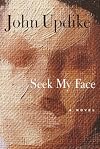
Seek My Face
by John Updike
On This Page
Description
John Updike's twentieth novel, like his first, The Poorhouse Fair, takes place in one day, a day that contains much conversation and some rain. The seventy-nine-year-old painter Hope Chafetz, who in the course of her eventful life has been Hope Ouderkirk, Hope McCoy, and Hope Holloway, answers questions put to her by a New York interviewer named Kathryn, and recapitulates, through stories from her career and many marriages, the triumphant, poignant saga of postwar American art. In the show more evolving relation between the two women, interviewer and subject move in and out of the roles of daughter and mother, therapist and patient, predator and prey, supplicant and idol. The scene is central Vermont; the time, the early spring of 2001. show lessTags
Recommendations



















Member Reviews
Even though the novel takes place over the course of just a single day, it ranges from the 1930s on through the end of the twentieth century in scope. As an artist is interviewed about her life--her work, her marriages, her children, her artistic husbands, and her thoughts on gender, art, and life as a whole--the novel moves gracefully between a female artist's ever-detailed memories and the long conversation she's engaged in with a young writer and student of art. As the dynamic between the two women changes over the course of the interview, the philosophical questions of art and love are more and more a consideration between them, as are questions of how being female has affected the artist's abilities to simply be an artist. And, of show more course, the disconnect between the artist and the critic is often at the forefront, humorous and disturbing as it may be at varying points. At the center of the book, though, is passion, which is celebrated.
I can't speak to how accurate the discussions of New York's art scene may be, or to how accurately the interview characterizes the art scene in America at mid-century, though it discusses both at length--I can, however, say that the novel is wonderfully entertaining, and beautifully conceived and written. I'd say this is a must-read for anyone whose life revolves around the creation of any form of art, or the criticism/analysis of it. Though the direct subject is painting, many of the discussions apply just so much to writing, dance, and any form of passion that consumes time, energy, and love without, necessarily, regard for the people affected.
Absolutely recommended. show less
I can't speak to how accurate the discussions of New York's art scene may be, or to how accurately the interview characterizes the art scene in America at mid-century, though it discusses both at length--I can, however, say that the novel is wonderfully entertaining, and beautifully conceived and written. I'd say this is a must-read for anyone whose life revolves around the creation of any form of art, or the criticism/analysis of it. Though the direct subject is painting, many of the discussions apply just so much to writing, dance, and any form of passion that consumes time, energy, and love without, necessarily, regard for the people affected.
Absolutely recommended. show less
Now in her seventies, artist Hope Chafetz reflects back on her life and her husbands in an interview with a journalist, Kathryn. The overall timeframe is just one day of an interview, but both their recorded interview and Hope's thoughts range all over the place, through the second World War, art school in New York, several artist movements, and how Hope arrived to this Vermont homestead at last.
While I read, I was reminded most of Mrs. Dalloway. Not a lot happens outside of the character's thoughts - and in this case conversation - but everything from birth to death to marriage and infidelity happens. The title "Seek My Face" causes me to ask the question, "Do we ever get to know Hope?" I'm still not sure I know the answer. This is the show more type of story my English professors loved and I might have admired once I finished a paper on them, but as a reader leave me frustrated. show less
While I read, I was reminded most of Mrs. Dalloway. Not a lot happens outside of the character's thoughts - and in this case conversation - but everything from birth to death to marriage and infidelity happens. The title "Seek My Face" causes me to ask the question, "Do we ever get to know Hope?" I'm still not sure I know the answer. This is the show more type of story my English professors loved and I might have admired once I finished a paper on them, but as a reader leave me frustrated. show less
The blurb on the back of this edition describes the book as "the triumphant story of postwar American art." I don't know if that's how Updike intended it, but as he presents it, there was nothing triumphant about it...just a boys' club of self-important, pretentious freaks, many of whom had little artistic skill, engaging in one big circle jerk. It's the story of successive "movements" lasting little more than a decade, only to be replaced by another even more vacuous "school" the tenets of which completely contradict it, based only on the whim of the moment with no real standards or values. Far from being triumphant, the story of postwar American art as Updike presents it is more like a nose-dive off a cliff, a nihilistic show more "deconstruction" of any genuine values that art can offer, expressing the view (in Updike's own words) that only rottenness matters, and beauty is of no importance whatsoever.
In any case, the blurb goes on to assure us, "this book is not a thinly-veiled treatise [on the history of modern art]"---but this is clearly a case of protesting too much, as that is exactly what it is. Some artists are actually mentioned by their real names, but those who are more sort of characters in the novel (such as Pollock and the "pop artists" like Warhol and Lichtenstein) are presented in barely-fictionalized versions with false names.
Still, it is well-written, and in a way it's to his credit that Updike is too honest a writer to present what is really a story of cultural decline as "triumphant" (though he is clearly sympathetic to it). Some of these characters' stories are interesting, whether you like them or not, though Updike unfortunately intersperses them with pretentious chunks of art "theory"---of course, the ideas are important to understand what these people were doing and why, but they are often rather clumsily inserted rather than skillfully integrated into the story.
If you want to read a novel about modern art, I would recommend Steve Martin's An Object of Beauty, which is at least somewhat more sincere, over this. show less
In any case, the blurb goes on to assure us, "this book is not a thinly-veiled treatise [on the history of modern art]"---but this is clearly a case of protesting too much, as that is exactly what it is. Some artists are actually mentioned by their real names, but those who are more sort of characters in the novel (such as Pollock and the "pop artists" like Warhol and Lichtenstein) are presented in barely-fictionalized versions with false names.
Still, it is well-written, and in a way it's to his credit that Updike is too honest a writer to present what is really a story of cultural decline as "triumphant" (though he is clearly sympathetic to it). Some of these characters' stories are interesting, whether you like them or not, though Updike unfortunately intersperses them with pretentious chunks of art "theory"---of course, the ideas are important to understand what these people were doing and why, but they are often rather clumsily inserted rather than skillfully integrated into the story.
If you want to read a novel about modern art, I would recommend Steve Martin's An Object of Beauty, which is at least somewhat more sincere, over this. show less
I decided to read this on a whim. This has been on my TBR-list for years and it was one of those likely never to be read. Hope is an artist in her 70s, married three times with three children. She is interviewed by young New York City journalist Kathryn, and the book is of this interview with Hope talking of her three husbands and the development of modern art. The book is one looong chapter. Updike's language is rich and he describes things well using analogies. He also manages to wean in nicely Hope's thoughts that weren't revealed to Kathryn in between what Hope told Kathryn. We, the privileged reader, know all in Hope's mind but not Kathryn.
A recurring qualification of the writing of John Updike is that technically it is perfect, but rather uninspired. Likewise, Seek my face, is a very well-written, but rather long and ultimately boring novel.
The novel, originally published in 2002, could fit into the postmodern genre, albeit somewhat late, of biographies of insignificant and fictional people. Why, otherwise, would any reader be interested to read 276 pages of what appears to be the fictional biography of the widow of Jackson Pollock?
Part of the technical skill is that the time line within the novel describes events over the period of a day, a long interview which the widow of the painter has granted to a young female journalist. Touching on themes and events of the show more various decades of the Twentieth Century, the relation between the women changes from that of the journalist, at first perceived as intrusive and naive, to that of the widow enjoying the role of maternal initiator, in disclosing the story of her life. The novel could perhaps be read as an exploration of the question to what extent young people can bridge the generation gap and understand the life and motives of people from whose life experiences they are separated by more than one generation.
Seek my face is not recommended to readers who are new to the work of John Updike. show less
The novel, originally published in 2002, could fit into the postmodern genre, albeit somewhat late, of biographies of insignificant and fictional people. Why, otherwise, would any reader be interested to read 276 pages of what appears to be the fictional biography of the widow of Jackson Pollock?
Part of the technical skill is that the time line within the novel describes events over the period of a day, a long interview which the widow of the painter has granted to a young female journalist. Touching on themes and events of the show more various decades of the Twentieth Century, the relation between the women changes from that of the journalist, at first perceived as intrusive and naive, to that of the widow enjoying the role of maternal initiator, in disclosing the story of her life. The novel could perhaps be read as an exploration of the question to what extent young people can bridge the generation gap and understand the life and motives of people from whose life experiences they are separated by more than one generation.
Seek my face is not recommended to readers who are new to the work of John Updike. show less
I took Seek My Face (2002) with me on our spring break a couple months ago, and that was a tough book to read during a vacation. Why? Because this novel had no chapter breaks at all. At 276 pages, it was one long story about a female artist/painter who was a major figure in the art world of the 1950s or so. This novel consists of the artist, named Hope, being interviewed over one day, and her life story unfolds over that one day. Hope’s first husband seems loosely based on Jackson Pollack, and her second husband seems like a heterosexual Andy Warhol. I did like this book (and I do, after all, like art), but I would not recommend this as a first Updike read unless you are really into the art world.
Good writing but I found the plot tiring. No real resolution at the end. Lots of stuff about modern art in America, stuff I'm not really familiar with.
Members
- Recently Added By
Author Information

340+ Works 53,355 Members
American novelist, poet, and critic John Updike was born in Reading, Pennsylvania on March 18, 1932. He received an A.B. degree from Harvard University, which he attended on a scholarship, in 1954. After graduation, he accepted a one-year fellowship to study painting at the Ruskin School of Drawing and Fine Art in Oxford, England. After returning show more from England in 1955, he worked for two years on the staff of The New Yorker. This marked the beginning of a long relationship with the magazine, during which he has contributed numerous short stories, poems, and book reviews. Although Updike's first published book was a collection of verse, The Carpentered Hen and Other Tame Creatures (1958), his renown as a writer is based on his fiction, beginning with The Poorhouse Fair (1959). During his lifetime, he wrote more than 50 books and primarily focused on middle-class America and their major concerns---marriage, divorce, religion, materialism, and sex. Among his best-known works are the Rabbit tetrology---Rabbit, Run (1960), Rabbit Redux (1971), Rabbit Is Rich (1981), and Rabbit at Rest (1988). Rabbit, Run introduces Harry "Rabbit" Angstrom as a 26-year-old salesman of dime-store gadgets trapped in an unhappy marriage in a dismal Pennsylvania town, looking back wistfully on his days as a high school basketball star. Rabbit Redux takes up the story 10 years later, and Rabbit's relationship with representative figures of the 1960s enables Updike to provide social commentary in a story marked by mellow wisdom and compassion in spite of some shocking jolts. In Rabbit Is Rich, Harry is comfortably middle-aged and complacent, and much of the book seems to satirize the country-club set and the swinging sexual/social life of Rabbit and his friends. Finally, in Rabbit at Rest, Harry arrives at the age where he must confront his mortality. Updike won the Pulitzer Prize for both Rabbit Is Rich and Rabbit at Rest. Updike's other novels range widely in subject and locale, from The Poorhouse Fair, about a home for the aged that seems to be a microcosm for society as a whole, through The Court (1978), about a revolution in Africa, to The Witches of Eastwick (1984), in which Updike tries to write from inside the sensibilities of three witches in contemporary New England. The Centaur (1963) is a subtle, complicated allegorical novel that won Updike the National Book Award in 1964. In addition to his novels, Updike also has written short stories, poems, critical essays, and reviews. Self-Consciousness (1989) is a memoir of his early life, his thoughts on issues such as the Vietnam War, and his attitude toward religion. He was elected to the American Academy of Arts and Letters in 1977. He died of lung cancer on January 27, 2009 at the age of 76. (Bowker Author Biography) John Updike was born in 1932, in Shillington, Pennsylvania. Since 1957 he has lived in Massachusetts. His novels have won the Pulitzer Prize, the National Book Award, the National Book Critics Circle Award, & the Howells Medal. (Publisher Provided) John Updike was born in 1932 and attended Harvard College and the Ruskin School of Drawing and Fine Art in Oxford, England. Form 1955 to 1957 he was a staff member of The New Yorker, which he contributed numerous writings. Updike's art criticism has appeared in publications including Arts and Antiques, The New Republic, The New York Times Book Review, and Realites, among many others. He is the author of such best-selling novels as Rabbit Run and Rabbit is Rich. His many works of fiction, poetry and criticism have been awarded the Pulitzer Prize, the National Book Award, the American Book Award, and the National Book Critics Circle Award. For the past 40 years he has lived in Massachusetts. (Publisher Provided) John Updike is the author of some 50 books, including collections of short stories, poems, & criticism. His novels have won the Pulitzer Prize, the National Book Award, the National Book Critics Circle Award, & the Howells Medal. Born in Shillington, Pennsylvania, in 1932, he has lived in Massachusetts since 1957. (Publisher Provided) show less
Awards and Honors
Awards
Distinctions
Series
Belongs to Publisher Series
Common Knowledge
- Original title
- Seek My Face
- Original publication date
- 2007-08
- First words
- "Let me begin by reading to you," says the young woman, her slender, black-clad figure tensely jackknifed on the edge of the easy chair, with its faded coarse plaid and broad arms of orangish varnished oak, which Hope first k... (show all)new in the Germantown sunroom, her grandfather posed in it reading the newspaper, his head tilted back to gain the benefit of his thick biofocals, more than, yes seventy years ago, "a statement of yours from the catalogue of your last show, back in 1996."
Permita-me que comece lendo-lhe uma afirmação sua, retirada do catálogo da sua última exposição de 1996. - Last words
- (Click to show. Warning: May contain spoilers.)Hope pensa agora em explorar o espaço entre as duas grandes almofadas de xadrez mas sente dores nas costas e na anca só de imaginar que se ajoelha gemendo sobre o tapete oval e tem medo de não encontrar nada.
- Publisher's editor
- Jones, Judith
- Original language
- English US
Classifications
Statistics
- Members
- 555
- Popularity
- 53,143
- Reviews
- 8
- Rating
- (3.21)
- Languages
- 6 — Dutch, English, French, German, Portuguese, Spanish
- Media
- Paper, Audiobook, Ebook
- ISBNs
- 21
- ASINs
- 5