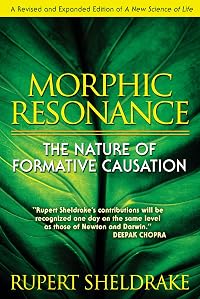
Morphic Resonance: The Nature of Formative Causation
by Rupert Sheldrake
On This Page
Description
"New updated and expanded edition of the groundbreaking book that ignited a firestorm in the scientific world with its radical approach to evolution"--Provided by publisher.Tags
Recommendations





Member Reviews
This is a book that mainstream scientists hate...
It just happens to present a coherent hypothesis that goes far toward resolving many unanswered questions.
Oh! It also has many suggestions for experiments to check its validity :-)
And, he makes a complex subject relatively easy to understand.
It just happens to present a coherent hypothesis that goes far toward resolving many unanswered questions.
Oh! It also has many suggestions for experiments to check its validity :-)
And, he makes a complex subject relatively easy to understand.
For a non scientific reader, it is a well made book; the hypothesis is very interesting , and it has some resonance with what I feel ( but it's no scientific for me to say); I will try to follow with this author.
i read this back in the 80s when i knew much less about science. it's compelling but ultimately it cannot be said to be based on actual scientific, empirical evidence or methodology.
here's a link to a Scientific American article that gives an overview of why Sheldrake's proposals just don't add up: http://www.scientificamerican.com/article/ruperts-resonance/
and another from the Guardian: http://www.theguardian.com/commentisfree/2009/feb/04/morphic-paranormal-science-...
here's a link to a Scientific American article that gives an overview of why Sheldrake's proposals just don't add up: http://www.scientificamerican.com/article/ruperts-resonance/
and another from the Guardian: http://www.theguardian.com/commentisfree/2009/feb/04/morphic-paranormal-science-...
A New Science of Life is an extraordinary and revolutionary new theory, which puts forward a radically new way of looking at life and nature.
Existinh science explains the regularities of nature in terms of laws assumed not to change through time. Dr Sheldrake suggests that these regularities are in fact more like habits, depending on what has happened before, and also on how often things have happened.
He calls this new type of causation across time and space 'formative causation', and argues that it is responsible for the shapes and instincts of all living things. Experimental evidence shows that when several rats have learned a new pattern of behaviour, subsequent rats all over the world tend to learn the same pattern more easily. In show more other words, living organisms tune in to the experience of the predecessors.
This is a serious and significant conjecture about the nature of life - it could herald a major scientific revolution.
Rupert Sheldrake read Natural Sciences an took a PhD in biochemistry in Cambridge. As the Rosenheim Research Fellow of the Royal Society he carried out research at Cambridge on the development of plants. He is now Consultant Plant Physiologist to the International Crops Research Institute for the Semi-Arid Tropics at Hyderabad. He lived for a year and a half at a Christian ashram in South India, where the present book was completed. show less
Existinh science explains the regularities of nature in terms of laws assumed not to change through time. Dr Sheldrake suggests that these regularities are in fact more like habits, depending on what has happened before, and also on how often things have happened.
He calls this new type of causation across time and space 'formative causation', and argues that it is responsible for the shapes and instincts of all living things. Experimental evidence shows that when several rats have learned a new pattern of behaviour, subsequent rats all over the world tend to learn the same pattern more easily. In show more other words, living organisms tune in to the experience of the predecessors.
This is a serious and significant conjecture about the nature of life - it could herald a major scientific revolution.
Rupert Sheldrake read Natural Sciences an took a PhD in biochemistry in Cambridge. As the Rosenheim Research Fellow of the Royal Society he carried out research at Cambridge on the development of plants. He is now Consultant Plant Physiologist to the International Crops Research Institute for the Semi-Arid Tropics at Hyderabad. He lived for a year and a half at a Christian ashram in South India, where the present book was completed. show less
Aug 18, 2017Finnish
Ratings
Members
- Recently Added By
Lists

The Joe Rogan Experience Library
254 works; 3 members
Author Information

41+ Works 3,758 Members
Rupert Sheldrake is the former director of studies in biochemistry and cell biology at Cambridge University. He lives in London.
Common Knowledge
- Original publication date
- 1981; 2nd ed., 1985
Classifications
Statistics
- Members
- 522
- Popularity
- 57,391
- Reviews
- 6
- Rating
- (3.69)
- Languages
- 7 — Czech, Dutch, English, French, German, Spanish, Swedish
- Media
- Paper, Audiobook, Ebook
- ISBNs
- 30
- ASINs
- 3