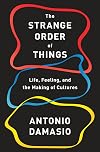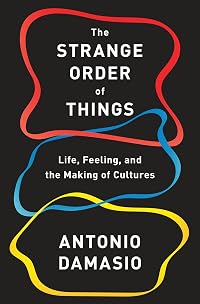
The Strange Order of Things: Life, Feeling, and the Making of Cultures
by Antonio Damasio
On This Page
Description
"A pathbreaking investigation into homeostasis, the condition of that regulates human physiology within the range that makes possible not only the survival but also the flourishing of life. Antonio Damasio makes clear that we descend biologically, psychologically, and even socially from a long lineage that begins with single living cells; that our minds and cultures are linked by an invisible thread to the ways and means of ancient unicellular life and other primitive life-forms; and that show more inherent in our very chemistry is a powerful force, a striving toward life maintenance that governs life in all its guises, including the development of genes that help regulate and transmit life."--supplied by publisher. show lessTags
Recommendations


Member Reviews
Homeostasis does the heavy lifting in Antonio Damasio’s account of life, subjectivity, consciousness, and culture. Not the homeostasis that your mom told you about, the one that describes the tendency towards a relatively stable equilibrium of independent elements. It’s that, of course, but it is also much more. For Damasio, homeostasis includes the notion of prevailing. Life, from its earliest beginnings, hasn’t been about maintaining the status quo, it’s been about prevailing. All life. From the tiniest bacteria to multi-talented mankind. This redefinition or realization (it could be either) underwrites Damasio’s claim to be setting the standard view of consciousness, subjectivity, even culture, on its head. Consciousness, show more it turns out, is as embedded in the basic homeostatic drives as is hunger or thirst or what have you. The order goes from the bottom up, not the top down.
Damasio is both a serious researcher and an accomplished writer on his scientific field of study. Much of this book is devoted to detailing the research by himself and others that support his view of homeostasis. Especially important in this regard is the fundamental contribution made by feelings. Feelings are not some flavouring added on to the dish of life. They are essential for homeostatic prevailing to succeed when life encounters a potentially hostile world. Damasio rightly notes the novelty of his position. If he’s right, philosophers and cognitive scientists have some hard thinking ahead.
Where Damasio’s story begins to fray is perhaps where it began. His initial inspiration for this book stemmed from reading Jean Genet’s account of creativity: “Beauty has no other origin but the singular wound, different for each person, hidden or visible.” Could homeostatic prevailing also explain human culture? Perhaps. Certainly if Damasio’s earlier story is close to accurate, there is no reason to think that homeostasis doesn’t underwrite culture. If it underwrites all aspects of life, that would follow. But does saying that get us anywhere? When something explains everything, it ends up not explaining much at all. To which the useful admonishment is — back to the rough ground.
Recommended. show less
Damasio is both a serious researcher and an accomplished writer on his scientific field of study. Much of this book is devoted to detailing the research by himself and others that support his view of homeostasis. Especially important in this regard is the fundamental contribution made by feelings. Feelings are not some flavouring added on to the dish of life. They are essential for homeostatic prevailing to succeed when life encounters a potentially hostile world. Damasio rightly notes the novelty of his position. If he’s right, philosophers and cognitive scientists have some hard thinking ahead.
Where Damasio’s story begins to fray is perhaps where it began. His initial inspiration for this book stemmed from reading Jean Genet’s account of creativity: “Beauty has no other origin but the singular wound, different for each person, hidden or visible.” Could homeostatic prevailing also explain human culture? Perhaps. Certainly if Damasio’s earlier story is close to accurate, there is no reason to think that homeostasis doesn’t underwrite culture. If it underwrites all aspects of life, that would follow. But does saying that get us anywhere? When something explains everything, it ends up not explaining much at all. To which the useful admonishment is — back to the rough ground.
Recommended. show less
The closest I've read to a theory of life and everything in a while. Damasio demonstrates how feelings are mental representations of how close the inner environment of the viscera and the endocrine system is to the ideal of homeostasis. If the organism is in a state conducive to homeostasis then the feelings are of a pleasant nature. If far then of an unpleasant nature. The interesting thing is that the nature of emotion and affect in accompanying the regulation of homeostasis is new in terms of evolutionary time. Single celled bacteria don't have feelings, but they do exhibit many of the behaviours that our affect goes along with. Brilliant book - possibly revolutionary.
Give it a chance and this book will blow your mind. Or at least turn upside down then inside out everything you thought you knew about you, your self-awareness and the discipline you exercised over how your mind ranged around. Welcome aboard the most exciting and fascinating roller-coaster ride you are ever likely to encounter in book form. Except and it is a very reluctant except, hence the missing half-point, it is tediously and pedantically slow in many places and reiterative. But then an author possibly cannot win. Setting to out to explain state of the art thinking to the general lay reader, what background knowledge can you assume? How fast on the uptake should you expect?
The book takes us on a slow evolutionary journey as ever show more increasingly complex organisms develop and check new mutations that give them a survival competitive edge over other rival organisms. Collaboratively these various evolving functions, energy intake, circulation, waste disposal, reproduction and so on, work together to optimise the organism's survival, leading to this integrated functional brain. Keeping all these basic systems working together intune with each other. More evolution and this evolving organism develops senses to experience the world it now inhabits, these senses, such as touch, sight, sound, taste also have to work collaboratively together but they have to respond to the driving needs of the function brain, so the senses brain and the function brain have to communicate and assign priorities between them. Until finally the magic happens and the organism evolves to have a sense of place, of itself within the world it inhabits which evolves to a self-awareness and to this brain which we know and believe to be the essence of us. So this thesis reaches its conclusion that self-awareness led to feelings and then ultimately to culture. Culture which enabled our inheritance of this brain to devise this complex technological world we have created. Powerful stuff.
But not one nice neat brain that you have freewill control over to decided between competing rationale and outcomes but a three tiered brain working beneath your self-awareness that predetermines the available thoughts that you might then consciously juggle with to reach a thought conclusion. Master of your mind! No. Freewill to choose? No. Reliable and consistent recall? No. Creativity you alone stimulate? No. No. No.
You have and are what your collective brains select for your conscious mind, for you to work with! show less
The book takes us on a slow evolutionary journey as ever show more increasingly complex organisms develop and check new mutations that give them a survival competitive edge over other rival organisms. Collaboratively these various evolving functions, energy intake, circulation, waste disposal, reproduction and so on, work together to optimise the organism's survival, leading to this integrated functional brain. Keeping all these basic systems working together intune with each other. More evolution and this evolving organism develops senses to experience the world it now inhabits, these senses, such as touch, sight, sound, taste also have to work collaboratively together but they have to respond to the driving needs of the function brain, so the senses brain and the function brain have to communicate and assign priorities between them. Until finally the magic happens and the organism evolves to have a sense of place, of itself within the world it inhabits which evolves to a self-awareness and to this brain which we know and believe to be the essence of us. So this thesis reaches its conclusion that self-awareness led to feelings and then ultimately to culture. Culture which enabled our inheritance of this brain to devise this complex technological world we have created. Powerful stuff.
But not one nice neat brain that you have freewill control over to decided between competing rationale and outcomes but a three tiered brain working beneath your self-awareness that predetermines the available thoughts that you might then consciously juggle with to reach a thought conclusion. Master of your mind! No. Freewill to choose? No. Reliable and consistent recall? No. Creativity you alone stimulate? No. No. No.
You have and are what your collective brains select for your conscious mind, for you to work with! show less
***.5
In many ways a modern version of Schrodinger's classic "What Is Life?" But extended to cover feelings and culture. His insight that even complex seeming behaviour can trace its lineage back to primitive bacteria was quite interesting.
Audiobook: the narration was quite dry and stuffy, and he has a deep sonorous British accent, making for a soporific listening experience. Normally I can adjust the playback speed to find a nice groove, but no matter what I did I couldn't concentrate for very long.
In many ways a modern version of Schrodinger's classic "What Is Life?" But extended to cover feelings and culture. His insight that even complex seeming behaviour can trace its lineage back to primitive bacteria was quite interesting.
Audiobook: the narration was quite dry and stuffy, and he has a deep sonorous British accent, making for a soporific listening experience. Normally I can adjust the playback speed to find a nice groove, but no matter what I did I couldn't concentrate for very long.
Antonio Damasio is simple even for a science background reader but its spetacular how he simplifies and clarifies every thing
PT- A ciência vista por este grande Doutor mesmo para quem tem background cientifico é bastante simplificada e clarificada .
Um livro que nos leva desde as tradicionais células procariotas até á integração do conteudo cerebral para a formação de tudo aquilo que conhecemos como cultural, brilhante e recomendável
PT- A ciência vista por este grande Doutor mesmo para quem tem background cientifico é bastante simplificada e clarificada .
Um livro que nos leva desde as tradicionais células procariotas até á integração do conteudo cerebral para a formação de tudo aquilo que conhecemos como cultural, brilhante e recomendável
A thesis. I got bored.
> Babelio : https://www.babelio.com/livres/Damasio-LOrdre-etrange-des-choses--La-vie-les-sen...
> Le chercheur américain en neurosciences et philosophie ouvre de livre en livre des perspectives novatrices sur les origines organiques de la conscience. « L’Ordre étrange des choses » en témoigne. Entrées dans une pensée en mouvement.
—(LeMonde, 04 décembre 2017)
> Le chercheur américain en neurosciences et philosophie ouvre de livre en livre des perspectives novatrices sur les origines organiques de la conscience. « L’Ordre étrange des choses » en témoigne. Entrées dans une pensée en mouvement.
—(LeMonde, 04 décembre 2017)
Nov 9, 2024French
Members
- Recently Added By
Lists

How Humans Work
18 works; 1 member

Review 3
41 works; 1 member

The Venus Project Recommended Books - Contemporary sources
53 works; 2 members
Author Information

23+ Works 6,961 Members
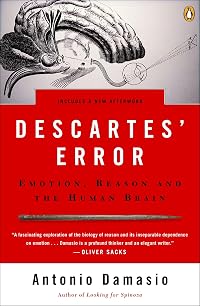
Antonio Damasio was born in Lisbon, Portugal and studied medicine at the University of Lisbon Medical School, where he also did his neurological residency and completed his doctorate. Eventually, he moved to the United States as a research fellow at the Aphasia Research Center in Boston. From 1976 to 2005, he was M.W. Van Allen Professor and Head show more of Neurology at the University of Iowa Hospitals and Clinics. He is currently the David Dornsife Professor of Neuroscience, Psychology, and Neurology, and director of the Brain and Creativity Institute at the University of Southern California. He has written several books on his research including Descartes' Error: Emotion, Reason, and the Human Brain, which won the Science et Vie prize; The Feeling of What Happens: Body and Emotion in the Making of Consciousness; and Looking for Spinoza: Joy, Sorrow, and the Feeling Brain. He has also received the Prince of Asturias Award in Science and Technology, the Kappers Neuroscience Medal, the Beaumont Medal from the American Medical Association, the Nonino Prize, the Reenpaa Prize in Neuroscience, and the Honda Prize. (Bowker Author Biography) show less
Common Knowledge
- Canonical title*
- L'ordre étrange des choses. La vie, les sentiments et la fabrique de la culture
- Original title
- The Strange Order of Things: Life, Feeling, and the Making of Cultures
- Original publication date
- 2017 (Germany) (Germany)
- Original language
- English
*Some information comes from Common Knowledge in other languages. Click "Edit" for more information.
Classifications
Statistics
- Members
- 424
- Popularity
- 72,977
- Reviews
- 7
- Rating
- (3.70)
- Languages
- 7 — Dutch, English, French, German, Italian, Portuguese, Spanish
- Media
- Paper, Audiobook, Ebook
- ISBNs
- 24
- ASINs
- 7