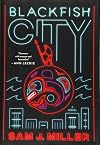
Blackfish City
by Sam J. Miller
On This Page
Description
After the climate wars, a floating city is constructed in the Arctic Circle, a remarkable feat of mechanical and social engineering, complete with geothermal heating and sustainable energy. Now crime and corruption have set in, the contradictions of incredible wealth alongside poverty are spawning unrest, and a new disease called "the breaks" is ravaging the population. When a strange new visitor arrives--a woman riding an orca, with a polar bear at her side--the city is entranced. She very show more subtly brings together four people--each living on the periphery--to stage unprecedented acts of resistance. By banding together to save their city before it crumbles under the weight of its own decay, they will learn shocking truths about themselves. show lessTags
Recommendations







Member Recommendations
Member Reviews
This is a delightful read. The investment you make in the first 100 pages pays off in a rich, enfolding experience of very able, capable worldbuilding by Author Miller.
Four PoV characters seems like a lot, I know, but each presents the reader with a different lens on a world that is all about where you are in its hierarchy as to what it looks like, feels like, and how Qaanaaq functions to meet your needs. Wealthy and privileged and bored Fill and Kaev, males at opposite ends of the city's caste system, and Kaev the professional fight-thrower is about to slip a few more rungs down the ladder. Ankit and non-binary Soq are the mobile middle-dwellers, each functioning in their differing-status jobs to support the power structure. Soq the show more messenger, the Mercury of Qaanaaq, was probably my favorite PoV in the book. The stealth they possess; the invisibility that rejecting binaries confers on them; all the moments of revelation this leads to make them a character I'd've loved to hear more from.
Author Miller is a top-notch talent, a maker of archetypes and a weaver of worlds whose skills are already as sharp as many with much longer résumés. What points of complaint I have are negligible compared to the central, overarching concerns he presents in this three-year-old and already timeless title.
Some of my favorite lines:
Four PoV characters seems like a lot, I know, but each presents the reader with a different lens on a world that is all about where you are in its hierarchy as to what it looks like, feels like, and how Qaanaaq functions to meet your needs. Wealthy and privileged and bored Fill and Kaev, males at opposite ends of the city's caste system, and Kaev the professional fight-thrower is about to slip a few more rungs down the ladder. Ankit and non-binary Soq are the mobile middle-dwellers, each functioning in their differing-status jobs to support the power structure. Soq the show more messenger, the Mercury of Qaanaaq, was probably my favorite PoV in the book. The stealth they possess; the invisibility that rejecting binaries confers on them; all the moments of revelation this leads to make them a character I'd've loved to hear more from.
Author Miller is a top-notch talent, a maker of archetypes and a weaver of worlds whose skills are already as sharp as many with much longer résumés. What points of complaint I have are negligible compared to the central, overarching concerns he presents in this three-year-old and already timeless title.
Some of my favorite lines:
Money is a mind, the oldest artificial intelligence. Its prime directives are simple, it's programming endlessly creative. Humans obey it unthinkingly, with cheerful alacrity. Like a virus, it doesn't care if it kills its host. It will simply flow on to someone new.show less
–and–
The American fleet had lacked a lot of things—food, shelter, fuel, civil liberties—but it hadn’t lacked weapons. The global military presence that had made the pre-fall United States so powerful, and then helped cause their collapse, had left them with all sorts of terrifying toys.
–and–
“Fine line between good business and a fucking war crime,” he said. “Ain’t that the goddamn epitaph of capitalism.”
I received an e-arc of Blackfish City from the lovely folks at Little, Brown UK via Netgalley in exchange for my review – thank you to the publisher and the author!
Blackfish City is a post-apocalyptic tale with an unusual premise: it’s set on Qaanaaq, a floating star-shaped city in the Arctic, built by a coalition of nations with private sector investment to be a haven for those fleeing climate change related disasters in the rest of the world. In Qaanaaq, everyone is a refugee, and much of is culture is based on the many remnants of human societies bumping up against each other to create new food, music and art. The city itself was built to be administered almost exclusively by AI, with elections for largely powerless posts on each show more of its eight “arms”, but decisions otherwise made by infallible machine logic. Unfortunately, what seemed like a good idea thirty years ago has turned out to be inadequate to the challenges Qaanaaq is now facing, and the city is decaying as its government fails to keep up with the impact of inequality, overpopulation and criminal extortion on its people. On top of this, a new epidemic called “The Breaks” is sweeping through the population, causing fear and stigma towards those it affects (it’s transmitted through body fluids, so sexual transmission is assumed to be the most common method of contracting it) and infecting its sufferers with strange delusions which appear to give them knowledge and memories from other places and times before inevitably killing them.
Into this city floats a woman, an orca, and a polar bear, representing the last of another strange technological experiment on humans. Her presence is the catalyst for events in the lives of other residents of the city: hapless rich boy Fill, coping with his new Breaks infection; Ankit, an election aide trying to understand the mystery behind her mother’s disappearance in the city’s prison-cum-psychiatric hospital; Kaev, a martial arts fighter who struggles with his own unexplained mental health issues; and Soq, a genderqueer teenager scraping together a living at the bottom of Qaanaaq’s socioeconomic heap. For the first half, Blackfish City reads rather like a fast-paced mosaic novel, with events and characters overlapping between the different stories, but no obvious whole. Things do coalesce in the second half, however, with a lot of new connections revealed between the characters which brings them together in a single story, though not necessarily on the same side. The narrative structure is mostly done very well, although there are elements from the characters’ individual plots which fall by the wayside as the group narrative overtakes the rest – most notably Ankit, whose political career and decisions get pushed quickly to one side as the plot to find her mother intersects with everyone else.
Blackfish City’s greatest strength is its atmospheric worldbuilding, using its different points of view to bring an odd and yet, in many ways, familiar city to life. My favourite parts of this were the little touches: like calling the main public services are “Health” and “Safety”, reminding us that Qaanaaq is a corporate idea of how a perfect city would be run, or having Fill react to a public art installation which involves projecting living images onto street fog. There’s also the chapters involving a piece of media (something we in the early 21st century would most likely call a podcast) called City Without a Map, which is an entirely anonymous production where different people read out monologues about different aspects of the city, and its culture and history. The whole thing adds up to a fictional city with a strong sense of place, where its easy to sympathise with the characters as they go through various stages of nostalgia and frustration with their deeply imperfect home. We also build up a picture of what the rest of the world looks like from asides and the occasional character moment, providing a grim but necessary backdrop.
It’s interesting to contrast this realistic portrayal of a future city with the journey the characters themselves go on, which I felt took a lot of beats from less realistic, more mythological styles of storytelling. The mystery behind Masaaraq, the orca woman, is also technological in nature but the way its handled, and the cultural understanding that she brings to who she is, gives it a strong note of fantasy, as do the revelations behind the nature of the Breaks. I felt this blending of realism and science-indistinguishable-from-magic was very well done, adding another layer to the sense of culture and place which Qaanaaq evokes. (I should add the disclaimer that I’m not sure if Masaaraq’s culture is supposed to be based on any particular indigenous traditions, and if so how well the parallels were handled – it felt like it was supposed to be its own thing but it’s not my area of expertise.)
My main source of frustration with Blackfish City was its depth. This isn’t a particularly long book, and it uses its space to cover a great deal of worldbuilding ground, as well as bringing in four main characters, an occasional fifth perspective, and a number of interludes for the different City Without a Map monologues. Inevitably, this means that it touches on a lot of things briefly which then never come up again – Ankit’s aspirations to change the political narrative being one, Kaev’s participation in the intriguing martial arts spectator sport of the city another. I could easily have read another hundred pages in this novel bringing “side quests” to a more satisfying close (or integrating them into the whole), as well as fleshing out character relationships and diving deeper into their particular corners of the city. The ending also felt a little rushed, although it did leave the story on a note which is true to both the characters and the city itself: tentative hope in the face of a broken world.
All in all, Blackfish City is a very strong piece of speculative fiction, creating a fully realised fictional city whose problems provoke us to ask difficult questions about the present and future of our own world. While it didn’t do everything I’d wish for, what it does deliver is well worth anyone’s time, and I’ll definitely be looking out for more of Sam J. Miller’s work in future. show less
Blackfish City is a post-apocalyptic tale with an unusual premise: it’s set on Qaanaaq, a floating star-shaped city in the Arctic, built by a coalition of nations with private sector investment to be a haven for those fleeing climate change related disasters in the rest of the world. In Qaanaaq, everyone is a refugee, and much of is culture is based on the many remnants of human societies bumping up against each other to create new food, music and art. The city itself was built to be administered almost exclusively by AI, with elections for largely powerless posts on each show more of its eight “arms”, but decisions otherwise made by infallible machine logic. Unfortunately, what seemed like a good idea thirty years ago has turned out to be inadequate to the challenges Qaanaaq is now facing, and the city is decaying as its government fails to keep up with the impact of inequality, overpopulation and criminal extortion on its people. On top of this, a new epidemic called “The Breaks” is sweeping through the population, causing fear and stigma towards those it affects (it’s transmitted through body fluids, so sexual transmission is assumed to be the most common method of contracting it) and infecting its sufferers with strange delusions which appear to give them knowledge and memories from other places and times before inevitably killing them.
Into this city floats a woman, an orca, and a polar bear, representing the last of another strange technological experiment on humans. Her presence is the catalyst for events in the lives of other residents of the city: hapless rich boy Fill, coping with his new Breaks infection; Ankit, an election aide trying to understand the mystery behind her mother’s disappearance in the city’s prison-cum-psychiatric hospital; Kaev, a martial arts fighter who struggles with his own unexplained mental health issues; and Soq, a genderqueer teenager scraping together a living at the bottom of Qaanaaq’s socioeconomic heap. For the first half, Blackfish City reads rather like a fast-paced mosaic novel, with events and characters overlapping between the different stories, but no obvious whole. Things do coalesce in the second half, however, with a lot of new connections revealed between the characters which brings them together in a single story, though not necessarily on the same side. The narrative structure is mostly done very well, although there are elements from the characters’ individual plots which fall by the wayside as the group narrative overtakes the rest – most notably Ankit, whose political career and decisions get pushed quickly to one side as the plot to find her mother intersects with everyone else.
Blackfish City’s greatest strength is its atmospheric worldbuilding, using its different points of view to bring an odd and yet, in many ways, familiar city to life. My favourite parts of this were the little touches: like calling the main public services are “Health” and “Safety”, reminding us that Qaanaaq is a corporate idea of how a perfect city would be run, or having Fill react to a public art installation which involves projecting living images onto street fog. There’s also the chapters involving a piece of media (something we in the early 21st century would most likely call a podcast) called City Without a Map, which is an entirely anonymous production where different people read out monologues about different aspects of the city, and its culture and history. The whole thing adds up to a fictional city with a strong sense of place, where its easy to sympathise with the characters as they go through various stages of nostalgia and frustration with their deeply imperfect home. We also build up a picture of what the rest of the world looks like from asides and the occasional character moment, providing a grim but necessary backdrop.
It’s interesting to contrast this realistic portrayal of a future city with the journey the characters themselves go on, which I felt took a lot of beats from less realistic, more mythological styles of storytelling. The mystery behind Masaaraq, the orca woman, is also technological in nature but the way its handled, and the cultural understanding that she brings to who she is, gives it a strong note of fantasy, as do the revelations behind the nature of the Breaks. I felt this blending of realism and science-indistinguishable-from-magic was very well done, adding another layer to the sense of culture and place which Qaanaaq evokes. (I should add the disclaimer that I’m not sure if Masaaraq’s culture is supposed to be based on any particular indigenous traditions, and if so how well the parallels were handled – it felt like it was supposed to be its own thing but it’s not my area of expertise.)
My main source of frustration with Blackfish City was its depth. This isn’t a particularly long book, and it uses its space to cover a great deal of worldbuilding ground, as well as bringing in four main characters, an occasional fifth perspective, and a number of interludes for the different City Without a Map monologues. Inevitably, this means that it touches on a lot of things briefly which then never come up again – Ankit’s aspirations to change the political narrative being one, Kaev’s participation in the intriguing martial arts spectator sport of the city another. I could easily have read another hundred pages in this novel bringing “side quests” to a more satisfying close (or integrating them into the whole), as well as fleshing out character relationships and diving deeper into their particular corners of the city. The ending also felt a little rushed, although it did leave the story on a note which is true to both the characters and the city itself: tentative hope in the face of a broken world.
All in all, Blackfish City is a very strong piece of speculative fiction, creating a fully realised fictional city whose problems provoke us to ask difficult questions about the present and future of our own world. While it didn’t do everything I’d wish for, what it does deliver is well worth anyone’s time, and I’ll definitely be looking out for more of Sam J. Miller’s work in future. show less
This is great! Post-climate-catastrophe, floating city, refugee crisis, tech-telepathy with orcas and polar bears. I loved the mash-up of different cultures, the vibrancy of the city, and the way gender identity was handled. Full of ideas big and small, loads of action. Well done.
The first book of Sam J. Miller's I read, The Art of Starving, was definitely a mixed bag--good on one hand, flawed on the other (review here). In that instance, for me, the flaws won out: the book wasn't sufficiently SFF to satisfy me. Thankfully, that isn't the case here. This book is all in on its science-fictional concept: an Earth deep in the throes of climate change, with refugees and cities flooding and burning, dire enough to get a new name that says it all: the Sunken World. Governments are being overthrown and humanity is fleeing to floating cities, in particular an eight-armed city in the newly opened Arctic (because of complete icemelt, one assumes) called Qaanaaq.
This is an exploration of the horrors of climate change, but show more it's also an indictment of capitalism, the system that has led (and will lead, if humanity doesn't come to its senses and muzzle it) to this worldwide disaster. There is no police or law enforcement presence on Qaanaaq, and the "government," such as it is, consists of a very uneasy balance of shareholders and crime syndicates. The rich live on the upper arms of the city, One through Three, with plenty of food, room and warmth, and the poor live on the lower arms (Six through Eight), stacked worse than sardines, with dozens of people per living space and many with no homes at all, just renting sleeping bubbles for the night. Due to these conditions, there is a sexually transmitted disease called "the breaks" sweeping the city, a poorly understood disease that behaves like a virus but also seems to transmit memories from its previous hosts.
Naturally, this explosive, immoral status quo cannot stand, and the arrival of a woman on a skiff, accompanied by a nanobonded killer whale (a rather clever idea, using nanotechnology to explain what has traditionally been psychically bonded humans and animals, in SF's past) and a polar bear, is just the match to set this smoldering city alight. But we don't get the revolution right away. Instead, we get several viewpoint characters, each with their own storylines and a slow, careful braiding thereof. It's a measure of Miller's skill at characterization that all of these characters held my interest, even when I didn't have the slightest idea how or if they would eventually meet. But about halfway through the book, the death of one of the POV characters snaps everything into place and sets the rest of the plot in motion, and from there on we have a wild, fast-paced ride. The secrets from the past come to the fore, a newfound family is discovered, and those who have created this terrible set of affairs are going down.
I believe this is a standalone story, although a sequel could certainly be written. I do appreciate the tight focus on Qaanaaq--the author could have pulled back to show the wider drowned world, but the horrors of what humans have done to themselves are effectively communicated through implications and the wise use of fragments of backstory alone. This is definitely not a future anyone would wish, and I think books like these are essential in pointing out the hell we will unleash on ourselves if we don't get serious about climate change. show less
This is an exploration of the horrors of climate change, but show more it's also an indictment of capitalism, the system that has led (and will lead, if humanity doesn't come to its senses and muzzle it) to this worldwide disaster. There is no police or law enforcement presence on Qaanaaq, and the "government," such as it is, consists of a very uneasy balance of shareholders and crime syndicates. The rich live on the upper arms of the city, One through Three, with plenty of food, room and warmth, and the poor live on the lower arms (Six through Eight), stacked worse than sardines, with dozens of people per living space and many with no homes at all, just renting sleeping bubbles for the night. Due to these conditions, there is a sexually transmitted disease called "the breaks" sweeping the city, a poorly understood disease that behaves like a virus but also seems to transmit memories from its previous hosts.
Naturally, this explosive, immoral status quo cannot stand, and the arrival of a woman on a skiff, accompanied by a nanobonded killer whale (a rather clever idea, using nanotechnology to explain what has traditionally been psychically bonded humans and animals, in SF's past) and a polar bear, is just the match to set this smoldering city alight. But we don't get the revolution right away. Instead, we get several viewpoint characters, each with their own storylines and a slow, careful braiding thereof. It's a measure of Miller's skill at characterization that all of these characters held my interest, even when I didn't have the slightest idea how or if they would eventually meet. But about halfway through the book, the death of one of the POV characters snaps everything into place and sets the rest of the plot in motion, and from there on we have a wild, fast-paced ride. The secrets from the past come to the fore, a newfound family is discovered, and those who have created this terrible set of affairs are going down.
I believe this is a standalone story, although a sequel could certainly be written. I do appreciate the tight focus on Qaanaaq--the author could have pulled back to show the wider drowned world, but the horrors of what humans have done to themselves are effectively communicated through implications and the wise use of fragments of backstory alone. This is definitely not a future anyone would wish, and I think books like these are essential in pointing out the hell we will unleash on ourselves if we don't get serious about climate change. show less
‘Blackfish City’ is in some ways an extrapolation of Donna Haraway’s proposal in [b:Staying with the Trouble: Making Kin in the Chthulucene|28369185|Staying with the Trouble Making Kin in the Chthulucene|Donna J. Haraway|https://images.gr-assets.com/books/1458692014s/28369185.jpg|48445485] that humans should bond with wildlife in order to improve our relationship with the environment. The initial impetus for the plot is the arrival in Qaanaaq, a floating city located in the Arctic Circle, of a woman bonded to an orca. Although she isn’t a point of view character, the disparate group who do narrate all turn out to have some connection with her. The narrators are an appealing, diverse, and interesting bunch. It was very satisfying show more when the long-lost family teamed up to break Ora out of the Cabinet, deploying their conveniently heist-compatible skillsets in an exciting series of action scenes. The city setting was also very well developed, reminding me in different ways of Bankok in [b:The Windup Girl|6597651|The Windup Girl|Paolo Bacigalupi|https://images.gr-assets.com/books/1278940608s/6597651.jpg|6791425] and Armada in [b:The Scar|68497|The Scar (New Crobuzon, #2)|China Miéville|https://images.gr-assets.com/books/1320435192s/68497.jpg|731674], both of which are memorably evoked. Miller extrapolates a vivid and convincing world ravaged by climate change, in which private shareholders have built a city that is run by landlords and smugglers. A mixture of refugee cultures have been thrown together after their previous homes disappeared under rising seas. The city has achieved a kind of fragile equilibrium, which is threatened by a strange, apparently incurable STD called ‘the breaks’. I was pleased by the link between the breaks and nano-bonding. Kaev’s recovery from his debilitating case of the breaks was very moving, making it all the more upsetting when Liam the polar bear dies. The book ends with Kaev’s prospects looking dark again, although at least he has his family around him.
The inclusion of an orca and a polar bear in the main cast was a very good choice and results in some spectacular imagery. I would love a faithful film adaptation of ‘Blackfish City’, as it has great cinematic potential: a tightly controlled mystery plot and plenty of exciting action set pieces. Not to mention an excellent set of characters who start the book alone and find companionship along the way.I must also respect Miller’s willingness to kill off major characters, not something I’ve come to expect. Fill dies quite abruptly, although I did feel like redeeming him would have been difficult after he knowingly infected Soq with a deadly STD. Dao’s death just seemed gratuitous, while Go’s death reminded me of Katniss murdering Coin at the end of the Hunger Games series. That same unwillingness for an ambitious woman to take power from the incumbent powerful man, because her agenda is not different enough from his and no systemic change would occur. After the 2016 US election, I have considerably less sympathy for this narrative conceit.
Indeed, the ending did strike me as a slight cop-out: escaping from Qaanaaq, leaving total chaos behind. It wasn’t obvious what the reconstituted family would have done if they had stayed, but the fact the final sentence takes the story back to its beginning implies an inability to truly leave the place behind. After living in such a teeming metropolis, I find it hard to believe that Ankit, Kaev, and especially Soq would immediately take to the abandoned wilderness of America. I’d happily read a sequel in which they gave it a try, though. EDIT: Looking back at the ending, I realised it's left ambiguous whether they stay or go. Staying seems more plausible. Either way, I'd be interested in their further adventures.
As the title suggests, the city itself should probably be considered the main character. Via the conceit of a popular podcast guide to Qaanaaq, Miller gives the reader considerable amounts of detail about its history, society, economy, and culture, not to mention its cuisine. I love this sort of dense world-building. The source of the podcast was clear to me from the start, as it had a narrative elegance to it.That Ora communicated with the outside world in such a way was very appealing. The concept of the breaks as shared memories, spread further in the form of a Lonely Planet travel guide, served well as a medium of world-building and a useful plot device. Miller is an ingenious and compelling writer. I enjoyed ‘Blackfish City’ very much and will look out for what he writes next. Also, if you’re looking for fiction with nonbinary, gay, bi, possibly even asexual characters, you will find them here. show less
The inclusion of an orca and a polar bear in the main cast was a very good choice and results in some spectacular imagery. I would love a faithful film adaptation of ‘Blackfish City’, as it has great cinematic potential: a tightly controlled mystery plot and plenty of exciting action set pieces. Not to mention an excellent set of characters who start the book alone and find companionship along the way.
Indeed, the ending did strike me as a slight cop-out: escaping from Qaanaaq, leaving total chaos behind. It wasn’t obvious what the reconstituted family would have done if they had stayed, but the fact the final sentence takes the story back to its beginning implies an inability to truly leave the place behind. After living in such a teeming metropolis, I find it hard to believe that Ankit, Kaev, and especially Soq would immediately take to the abandoned wilderness of America. I’d happily read a sequel in which they gave it a try, though. EDIT: Looking back at the ending, I realised it's left ambiguous whether they stay or go. Staying seems more plausible. Either way, I'd be interested in their further adventures.
As the title suggests, the city itself should probably be considered the main character. Via the conceit of a popular podcast guide to Qaanaaq, Miller gives the reader considerable amounts of detail about its history, society, economy, and culture, not to mention its cuisine. I love this sort of dense world-building. The source of the podcast was clear to me from the start, as it had a narrative elegance to it.
Climate change has turned much of humanity into refugees. Qaanaaq is a floating city in the Artic, controlled by its shareholders and teeming with both registered and unregistered occupants. When the sole survivor of a genocide arrives with an orca and a captive polar bear, she provides an impetus for a war by a crime syndicate against a powerful shareholder. All the while, the strange disease the breaks is driving people to horrible deaths amidst images of lives they’ve never led, and the AIs running the city can’t do anything about it. Although almost everything goes wrong and key players don’t make it to the end of the story, it’s also about the kind of hope that can persist even in ashes, and the family connections that show more survive all kinds of wrongs. show less
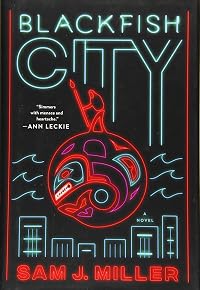
I'd been wanting to read this book since I first heard of it (great cover, polar fiction, intriguing concept), but was forcing myself to wait for the paperback, as per usual. Except then I discovered that the hardback cover glowed in the dark, and then my friend challenged me to make some glowing earrings to coordinate with it, so to the library I went.
(The paperback actually came out while I was reading the library copy, and I ran out to buy it. Tragically, the paperback doesn't glow. But it's still gorgeous.)
I ATE THIS BOOK UP. Interesting world-building, some great, spiky characters, lots of polar-fiction flavor, despite the hotter, climate-changed world. I was on this ride 100% and careening through it as fast as I could to find out show more would happen until a certain plot point I am avoiding because spoilers. I mean, it's not as it didn't make sense, necessarily, as an in-world consequence. Maybe it just felt bigger to me than the book seemed to make it out to be -- I wanted more build-up to it, more impact after. (Not that there wasn't impact after.) I just felt kind of hollow after that moment -- not 100% on the ride anymore. Which is fine, it just knocked the book down from a 5-star for me, which it was well on its way toward being until then. show less
(The paperback actually came out while I was reading the library copy, and I ran out to buy it. Tragically, the paperback doesn't glow. But it's still gorgeous.)
I ATE THIS BOOK UP. Interesting world-building, some great, spiky characters, lots of polar-fiction flavor, despite the hotter, climate-changed world. I was on this ride 100% and careening through it as fast as I could to find out show more would happen until a certain plot point I am avoiding because spoilers. I mean, it's not as it didn't make sense, necessarily, as an in-world consequence. Maybe it just felt bigger to me than the book seemed to make it out to be -- I wanted more build-up to it, more impact after. (Not that there wasn't impact after.) I just felt kind of hollow after that moment -- not 100% on the ride anymore. Which is fine, it just knocked the book down from a 5-star for me, which it was well on its way toward being until then. show less
Members
- Recently Added By
Lists

2019 Hugo Eligible Novels
40 works; 12 members

Dystopian and Apocalyptic Literature
350 works; 74 members

It's the end of the world as we know it!
90 works; 23 members

2018 New SF Releases
24 works; 1 member

LGBTQ+ Speculative Fiction
821 works; 51 members

Amazon best fictional genre picks monthly for 2018
418 works; 9 members

Fiction to Read for Earth Day
50 works; 8 members

Grist Magazine's Definitive Climate Fiction Reading List
22 works; 2 members

Books Read in 2022
5,226 works; 115 members

Adult Stories Involving Animals
76 works; 6 members
Author Information

22+ Works 1,641 Members
Sam J. Miller is an American author, based in New York. He writes novels and short stories in science fiction, fantasy, and horror genres. Before becoming a writer, he worked as a butcher, guitarist in a punk rock band, and a painter's model. He was co-editor of the anthology, Horror After 9/11. His other work includes Blackfish City, and The Art show more of Starving, which won the 2017 Nebula Awards, Andre Norton Award for young adult science-fiction and fantasy. (Bowker Author Biography) show less
Some Editions
Awards and Honors
Awards
Work Relationships
Has as a study
Common Knowledge
- Canonical title
- Blackfish City
- Original title
- Blackfish City
- Original publication date
- 2018
- People/Characters
- Masaaraq; Fill Podlove; Ishmael Barron; Ankit; Kaev; Go (show all 14); Ora; Soq; Fyodorovna; Jeong; Dao; Martin Podlove; Atkonartok; Liam
- Important places
- Qaanaaq, a floating city (fictional); Taastrup; New York, New York, USA
- Epigraph
- There is nothing safe about the darkness of this city and its stink. Well, I have abrogated all claim to safety, coming here. It is better to discuss it as though I had chosen. That keeps the scrim of sanity before the awful ... (show all)set. What will lift it?
-- Samuel R Delany, Dhalgren - First words
- People would say she came to Quanaaq in a skiff towed by a killer whale harnessed to the front like a horse.
- Quotations
- Epidemics do not have medical causes; they have social ones.
- Last words
- (Click to show. Warning: May contain spoilers.)"People would say she came to Quanaaq in a skiff towed by a killer whale harnessed to the front like a horse..."
- Publisher's editor
- Wagman, Zachary
- Blurbers
- Leckie, Ann; Machado, Carmen Maria; Gregory, Daryl; Sternbergh, Adam
- Original language
- English
- Canonical DDC/MDS
- 813.6
- Canonical LCC
- PS3613.I55288
Classifications
Statistics
- Members
- 918
- Popularity
- 29,235
- Reviews
- 33
- Rating
- (3.43)
- Languages
- English, French, Hungarian, Japanese
- Media
- Paper, Audiobook, Ebook
- ISBNs
- 19
- ASINs
- 4