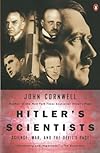
Hitler's Scientists: Science, War, and the Devil's Pact
by John Cornwell
On This Page
Description
In Hitler's Scientists, British historian John Cornwell explores German scientific genius in the first half of the twentieth century and shows how Germany's early lead in the new physics led to the discovery of atomic fission, which in turn led the way to the atom bomb, and how the ideas of Darwinism were hijacked to create the lethal doctrine of racial cleansing.Tags
Recommendations
















































Member Reviews
Before Hitler most of the pioneering atomic scientists were working in Germany. Many of them were Jewish. So many brilliant men, working at the same time! Great scientists were not necessarily great men, and some remained in Germany to further their careers, taking the jobs of sacked Jews, disclaiming responsibility for Nazi atrocities and using slave labour.
Cornwell compares the moral limitations and hypocrisy of scientists in Nazi Germany with those of scientists today . He quotes the words of Rotblat, winner of the Nobel Peace Prize and the only scientist to resign from the Manhattan Project when it became clear that Germany was not developing an atomic bomb. Rotblat believed that the way to prevent the prostitution of science was show more for scientists to be "human beings first and scientists second." show less
Cornwell compares the moral limitations and hypocrisy of scientists in Nazi Germany with those of scientists today . He quotes the words of Rotblat, winner of the Nobel Peace Prize and the only scientist to resign from the Manhattan Project when it became clear that Germany was not developing an atomic bomb. Rotblat believed that the way to prevent the prostitution of science was show more for scientists to be "human beings first and scientists second." show less
Some books don't live up to the promise of the Title, while others, like this one, give more than expected from the title alone. Cornwell discusses many of Germany's leading scientists, some of whom chose to leave their homeland as the Nazi's came to power, others who felt compelled to stay due to their Nationalistic feelings, and others who willingly and knowingly participated in the racist philosophy of the Nazi's. But the book also give a lot of historical context of the era, from WWI up to and through the cold war well after the fall of Germany. There are also numerous parallel stories involving British and American scientific efforts, such as those involving code breaking and atomic weapon developments. And while its easy to show more condemn any German scientist who supported the Nazi war effort, Cornwell also reminds us that many of those same scientists were subsequently recruited by both Soviet and western governments after the war to work on rocket and weapon research programs for these Cold War opponents. The dilemma raised by the book, for scientists and citizens alike, is recognizing the difference between the necessity of fully supporting your duly elected leaders, and the personal decisions to be made if policies have drifted beyond recognized moral limits as during the Holocaust. show less
Pleasantly surprised with this one. Title seemed indicative of an exploitative 'oh-the-horror' book, but this was a well-researched analysis of the ethical dilemmas which faced the brilliant German scientists of the era. Covers several technical areas, and eras ranging from WWI (Fritz Haber is an especially interesting case) to the Cold War. Hitler's astonishing ignorance of technical affairs played a role in Germany's misapplied research programs in WW2.
A necessary and interesting book.
A necessary and interesting book.
Excellent, but should have stopped at section seven of perhaps six. The last sections are written as if the author is trying to fill pages, not with the same interest as the first part of the book.
Great read, compelling at times but becomes a little stale in the last eight of the book where his opinions encourage speed reading.
This book is really a long overview of Nazi science and scientific ethics. It begins in the World War One era with Weimar science and how Germany was the top of the scientific world. Rocketry, poison gas, the use of slave labor and the evil of IG Farben are all discussed, although a large portion of the book is dedicated to the Nazi nuclear bomb program, or lack thereof. The book goes into a little detail about the truly eccentric pseudo-science views of Hitler and Himmler. Good book for someone who's interested.
This work bounces around and repeats itself continuously. Cornwell conducts solid research, yet spins everything in a way that seems juvenile and unnecessary.
Members
- Recently Added By
Author Information

20+ Works 3,125 Members
John Cornwell is Senior Research Fellow at Jesus College, Cambridge, England, and an award-winning journalist and author. His A Thief in the Night: The Death of Pope John Paul I was a world bestseller. He has profiled Pope John Paul II for Vanity Fair and the London Sunday Times magazine and has written on Catholic issues for many publications show more around the world. show less
Series
Belongs to Publisher Series
Common Knowledge
- Original title
- Hitler's scientists. Science, war and the devil's pact
- Important events
- World War II (1939 | 1945)
- Publisher's editor*
- Albin Michel
*Some information comes from Common Knowledge in other languages. Click "Edit" for more information.
Classifications
Statistics
- Members
- 578
- Popularity
- 50,715
- Reviews
- 13
- Rating
- (3.72)
- Languages
- 8 — Dutch, English, French, German, Italian, Polish, Portuguese, Spanish
- Media
- Paper, Audiobook, Ebook
- ISBNs
- 17
- UPCs
- 1
- ASINs
- 4