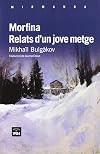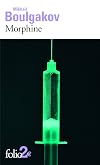
Morfine
by Mikhail Afanasevich Bulgakov
On This Page
Description
Young Dr. Bromgard has come to a small country town to assume a new practice. No sooner has he arrived than he receives word that a colleague, Dr. Polyakov, has fallen gravely ill. Before Bromgard can go to his friend's aid, Polyakov is brought to his practice in the middle of the night with a self-inflicted gunshot wound, and, barely conscious, gives Bromgard his journal before dying. What Bromgard uncovers in the entries is Polyakov's uncontrollable and merciless descent into morphine show more addiction -- his first injection to ease his back pain, the thrill of the drug as it overtakes him, the looming signs of addiction, and the feverish final entries before his death. show lessTags
Recommendations



























Member Reviews
I am a Bulgakov fan. I have read & loved both The Master and Margarita, as well as Heart of a Dog.
This novella was originally included as part of a larger work known as A Young Doctor's Notebook or A Country Doctor's Notebook. While today we know Bulgakov as an author, he did spend the early part of his career as a doctor. During WW1, as a doctor on the front lines, he suffered serious injuries at least twice. Suffering from chronic pain, he ended up being addicted to morphine. In 1918, he managed to stop his morphine use. Almost ten years later, he wrote this fictional novella, obviously semi-autobiographical & based on fighting his own demons in relation to morphine addiction.
It's a riveting read on the descent into drug addiction: show more the behaviors, the compromises, the urgency, the paranoia, the desperation. It's a bold, succinct cautionary tale. show less
This novella was originally included as part of a larger work known as A Young Doctor's Notebook or A Country Doctor's Notebook. While today we know Bulgakov as an author, he did spend the early part of his career as a doctor. During WW1, as a doctor on the front lines, he suffered serious injuries at least twice. Suffering from chronic pain, he ended up being addicted to morphine. In 1918, he managed to stop his morphine use. Almost ten years later, he wrote this fictional novella, obviously semi-autobiographical & based on fighting his own demons in relation to morphine addiction.
It's a riveting read on the descent into drug addiction: show more the behaviors, the compromises, the urgency, the paranoia, the desperation. It's a bold, succinct cautionary tale. show less
I was at the bookstore on a quest for a classic science fiction anthology I had seen once before. Thwarted (temporarily, sf anthologies turned out to be in a slightly stupid place), I drifted about, scanning for Melville House books, like I do. This was similar enough to the novella series design to stop me, and when I saw it was Bulgakov, I was in.
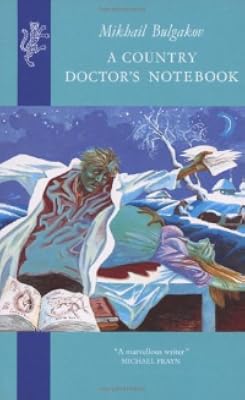
I did not realize that this was one of the stories from A Country Doctor's Notebook until after I read it. Meh. That just means I can give this copy away once I get a copy of Notebook. (But will I? This copy is so small and lovely!)
I really loved the opening -- Dr. Bromgard's relief at moving to a small city with a hospital with departments in which he is merely one cogged wheel after being a show more country doctor -- on call 24/7 -- the only thing between any resident of his district and death. Or so he felt. This is nicely contrasted with Dr. Polyakov's notebook, another doctor in a country post. Isolated, recently heartbroken, certainly depressed. One night he suffers severe and unexplained pain, and is given a shot of morphine. The rest of the diary is a descent into addiction and depravity. Sometimes desperate, sometimes lucid except for his insistence in those moments that everything is fine... At times directly indicting the way we treat people with mental illness and addiction, always indicting, if indirectly, and society in which people are expected to bear all their burdens on their own shoulders.
Many words for such a short book, but Bulgakov is a master. show less
I did not realize that this was one of the stories from A Country Doctor's Notebook until after I read it. Meh. That just means I can give this copy away once I get a copy of Notebook. (But will I? This copy is so small and lovely!)
I really loved the opening -- Dr. Bromgard's relief at moving to a small city with a hospital with departments in which he is merely one cogged wheel after being a show more country doctor -- on call 24/7 -- the only thing between any resident of his district and death. Or so he felt. This is nicely contrasted with Dr. Polyakov's notebook, another doctor in a country post. Isolated, recently heartbroken, certainly depressed. One night he suffers severe and unexplained pain, and is given a shot of morphine. The rest of the diary is a descent into addiction and depravity. Sometimes desperate, sometimes lucid except for his insistence in those moments that everything is fine... At times directly indicting the way we treat people with mental illness and addiction, always indicting, if indirectly, and society in which people are expected to bear all their burdens on their own shoulders.
Many words for such a short book, but Bulgakov is a master. show less
The fact that Bulgakov himself suffered from a morphine addiction adds a certain poignancy to this story; he writes of what he knows. Luckily, Bulgakov beat the addiction and survived but the experience plainly showed him what could happen in extremis, as it does to his protagonist.
This is not even a novella it is so short (often included with short stories), but it is a good description of the descent into addiction, which need not be specific to morphine, beginning with pain relief that is welcome, but then moving onto dependence and finally addiction with all the attendant pathologies of paranoia, denial, lying, rationalization, self-destruction, thieving, physical decline, more denial, and then the final, awful realization that show more there is no salvation, that the addiction will triumph over any effort to thwart it, that any human relationship, even love, will be sacrificed to the need for the needle, and the only way out is death.
This all takes place at the time of the abdication of the Tsar, the Revolution, and the beginnings of the Civil War. There are oblique references to those events which are turning Russian society and politics inside-out, but I don't think Bulgakov is reaching for any deeper metaphors.
One thing that did come to mind, is how history is shaped and structured by momentous events under which play-out the lives and loves, hopes and fears, successes and failures, happiness and terrors of millions of individuals. The broken-hearted Doctor's descent into the madness of addiction is just one of those stories of the human condition that persist whatever the larger political, economic, social contexts and currents.
If there is a deeper sense to the story, maybe it is that individuals are quite capable, for a multitude of rational and irrational reasons, to ruin their own lives, never mind the wholesale destruction visited upon millions and millions of individuals by great historic events. show less
This is not even a novella it is so short (often included with short stories), but it is a good description of the descent into addiction, which need not be specific to morphine, beginning with pain relief that is welcome, but then moving onto dependence and finally addiction with all the attendant pathologies of paranoia, denial, lying, rationalization, self-destruction, thieving, physical decline, more denial, and then the final, awful realization that show more there is no salvation, that the addiction will triumph over any effort to thwart it, that any human relationship, even love, will be sacrificed to the need for the needle, and the only way out is death.
This all takes place at the time of the abdication of the Tsar, the Revolution, and the beginnings of the Civil War. There are oblique references to those events which are turning Russian society and politics inside-out, but I don't think Bulgakov is reaching for any deeper metaphors.
One thing that did come to mind, is how history is shaped and structured by momentous events under which play-out the lives and loves, hopes and fears, successes and failures, happiness and terrors of millions of individuals. The broken-hearted Doctor's descent into the madness of addiction is just one of those stories of the human condition that persist whatever the larger political, economic, social contexts and currents.
If there is a deeper sense to the story, maybe it is that individuals are quite capable, for a multitude of rational and irrational reasons, to ruin their own lives, never mind the wholesale destruction visited upon millions and millions of individuals by great historic events. show less
First published in 1925, Morphine is a mini-novel by Mikhail Bulgakov, one of the giants of twenteith century Russian literature. The storyline is simple: Bromgard, a young doctor moves from the backwoods to a small country town to practice medicine in a clinic. A month passes and he receives news that Polyakov, a friend, a "very reasonable man," he knew as a student in medical school is ill and needs his help.
Bromgard plans to travel by train to his friend but before his scheduled departure Polyakov is brought to the clinic on the verge of death, resulting from a self-inflicted bullet wound. But before Polyakov dies, he hands Dr. Bromgard a diary recording his addiction to morphine. And the heart and soul of this Bulgakov tale is the show more contents of the diary.
Such a simple story. But please don't be fooled - through Bulgakov's literary magic we are given a gem. The author crafts with a kind of subtle perfection the step-by-step decent of an intelligent young man with a promising future in the grip of morphine addiction.
And it all starts so innocently: On the night of February 15th an otherwise perfectly healthy twenty-three year old Dr. Poyakov experiences intense stomach pain. He sends for Anna Kirillovna, a kind and intellegent nurse, and she gives him a morphine injection.
The next day, Dr. Polyakov makes a decision that will prove to be a drastic mistake, turning him into an addict. We read, "Fearing a recurrence of yesterday's attack, I injected myself in the thigh with one centigramme"
Such a penetrating observation on human psychology: the young doctor does not experience intense pain; rather, he gives himself a morphine injection because he fears intense pain. Oh my goodness: according to the wisdom of ancient Greek philosophers, a prime emotion we must overcome is our fear, most especially fear of pain and fear of death. And ff we act based solely on our fear, the consequences can quite possibly be dreadful in the extreme
A mere two weeks later, the young doctor's identity has completely transformed; he and his morphine are one. Here are his words from the diary: "I would say that a man can only work normally after an injection of morphine."
Then, we read the following March 10 entry: "Never before have I had such dreams at dawn. They are double dreams. The main one, I would say, is made of glass. It is transparent. This is what happened: I see a lighted lamp, fearfully bright, from which blazes a stream of many-colored light. Amneris, swaying like a green feather, is singing. An unearthly orchestra is playing with a full, rich sound - although I cannot really convey this in words. In short, in a normal dream music is soundless . . . but in my dream the music sounds, quite heavenly. And best of all I can make the music louder or softer at will."
Ecstasy! Ecstasy! Ecstasy! Our young doctor is completely hooked, psychologically every bit as much as physically. Incidentally, Amneris is an opera singer, the doctor's former mistress who left him weeks prior to his first morphine injection.
But such ethereal, blissful dreams have a price, a big price. On April 9th he writes, "The devil is in this phial. . . . This is the effect: on injecting one syringe of a 2% solution, you feel almost immediately a state of calm, which quickly grows into a delightful euphoria. This lasts for only a minute or two, then it vanishes without a trace as though it has never been. Then comes pain, horror, darkness."
And then a month later we read: "What overtakes the addict deprived of morphine for a mere hour or two is not a "depressed condition": it is slow death."
Ten more months of morphine addiction, alternating between injections and the slow death between injections, Dr. Polyakov takes his own life at tender age of twenty-four. Such a tragedy.
From what I've read on the net, this is a much read and consulted cautionary tale for those involved in the medical industry. And recognizing the many forms of drug addiction in our brave new twenty-first century world, Bulgakov's Morphine is a cautionary tale for each and every one of us. show less
First published in 1925, Morphine is a mini-novel by Mikhail Bulgakov, one of the giants of 20th century Russian literature. The storyline is simple: Bromgard, a young doctor moves from the backwoods to a small country town to practice medicine in a clinic. A month passes and he receives news that Polyakov, a friend, a `very reasonable man', he knew as a student in medical school is ill and needs his help. Bromgard plans to travel by train to his friend but before his scheduled departure Polyakov is brought to the clinic on the verge of death, resulting from a self-inflicted bullet wound. But before Polyakov dies, he hands Dr. Bromgard a diary recording his addiction to morphine. And the heart of this Bulgakov tale is the contents of show more the diary.
Such a simple story. But please don't be fooled - through Bulgakov's literary magic we are given a gem. The author crafts with a kind of subtle perfection the step-by-step decent of an intelligent young man with a promising future in the grip of morphine addiction. And it all starts so innocently: On the night of February 15 an otherwise perfectly healthy 23 year old Dr. Poyakov experiences intense stomach pain. He sends for Anna Kirillovna, a kind and intellegent nurse, and she gives him a morphine injection.
The next day, Dr. Polyakov makes a decision that will prove to be a drastic mistake, turning him into an addict. We read, "Fearing a recurrence of yesterday's attack, I injected myself in the thigh with one centigramme" Such a penetrating observation on human psychology: the young doctor does not experience intense pain, but he gives himself a morphine injection because he fears intense pain. Oh my goodness: according to the wisdom of ancient Greek philosophers, a prime emotion we must overcome is our fear, fear of pain and fear of death. If we act from our fear, the consequences can be dreadful.
A mere two weeks later, the young doctor's identity has completely transformed; he and his morphine are one. Here are his words from the diary: "I would say that a man can only work normally after an injection of morphine." Then, we read the following March 10 entry: "Never before have I had such dreams at dawn. They are double dreams. The main one, I would say, is made of glass. It is transparent. This is what happened: I see a lighted lamp, fearfully bright, from which blazes a stream of many-colored light. Amneris, swaying like a green feather, is singing. An unearthly orchestra is playing with a full, rich sound - although I cannot really convey this in words. In short, in a normal dream music is soundless . . . but in my dream the music sounds, quite heavenly. And best of all I can make the music louder or softer at will." Oh, such ecstasy! Our young doctor is completely hooked, psychologically every bit as much as physically. Incidentally, Amneris is an opera singer, the doctor's former mistress who left him weeks prior to his first morphine injection.
But such ethereal, blissful dreams have a price, a big price. On April 9th he writes, "The devil is in this phial. . . . This is the effect: on injecting one syringe of a 2% solution, you feel almost immediately a state of calm, which quickly grows into a delightful euphoria. This lasts for only a minute or two, then it vanishes without a trace as though it has never been. Then comes pain, horror, darkness." And then a month later we read: "What overtakes the addict deprived of morphine for a mere hour or two is not a `depressed condition': it is slow death." Ten more months of morphine addiction, alternating between injections and the slow death between injections, Dr. Polyakov takes his own life at age 24.
From what I've read on the net, this is a much read and consulted cautionary tale for those involved in the medical industry. And recognizing the many forms of drug addiction in our brave new 21st century world, Bulgakov's Morphine is a cautionary tale for each and every one of us. Available on-line: https://www.google.com/#q=morphine bulgakov pdf show less
As my wife suggests: sometimes a great author's minor works are considered minor for a reason. This was my first time reading Bulgakov, for the very simple reason that I mostly get books second hand, and his books are never available second hand. An excellent sign! But this was disappointing. No doubt someone who knows more about Russia than I do might be able to turn this very sub-Dostoevskian tale of madness and addiction into an allegory for the Russian revolution. There are references to the events every now and then, and I'm sure one can make decent analogies between the country doctor's reliance on morphine to overcome a mysterious pain on the one hand, and, on the other, a country's reliance on rigid dogma to overcome a show more mysterious pain (i.e., the horrific injustice that preceded the revolution) on the other.
But sadly, as I was reading this I kept thinking that any familiarity with 20th century drug lit at all makes it very hard to really get interested in a *morphine* addiction that leads to little more than one hallucination and a fairly gentle seeming death. That's not Mikhail's fault, of course. It is his fault that I also kept thinking that Dostoevsky would have done it better, and earlier. Bulgakov surely has much more than this to recommend him. So, in a weird way, perhaps I'll be more likely to get a new copy of M&M.
As a side note, goodreads suggests that this is crazy popular in arabic. I'd love to read those reviews and find out why. show less
But sadly, as I was reading this I kept thinking that any familiarity with 20th century drug lit at all makes it very hard to really get interested in a *morphine* addiction that leads to little more than one hallucination and a fairly gentle seeming death. That's not Mikhail's fault, of course. It is his fault that I also kept thinking that Dostoevsky would have done it better, and earlier. Bulgakov surely has much more than this to recommend him. So, in a weird way, perhaps I'll be more likely to get a new copy of M&M.
As a side note, goodreads suggests that this is crazy popular in arabic. I'd love to read those reviews and find out why. show less
Bulgakov got hooked on morphine for a year, but his wife marshalled him successfully through withdrawal and recovery. No such luck for the hero of his novella, also a doctor, also deployed in a tiny provincial town, and also getting addicted following medical treatment.
Other autobiographical touches include a suicide letter similar to the one left by a friend of Bulgakov's, and the hero's love of opera. The authenticity of the account gets a quirky further recognition in the fact of Soviet censorship of the dosages used, at original publication.
Other autobiographical touches include a suicide letter similar to the one left by a friend of Bulgakov's, and the hero's love of opera. The authenticity of the account gets a quirky further recognition in the fact of Soviet censorship of the dosages used, at original publication.
Members
- Recently Added By
Author Information

370+ Works 35,281 Members
Mikhail Afanasevich Bulgakov was a Russian playwright, novelist, and short-story writer best known for his use of humor and satire. He was born in Kiev, Ukraine, on May 15, 1891, and graduated from the Medical School of Kiev University in 1916. He served as a field doctor during World War I. Bulgakov's association with the Moscow Art Theater began show more in 1926 with the production of his play The Days of the Turbins, which was based on his novel The White Guard. His work was popular, but since it ridiculed the Soviet establishment, was frequently censored. His satiric novel The Heart of a Dog was not published openly in the U.S.S.R. until 1987. Bulgakov's plays including Pushkin and Moliere dealt with artistic freedom. His last novel, The Master and Margarita, was not published until 1966-67 and in censored form. Bulgakov died in Moscow on March 10, 1940. (Bowker Author Biography) A practicing physician like Anton Chekhov, Mikhail Afanasevich Bulgakov became a popular writer and playwright in the comparatively easier political climate of the Soviet Union during the 1920s. The civil war and its internecine horrors became one of his major themes as did the new Soviet society. His early prose is often satiric, with strong elements of the fantastic and grotesque, but it also contains the themes of guilt and personal responsibility that become so crucial in his later work. Bulgakov wrote a number of important plays that provoked bitter attacks in the press, and he was shut out of the theater and literature in 1929. Only a direct appeal to Stalin allowed Bulgakov to resume a professional career. Even then, however, some publishing houses and theaters rejected some of his important works, such as the novel Life of Monsieur de Moliere (1933). Bulgakov's masterpiece written over a number of years and only published decades after his death is the novel Master and Margarita (1966-67). Combining two principal plot lines-Satan's visit to contemporary Moscow and the trial and execution of Jesus in biblical Judaea-the work may be read on many levels, from the purely satiric to the allegorical. It has been acclaimed as one of the most important achievements of twentieth-century Russian fiction. Today, Bulgakov is celebrated for both his plays and his novels. Several of his plays are public favorites and standard fare in Russian theaters. Bulgakov died in Moscow on March 10, 1940. (Bowker Author Biography) show less
Some Editions
Awards and Honors
Notable Lists
Series
Belongs to Publisher Series
Work Relationships
Is contained in
Common Knowledge
- Canonical title
- Morfine
- Original title
- Морфий
- Original publication date
- 1926
- Related movies
- Morfiy (2008 | IMDb)
- First words
- Clever people have been pointing out for a long time that happiness is like good health: when it's there, you don't notice it. But when the years have passed, how do you remember happiness, oh, how do you remember it!
- Original language
- Russian
Classifications
- Genres
- Fiction and Literature, General Fiction
- DDC/MDS
- 891.7342 — Literature & rhetoric Literatures of other languages East Indo-European and Celtic literatures Russian and East Slavic languages Russian fiction USSR 1917–1991 Early 20th century 1917–1945
- LCC
- PG3476 .B78 .M6713 — Language and Literature Slavic languages and literatures. Baltic languages. Albanian language Slavic. Baltic. Albanian Russian literature Individual authors and works 1917-1960
- BISAC
Statistics
- Members
- 339
- Popularity
- 93,920
- Reviews
- 9
- Rating
- (3.79)
- Languages
- 16 — Catalan, Czech, Dutch, English, Finnish, French, German, Hungarian, Italian, Japanese, Latvian, Polish, Portuguese, Russian, Spanish, Turkish
- Media
- Paper, Audiobook, Ebook
- ISBNs
- 40
- ASINs
- 7