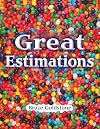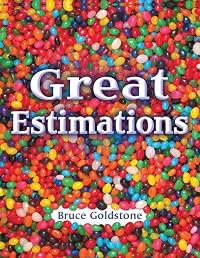
Great Estimations
by Bruce Goldstone
On This Page
Description
Learn to train your eyes and your mind to help you estimate number of objects in a group.Tags
Recommendations





Member Reviews
I checked this book out after reading That’s a Possibility by Bruce Goldstone. Both are great books, but I like this one better. It is colorful and simple. The presentation and photographs are wonderful. Take a look at page 17 to see what an entire box of cereal looks like laid out in a line. How many O’s are in there? Surely, you wouldn’t count every single one. You can get a close answer by estimating.
This book could spark kids to bring create their own pile of items to estimate. Show the class a box of toothpicks to a board and have everyone guess how many are present. Then ask them to use tactics in this book like clump counting and box counting. Compare the answers with and without Goldstone’s strategies. Do you notice any show more difference?
This is one of my favorite math books. It leaves a lot for children to think about without being too cluttered or confusing. Check it out! show less
This book could spark kids to bring create their own pile of items to estimate. Show the class a box of toothpicks to a board and have everyone guess how many are present. Then ask them to use tactics in this book like clump counting and box counting. Compare the answers with and without Goldstone’s strategies. Do you notice any show more difference?
This is one of my favorite math books. It leaves a lot for children to think about without being too cluttered or confusing. Check it out! show less
Goldstone’s book models problem solving and reasoning processes by picturing colorful photos of lots of something, posing a question, and providing hints for the reader to arrive at estimates. Hints include training eyes to see groups of 10 or 100, comparing benchmarks of 100 or 1000 to a larger sample as well as clump counting and dividing pictures into grids. Goldstone also provides hints for guessing how long, how tall, or how heavy items are by using comparisons. The book is best taken in small doses, not all at once. Connecting students’ math understanding to the world of work, the author notes the likely jobs where people make use of estimating: writers estimate the number of words written; carpenters estimate lengths of wood; show more planners estimate crowds when preparing for events; scientists use photos to estimate changes in environment, all of which provide natural extensions for having students engage estimation as do professionals. show less
Retelling: This book does not contain a single exact count of the pictures it asks you to estimate. You have to use your great estimation strategies to come as close as you can to the answer.
Thoughts and Feelings: Estimation is like a superpower. Counting really large numbers of things seems impossible, but if you think about what IS possible, what you CAN say, you get closer and closer to the answer. It's like an exercise in positive thinking. LOVE IT!
Thoughts and Feelings: Estimation is like a superpower. Counting really large numbers of things seems impossible, but if you think about what IS possible, what you CAN say, you get closer and closer to the answer. It's like an exercise in positive thinking. LOVE IT!
I enjoyed using this book in the classroom however I felt as though it should be geared to a higher grade level. I felt like my students weren't fully capable to making a educated guess or estimation for all of the pictures provided. However, I did like the open interaction that it allowed for the classroom. It gave the students the opportunity to put on there thinking caps and really observe and do think alouds for each page of the book.
What do 10,000 rubber duckies look like? This book gives an excellent, and accurate portrayal of large quantity items. I loved the every day objects the book uses to illustrate this concept. The hints are very helpful too on the bottom of the pages. In a classroom setting, I would read this book out loud first. I would then take several objects and have my students estimate the quantity. Examples include a jar filled with jelly beans, a bag full of marbles, or pen holder full of pens.
This book may be pretty advanced for elementary kids, however it breaks down using estimation to guess with extremely large numbers. Like how many blades of grass are on a football field. The pictures are a must for this book, and they accompany the rest of the book very well. I believe that it could be hard for elementary kids to understand and older kids may find the book boring. However, it still does a nice job teaching someone the basics of estimation.
This my second book review on a book aimed at young readers about the math skill of estimation. The first Estimations by Linn I felt would be useful mostly to teachers as a resource for specific activities to use in class. This book is also categorized as a specialized one with its very narrow focus. I have rated it higher because it has more visual appeal and use for students to access alone. While high school students would not want to use such a "childish" looking book, I could see myself using the book for in class activities. I really like the pages involving estimating size in inches/centimeters and feet/yards/meters. There is also a website I plan to check out (there are estimation games). As a specialized book the content does show more move from simple to more complex. show less
Members
- Recently Added By
Author Information

25 Works 2,580 Members
Awards and Honors
Awards
Classifications
Statistics
- Members
- 874
- Popularity
- 31,247
- Reviews
- 18
- Rating
- (3.73)
- Languages
- English, French
- Media
- Paper
- ISBNs
- 10
- ASINs
- 5