Brushfire: Illuminations from the Inferno
by Wayne Barlowe
On This Page
Description
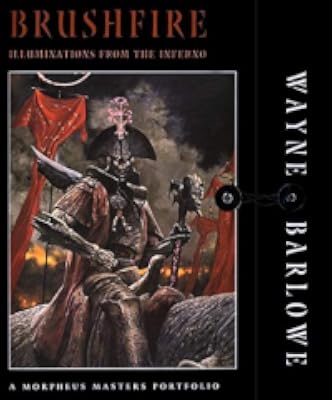
With a verisimilitude Hieronymus Bosch would have admired, Wayne Barlowe renders his latest visual nightmare in a startling yet classic style. Fifteen new paintings, along with numerous drawings, portray a world of warriors, hellish beasts, and infernal landscapes. With its heavy stock, embossed cover, and button-tie closure, this book resembles an authentic portfolio.Tags
Recommendations












Member Reviews
Wayne Barlowe returns to Hell in this slim volume. Subtitled “Illuminations from the Inferno,” he presents the reader with a series of frightening visions, simultaneously horrifying and erotic. A civil war brews in Hell between the Demons Major Sargatanas and Astaroth. The reader is shown Astaroth’s Herald and Standard-bearer. The Herald is “marginally humanoid” with two wings sprouting from a malformed mouth sitting within the middle of its chest. It appears like a wicked parody of the term vagina dentata. On another page, a succubus beckons with stony skin and cloven feet. The eroticism is alienating, since one can’t escape the fact her skin is cold stone. We see Hannibal and his Army of Souls, reminiscent of the Deadites show more from the classic film Army of Darkness. The picture gives no quarter to anything like camp or humor as in the Bruce Campbell cinematic masterpiece.
Continuing the multicultural aspect of Hell, Barlowe depicts a group of Behemoths, huge beasts of burden to Sargatanas. Stabled like giant horses, the Behemoths used to be chamberlains, viziers, and court officials of Chinese emperors. One need not go far these days to find an appropriate public official deserving this treatment in eternal damnation. One might be less eager to start pointless wars if one had this punishment as a reward.
One of the most frightening visages Barlowe depicts is that of a Scourge. It is “a winged and limbless enigma” with the face like that of an African mask. Morphologically perverse, its classification remained that of a demon. Its purpose was to subjugate souls. “Without flocks of them there could, and probably would, be complete chaos in the streets of Dis.” While the inhabitants of Hell exhibit bodies bent, broken, and battered, twisted into incoherent shapes, and subject to chaotic tortures, its leadership and organization is rigid, authoritarian, and orderly. The stark contrast between these two phenomena gives Barlowe’s vision a ferocious punch.
One on the last page, the reader sees a battle-scarred veteran from wars in Hell. He gives General William Tecumseh Sherman’s expression that “War is hell” a physical form and then turns it into a sick joke. One is thankful that soldiers only have to die once when they are involved in armed conflicts. In Hell, soldiers are given no such luxury. They unquestioningly obey the fickle orders of their sadistic superiors, suffer horribly, and then fight again and again. The prospect of such an existence is numbing to even contemplate.
Wayne Barlowe again delivers with his dark illuminations. Even today, with our myriad horrors and catastrophes, our everyday sadism and incompetence, art can show us there can be something even more horrifying.
This review is part of a blog post examining how different artists depict Hell:
http://driftlessareareview.wordpress.com/2010/11/14/critical-appraisal-the-lands... show less
Continuing the multicultural aspect of Hell, Barlowe depicts a group of Behemoths, huge beasts of burden to Sargatanas. Stabled like giant horses, the Behemoths used to be chamberlains, viziers, and court officials of Chinese emperors. One need not go far these days to find an appropriate public official deserving this treatment in eternal damnation. One might be less eager to start pointless wars if one had this punishment as a reward.
One of the most frightening visages Barlowe depicts is that of a Scourge. It is “a winged and limbless enigma” with the face like that of an African mask. Morphologically perverse, its classification remained that of a demon. Its purpose was to subjugate souls. “Without flocks of them there could, and probably would, be complete chaos in the streets of Dis.” While the inhabitants of Hell exhibit bodies bent, broken, and battered, twisted into incoherent shapes, and subject to chaotic tortures, its leadership and organization is rigid, authoritarian, and orderly. The stark contrast between these two phenomena gives Barlowe’s vision a ferocious punch.
One on the last page, the reader sees a battle-scarred veteran from wars in Hell. He gives General William Tecumseh Sherman’s expression that “War is hell” a physical form and then turns it into a sick joke. One is thankful that soldiers only have to die once when they are involved in armed conflicts. In Hell, soldiers are given no such luxury. They unquestioningly obey the fickle orders of their sadistic superiors, suffer horribly, and then fight again and again. The prospect of such an existence is numbing to even contemplate.
Wayne Barlowe again delivers with his dark illuminations. Even today, with our myriad horrors and catastrophes, our everyday sadism and incompetence, art can show us there can be something even more horrifying.
This review is part of a blog post examining how different artists depict Hell:
http://driftlessareareview.wordpress.com/2010/11/14/critical-appraisal-the-lands... show less
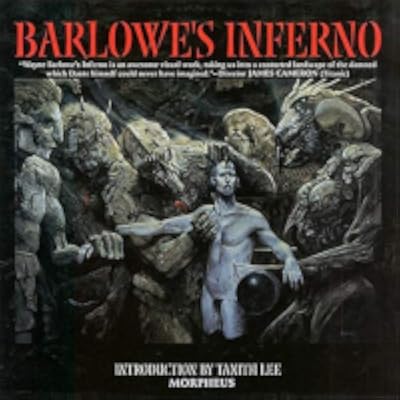
This book, a sort of artistic sequel to Barlowe's 'Inferno', presents itself as a folio of the work the artist has done as a guests of the demon lords of hell, complete with a flap that can be sealed shut with a string. It is very short, with perhaps fifteen plates, each featuring incredibly detailed, occasionally gory, often disturbing, and unsettlingly beautiful imagery of devils, lost souls, and the beasts of the abyss. Barlowe's style is very technical and realistic, if one can say that, which at times actually takes away from the effect as it makes that which we fear too visible. The pictures also feature a short description by the fictional artist of the subject, complete with name, infernal rank, and assigned task there in the show more darkness. Each one would serve well as a print for those with rather peculiar tastes, and indeed the book may have been made just for that purpose. Fans of Barlowe and dark imagery in general will probably enjoy this collection, as long as you can accept its brevity. show less
Very good art, but not much story, hurried ending, with no conclusion.
Ratings
Members
- Recently Added By
Author Information

12+ Works 2,124 Members
Classifications
Statistics
- Members
- 44
- Popularity
- 676,572
- Reviews
- 3
- Rating
- (4.27)
- Languages
- English
- Media
- Paper
- ISBNs
- 1
- ASINs
- 1