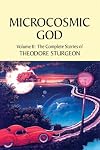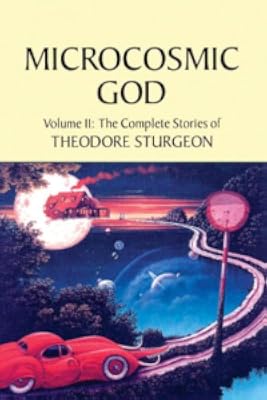
Microcosmic God: Volume II: The Complete Stories of Theodore Sturgeon
by Theodore Sturgeon
The Complete Stories of Theodore Sturgeon (2)
On This Page
Description
The second of a planned 10 volumes that will reprint all Sturgeon's short fiction covers his prolific output during 1940 and 1941, after which he suffered five years of writer's block. Showcasing Sturgeon's early penchant for fantasy, the first six selections include whimsical ghost stories, such as "Cargo," in which a World War II munitions freighter is commandeered by invisible, peace-loving fairies. With the publication of his enduring SF classic, "Microcosmic God," Sturgeon finally found show more his voice, combining literate, sharp-edged prose with fascinating speculative science while recounting the power struggle between a brilliant scientist, who creates his own miniature race of gadget makers, and his greedy banker. Voice found or not, every one of the stories here is readable and entertaining today because of Sturgeon's singular gifts for clever turns of phrase and compelling narrative. As Samuel R. Delaney emphasizes in an insightful introduction, Sturgeon was the single most influential SF writer from the 1940s through the 1960s. show lessTags
Recommendations




















Member Reviews
Another wonderful collection of Theodore Sturgeon stories, made all the more impressive by the fact that he churned this batch out in such a short time period. Roughly half of the stories are fantasy (written for John W. Campbell, Jr.'s Unknown), and half are science fiction (written for Campbell's Astounding Science-Fiction).
"Microcosmic God," the title story for this volume, is one of Sturgeon's most famous tales although it was never one of his personal favorites. It's a brilliant story, although I thought it lacks the extraordinary empathy which marks Sturgeon's very best works ("Thunder and Roses" for example). The world in a microcosm tale had been done before, if not as well, but other stories in this collection were truly show more groundbreaking. "Poker Face" was the first story to deal with aliens living and working amongst us (a topic Sturgeon revisited later that same year in "The Golden Egg"). I was also surprised that stories published in 1941 dealt very directly with issues around atomic energy, nuclear explosions, and Uranium-235 vs Uranium-238. Three of these stories seem to be set in the same future universe: "Biddiver," "Artnan Process," and "Two Percent Solution." This trio shares a strong space opera flavor I don't typically associate with Sturgeon (although the Two Percent Solution ends with a triple twist very much in the style of Sturgeon's earliest stories).
A general comment I would make about this group of stories is they are not as assured as Sturgeon's best at capturing empathy. The boy meets girl stories in this volume "The Haunt" and "The Golden Egg," for example, are not nearly as effective as his other stories of this ilk. The story notes from editor Paul Williams are not as extensive as those from the first volume, but still add a lot. Highly recommended. show less
"Microcosmic God," the title story for this volume, is one of Sturgeon's most famous tales although it was never one of his personal favorites. It's a brilliant story, although I thought it lacks the extraordinary empathy which marks Sturgeon's very best works ("Thunder and Roses" for example). The world in a microcosm tale had been done before, if not as well, but other stories in this collection were truly show more groundbreaking. "Poker Face" was the first story to deal with aliens living and working amongst us (a topic Sturgeon revisited later that same year in "The Golden Egg"). I was also surprised that stories published in 1941 dealt very directly with issues around atomic energy, nuclear explosions, and Uranium-235 vs Uranium-238. Three of these stories seem to be set in the same future universe: "Biddiver," "Artnan Process," and "Two Percent Solution." This trio shares a strong space opera flavor I don't typically associate with Sturgeon (although the Two Percent Solution ends with a triple twist very much in the style of Sturgeon's earliest stories).
A general comment I would make about this group of stories is they are not as assured as Sturgeon's best at capturing empathy. The boy meets girl stories in this volume "The Haunt" and "The Golden Egg," for example, are not nearly as effective as his other stories of this ilk. The story notes from editor Paul Williams are not as extensive as those from the first volume, but still add a lot. Highly recommended. show less
Includes a fascinating introductory essay by Samuel R. Delaney about Sturgeon’s influence. Sturgeon once published a revised version of a story, which was shocking, Delaney argues, because sf had managed to survive as “not good for you” literature by pretending that it was written easily. But if the authors sweated over every word, that makes them more serious miscreants against right thinking. Sturgeon’s revision thus helped the field recognize its own claims to literary status. Relatedly, in an aside that makes me think of Francesca Coppa, “the conceptual space of science fiction is finally far closer in organization to the performance space of the circus (with its extraordinary vertical as well as horizontal organization show more recalling science fiction’s spaceships and alien worlds; with its audience surround and its oddly fuzzy distinction between backstage and performance area recalling SF writers’ relation to their vociferous and ever-presnet fans; and the circus was the first art to insist openly that more must go on in the performance space than can possibly be seen at once) than it is to the staid divisions of the theater (backstage, stage, and audience)….” The stories themselves often reminded me that misanthropy in a misogynist world is often misogyny. Which is to say, though most of the characters don’t come off well, women come off especially badly. Part of the insult misogyny adds to injury is that it makes good thinkers into bad ones: Sturgeon’s vicious inventiveness turns stale and boring whenever women enter the picture, as when an all-powerful alien adopts a human form (after first thinking that the “drab” ones must be the women, figuring out his error (because gender is a universal, of course) and choosing a male form) and achieves the great insight that women can only love men who abuse them. Or when a man who lusts after a woman who doesn’t take him seriously decides “I’m going to shake her off her high horse, by all that’s unholy, if I have to kill her to do it” and sets out to terrify her into being weak so he can be strong (and it works because misogyny). show less
Ratings
Members
- Recently Added By
Author Information

323+ Works 15,910 Members
Theodore Sturgeon was born Edward Hamilton Waldo in New York City on February 26, 1918. He sold his first short story, Heavy Insurance, while serving in the United States Merchant Marine from 1935 to 1938. He won numerous awards including the 1954 International Fantasy Award for More than Human, the 1970 Nebula and Hugo Awards for Slow Sculpture, show more and the 1985 World Fantasy Award for Lifetime Achievement. He was inducted into the Science Fiction and Fantasy Hall of Fame in 2000. He died of pneumonia in Eugene, Oregon on May 8, 1985. (Bowker Author Biography) Theodore Sturgeon was the author of numerous novels and over 200 stories. He died in 1985. (Publisher Provided) show less
Series

Belongs to Publisher Series
Classifications
Statistics
- Members
- 267
- Popularity
- 121,176
- Reviews
- 2
- Rating
- (3.93)
- Languages
- English
- Media
- Paper, Ebook
- ISBNs
- 5
- ASINs
- 6