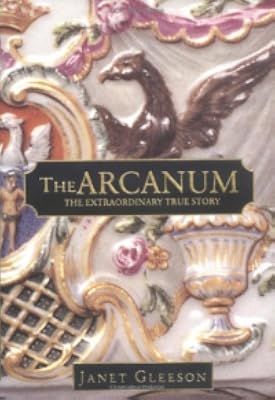
The Arcanum: The Extraordinary True Story
by Janet Gleeson
On This Page
Description
An extraordinary episode in cultural & scientific history comes to life in the fascinating story of a genius, greed, & exquisite beauty revealed by the obsessive pursuit of the secret formula for one of the most precious commodities of eighteenth century European royalty-fine porcelain.Tags
Recommendations

































Member Reviews
Who would have thought that a book about the history of European porcelain manufacturing would be a fun read? But that’s exactly what The Arcanum is and it makes this history read like a novel. It is the story of a Johann Frederick Bottger, a precocious young 18th century chemist who in a misguided attempt to prove his worthiness to a King (August the Strong of Saxony and Poland) promises that he has the ability to create gold out of ordinary metals. The King orders Bottger locked away in a castle for years so that he can provide this creation for the King’s benefit.
Eventually, in desperation for some freedom and to avoid execution for fraudulently representing himself, Bottger instead comes up with the formula (the Arcanum) for show more making hard porcelain in the manner of the Chinese. Chinese porcelain had been highly prized in Europe for its delicacy, beauty and durability. The Europeans could not replicate porcelain until Bottger figured out how. Once he did, August the Strong opened a factory in Meissen, Germany (where it still remains) which produced highly sought beautiful and delicate objects. The book details the intrigues in the factory as well as the plots and conspiracies throughout Europe in efforts to steal the porcelain formula and compete with August’s monopoly on this lucrative, highly desired and valuable luxury.
It really is a fascinating and enjoyable story and Gleeson manages to provide historical and political background as well as a real taste of life in the 1700’s in Europe. If I have one complaint about the book, it is that there are no photos of Meissen porcelain. Given that Meissen established the precedent for this decorative art in Europe, it seems that the inclusion of photos of the porcelain would have added a lot to the book and the lack of photography is a huge omission. Simply put, seeing examples of Meissen would have visually answered the question of what the fuss was all about 300 years ago. show less
Eventually, in desperation for some freedom and to avoid execution for fraudulently representing himself, Bottger instead comes up with the formula (the Arcanum) for show more making hard porcelain in the manner of the Chinese. Chinese porcelain had been highly prized in Europe for its delicacy, beauty and durability. The Europeans could not replicate porcelain until Bottger figured out how. Once he did, August the Strong opened a factory in Meissen, Germany (where it still remains) which produced highly sought beautiful and delicate objects. The book details the intrigues in the factory as well as the plots and conspiracies throughout Europe in efforts to steal the porcelain formula and compete with August’s monopoly on this lucrative, highly desired and valuable luxury.
It really is a fascinating and enjoyable story and Gleeson manages to provide historical and political background as well as a real taste of life in the 1700’s in Europe. If I have one complaint about the book, it is that there are no photos of Meissen porcelain. Given that Meissen established the precedent for this decorative art in Europe, it seems that the inclusion of photos of the porcelain would have added a lot to the book and the lack of photography is a huge omission. Simply put, seeing examples of Meissen would have visually answered the question of what the fuss was all about 300 years ago. show less
Extremely well written and a fascinating tale. Although I have no particular interest in porcelain or its history, this book kept me entertained and interested throughout.
Surprisingly riveting and entirely engrossing. I found her writing style easy to read and her detailed descriptions rich enough to make it seem like I was reading fiction rather than non. Though I read it several years ago, it's a book that has stayed with me, and I recommend it whenever a friend mentions they like nonfiction narratives. The only negative thing I have to say, and it's hardly a fault of the writer, is that the three main characters all being Johann's can lead to a bit of confusion at times!
Did you know that for centuries, only Asian countries knew the secret of creating porcelain? Neither did I, until I happened upon Janet Gleeson’s The Arcanum: The Extraordinary True Story. Gleeson’s book tells the story of a self-proclaimed alchemist who convinced a king that he could turn lead into gold. Unable to duplicate his initial “success,” the alchemist was imprisoned until such time as he made good on his claims. He was never able to turn lead into gold, but he did stumble upon the recipe for porcelain. The kicker is that he never really got out of prison—although happy to profit from the sudden fashion for porcelain, the king never forgave the erstwhile alchemist for not turning lead into gold.
This is a fascinating work of history that reads like fiction. Johann Frederick Bottger is a 19-year-old alchemist who boasts that he has discovered the Arcanum, the secret formula for transforming base metals into gold. His boasts get him into trouble when he is imprisoned by Augustus the Strong, king of Poland. Augustus is in debt, and threatens to keep Bottger imprisoned until he creates some gold, which of course he cannot do.
Luckily for Bottger, he succeeds in discovering something just as valuable: the formula for making porcelain. Until this point, porcelain has been made in China, and the Chinese have kept their closely guarded secret for centuries. Bottger's discovery will alter international trade, and enrich his king.
Luckily for Bottger, he succeeds in discovering something just as valuable: the formula for making porcelain. Until this point, porcelain has been made in China, and the Chinese have kept their closely guarded secret for centuries. Bottger's discovery will alter international trade, and enrich his king.
The story of porcelain manufacturing in Europe, with the discovery of it's "arcanum", or secret formula, as the linchpin. A veritable rogues gallery of central Europe in the early eighteenth century. Well written, but not a real page turner, and some of the digressions were, well, tired. Would have profited greatly from a few photos of the works described.
I bought this book on a whim, expecting to be quickly bored with it: how could a historical account of the discovery and commercialization of porcelain be anything but boring. In fact, this is a fascinating book about all the back-stabbing, secrecy, lunatics and eccentric geniuses behind porcelain. I strongly recommend this book.
Members
- Recently Added By
Author Information

14 Works 2,021 Members
Janet Gleeson is a bestselling author. She lives in Dorset with her husband, three children, and two dogs
Common Knowledge
- Original publication date
- 1998
- Dedication
- For Paul, Lucy, Annabel and James
- First words
- It all began with gold.
- Last words
- (Click to show. Warning: May contain spoilers.)Or that in making white gold, and earning a place in the history books, he had come so close to the true arcanum after all ?
Classifications
- Genres
- History, Nonfiction, General Nonfiction
- DDC/MDS
- 738.092243214 — Arts & recreation Sculpture, ceramics & metalwork Ceramic arts modified standard subdivisions History and geography of pottery
- LCC
- NK4380 .G59 — Fine Arts 3600-(9990) Other arts and art industries Decorative arts Other arts and art industries Ceramics
- BISAC
Statistics
- Members
- 585
- Popularity
- 50,188
- Reviews
- 18
- Rating
- (3.81)
- Languages
- 6 — Dutch, English, French, German, Italian, Swedish
- Media
- Paper, Audiobook, Ebook
- ISBNs
- 15
- UPCs
- 1
- ASINs
- 4