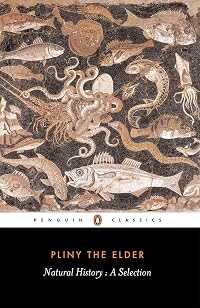
Natural History: A Selection
by Pliny the Elder
On This Page
Description
Mingling acute observation with often wild speculation, it offers a fascinating view of the world as it was understood in the first century AD, whether describing the danger of diving for sponges, the first water-clock, or the use of asses' milk to remove wrinkles. Pliny himself died while investigating the volcanic eruption that destroyed Pompeii in AD 79, and the natural curiosity that brought about his death is also very much evident in the Natural History - a book that proved highly show more influential right up until the Renaissance and that his nephew, Pliny the younger, described 'as full of variety as nature itself'. show lessTags
Recommendations






















Member Reviews
This review is specifically for the Penguin edition edited by John F. Healy. Pliny's writing is often fascinating, and his prejudices are clear. Italy is the most wonderful of all countries--a lot of modern day travelers would still agree with him, of course; things were much better in the old days; people now are too greedy and ostentatious; and so on. The book is filled with pretty much anything Pliny could throw in, and this is just a severe abridgment! Healy lets us down as editor, however. His footnotes are often few and far between and most of them simply translate Pliny's dates to dates we can understand. Most of the inexplicable references or words Pliny uses aren't explained at all. More importantly, there is no insight show more provided as to how someone as seemingly intelligent as Pliny could also believe such ridiculous things. For instance, that a 2-inch long Goby fish could attach itself the rudder of a Roman warship and stop it from moving! There are lots of other similar things here that demand a lot more explanation--or maybe I just need a different book that provides an extended analysis of Pliny's Natural History without being an actual translation. With its short sections, I ended up leaving this book beside my bed and reading a few pages each night. It is not something you can just sit down and devour dozens of pages at a time. My recommendation for potential readers is to look for a more insightful, helpful version. show less
Pliny was a "scientist" of his day. Although recording natural phenomena - he tied watching the destruction of Pompeii from a ship in its harbor - he also recorded the weird beliefs of the day, such as the weasel being the most destructive of all creatures, so horrific even alligators fear it. (They have a penchant for rushing down the throat when the gator is yawning and eating its way out!) Novel information and an entertaining book.
Entertaining - especially to think this was a scientific journal of its day.
science, ancient, selection, translation, Roman
Ratings
Members
- Recently Added By
Lists

100 Books to Read in a Lifetime (That Are Older Than 200 Years)
415 works; 173 members

Works Cited in The History of White People by Nell Irvin Painter
321 works; 2 members
Author Information

179+ Works 2,227 Members
Some Editions
Series
Belongs to Publisher Series
Common Knowledge
- Canonical title
- Natural History: A Selection
- Original publication date
- 77 CE
Classifications
Statistics
- Members
- 419
- Popularity
- 73,830
- Reviews
- 4
- Rating
- (3.79)
- Languages
- English, Latin
- Media
- Paper, Ebook
- ISBNs
- 3
- ASINs
- 1