
Justinian (–0565)
Author of The Digest of Roman Law: Theft, Rapine, Damage, and Insult
About the Author
Works by Justinian
The Digest of Justinian, Vols. 1 & 2 2 copies
Associated Works
The Secret History: with Related Texts (Hackett Classics) (2010) — Author, some editions — 102 copies, 1 review
Tagged
Common Knowledge
- Legal name
- Sabbatius, Petrus
- Other names
- Flavius Petrus Sabbatius Iustinianus Augustus
Justinian the Great
St. Justinian the Great
Justinian I
Sabbatius, Petrus - Birthdate
- c. 0482
- Date of death
- 0565-11-14
- Gender
- male
- Occupations
- Emperor of the Byzantine Empire (527-565)
- Nationality
- Byzantine Empire
- Burial location
- Constantinople, Byzantine Empire
- Associated Place (for map)
- Byzantine Empire
Members
Reviews
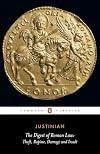
Emperor Justinian’s remarkable collection of law stands as a monument to reason and organization. It is true that Justinian did not initiate the concept of rule of law, nor did he promulgate innovative decrees, nor sweeping legislative reform. In fact, Justinian himself was not an integral part of the group of men who compiled his code of laws. Justinian does, however, deserve credit for insti-gating the collection and clarification of what had become, by the early sixth cen-tury, an show more overwhelming and confusing miasma of laws and precedents.
When Justinian became emperor in 527, he knew the existing legal sys-tem was flawed – cumbersome, bloated, confusing and contradictory. Emperors issued new constitutions and rescripts, which had the force of law, but they were not systematically published and even the imperial archives did not always keep copies of new laws. The situation was muddied further by the great number of legal opinions offered by legal experts (iurisconsulti) of the second and third cen-turies. Theodosius II had re-codified the law only a century before. The plethora of legal documents was far and beyond that which the empire could handle. Many of the codes were outdated and contained changes that were essential to the law's interpretation.
Justinian assembled leading legal minds to undertake the job of gathering, modernizing, codifying and annotating all Roman law of the past. The Commis-sion of Ten, including the jurist, Tribonian, headed the project. However, the ju-rists were not the only legal officers that were able to give advice to this special policy of Justinian. One civil servant, eleven legal practitioners, four professors of law (two from Constantinople, two from Beirut) were selected to aid and add opinion to the scheme that would lead to the Digest.
The Digest contained fifty books of legal doctrine composed by thirty-nine legal experts. The books were arranged into subcategories as they pertained to the law. Among the ancient Roman jurists, Ulpian influenced the resulting compi-lation more than any other. There is evidence of this in the amount of extracts which can be traced to him. The jurist, Paul, followed close behind. The contri-butions of these two thinkers constituted only fifty-two fewer extracts of the con-tent of The Digest than all the rest combined.
The Digest not only clarified and simplified legal proceedings for Justin-ian’s time, but it had the fortuitous benefit of preserving, either directly or by ref-erence and allusion, an abundance of the legal thinking for over a thousand years of Roman history. Aside from the direct influence The Digest has had on jurisprudence, the work provides a glimpse into Byzantine society in Justinian’s time. Laws reflect a society’s beliefs, values, fears and problems. Examination of this body of writing reveals the official attitudes about property, the individual, obligations to the state, family and others, honor, women, children, animals and slaves.
The specifics that emerge from such an examination indicate that the Ro-mans had a precise approach to legal matters and they appreciated many fine nuances of a situation. The section that specified degrees of responsibility in a case where two sets of mule carts were on a hill and the upper cart rolled down, hitting the lower cart causing it, in turn, to roll down and cause an injury, illus-trated the fine and keen sense of the many varying degrees of culpability which could obtain from a single incident depending on the circumstances.
Furthermore, one sees that, although there are many specifics in which Roman law is antiquated and unequivocally bound to the past, in other ways its spirit is still fresh and vibrant, holding much that is still applicable in Western so-ciety today. The very fact that Justinian found it useful to codify the law is a tes-tament to civilization. When he found the mass of laws overwhelming and bur-densome he did not consider abandoning them or the concept of law, rather he chose to build and improve upon the foundation of legal principles upon which Rome was built.
Alex Hunnicutt show less
When Justinian became emperor in 527, he knew the existing legal sys-tem was flawed – cumbersome, bloated, confusing and contradictory. Emperors issued new constitutions and rescripts, which had the force of law, but they were not systematically published and even the imperial archives did not always keep copies of new laws. The situation was muddied further by the great number of legal opinions offered by legal experts (iurisconsulti) of the second and third cen-turies. Theodosius II had re-codified the law only a century before. The plethora of legal documents was far and beyond that which the empire could handle. Many of the codes were outdated and contained changes that were essential to the law's interpretation.
Justinian assembled leading legal minds to undertake the job of gathering, modernizing, codifying and annotating all Roman law of the past. The Commis-sion of Ten, including the jurist, Tribonian, headed the project. However, the ju-rists were not the only legal officers that were able to give advice to this special policy of Justinian. One civil servant, eleven legal practitioners, four professors of law (two from Constantinople, two from Beirut) were selected to aid and add opinion to the scheme that would lead to the Digest.
The Digest contained fifty books of legal doctrine composed by thirty-nine legal experts. The books were arranged into subcategories as they pertained to the law. Among the ancient Roman jurists, Ulpian influenced the resulting compi-lation more than any other. There is evidence of this in the amount of extracts which can be traced to him. The jurist, Paul, followed close behind. The contri-butions of these two thinkers constituted only fifty-two fewer extracts of the con-tent of The Digest than all the rest combined.
The Digest not only clarified and simplified legal proceedings for Justin-ian’s time, but it had the fortuitous benefit of preserving, either directly or by ref-erence and allusion, an abundance of the legal thinking for over a thousand years of Roman history. Aside from the direct influence The Digest has had on jurisprudence, the work provides a glimpse into Byzantine society in Justinian’s time. Laws reflect a society’s beliefs, values, fears and problems. Examination of this body of writing reveals the official attitudes about property, the individual, obligations to the state, family and others, honor, women, children, animals and slaves.
The specifics that emerge from such an examination indicate that the Ro-mans had a precise approach to legal matters and they appreciated many fine nuances of a situation. The section that specified degrees of responsibility in a case where two sets of mule carts were on a hill and the upper cart rolled down, hitting the lower cart causing it, in turn, to roll down and cause an injury, illus-trated the fine and keen sense of the many varying degrees of culpability which could obtain from a single incident depending on the circumstances.
Furthermore, one sees that, although there are many specifics in which Roman law is antiquated and unequivocally bound to the past, in other ways its spirit is still fresh and vibrant, holding much that is still applicable in Western so-ciety today. The very fact that Justinian found it useful to codify the law is a tes-tament to civilization. When he found the mass of laws overwhelming and bur-densome he did not consider abandoning them or the concept of law, rather he chose to build and improve upon the foundation of legal principles upon which Rome was built.
Alex Hunnicutt show less
... Your edition will be very useful to our lawyers, some of whom will need the translation as well as the Notes ... (TJ to Cooper, 16 January 1814)
http://lcweb2.loc.gov/cgi-bin/ampage?collId=rbc3&fileName=rbc0001_2007jeffca...
http://lcweb2.loc.gov/cgi-bin/ampage?collId=rbc3&fileName=rbc0001_2007jeffca...
Lists
You May Also Like


Associated Authors
Statistics
- Works
- 37
- Also by
- 2
- Members
- 555
- Popularity
- #44,975
- Rating
- 3.8
- Reviews
- 2
- ISBNs
- 29
- Languages
- 3
