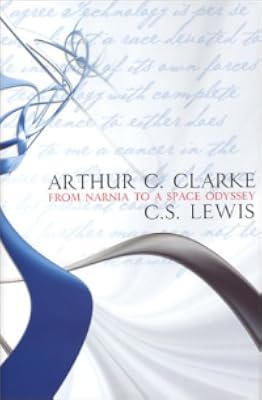
From Narnia to a Space Odyssey : The War of Ideas Between Arthur C. Clarke and C.S. Lewis
by Arthur C. Clarke, C.S. Lewis, Ryder W. Miller (Editor)
On This Page
Description
"From Narnia to a Space Odyssey" is the dialogue -- through fiction, non-fiction, and correspondence -- in which Arthur C Clarke and C S Lewis debate, discuss, and consider the great hope and potential dangers of the rise of technology. Their encounter sets the stage for a question we face today: Is technology the beauty that will lead to a more utopian society, or is it the beast that endangers our humanity and spirit?Tags
Recommendations










Member Reviews
This book's centerpiece, its raison d'etre, is the collected correspondence between Lewis and Clarke -- yet that correspondence only runs from page 36 through 52, a total of 15 letters. Three of Lewis's amount to little more than "Thank you for the transcript" or "Thank you for the invitation." This is no "war of ideas," only a brief difference of opinion. The rest of the book consists of short stories and essays from the two authors and a couple of introductory pieces from the editor.
The book is rife with typos, and the transcriptions of Lewis's hand-written letters are quite bad. Here's a direct quote from one of the transcriptions: "I will write a whole story in the mnts. Wh. in heavens name, be pushed out of the center and its show more center taken of is an unethically banal little laboratory intrigue." And another, from the same letter: "If a focus is milieu in a certain place, its particular qualities or that milieu meant he can ploated."
It looks rather as if that last bit should actually be something like "...must be exploited." If the editor knew what was meant, why let it stand as "meant he can ploated?" And if not, why assemble a book around letters he apparently couldn't read?
The introductory pieces from the editor added little to the book, and apart from Clarke's brief preface and minuscule afterword, I believe all of Lewis's and Clarke's essays and stories reprinted here are readily available elsewhere, leaving little to recommend this particular volume. show less
The book is rife with typos, and the transcriptions of Lewis's hand-written letters are quite bad. Here's a direct quote from one of the transcriptions: "I will write a whole story in the mnts. Wh. in heavens name, be pushed out of the center and its show more center taken of is an unethically banal little laboratory intrigue." And another, from the same letter: "If a focus is milieu in a certain place, its particular qualities or that milieu meant he can ploated."
It looks rather as if that last bit should actually be something like "...must be exploited." If the editor knew what was meant, why let it stand as "meant he can ploated?" And if not, why assemble a book around letters he apparently couldn't read?
The introductory pieces from the editor added little to the book, and apart from Clarke's brief preface and minuscule afterword, I believe all of Lewis's and Clarke's essays and stories reprinted here are readily available elsewhere, leaving little to recommend this particular volume. show less
Some Dialogue!
This book is advertised as being "the dialogue of letters between Arthur C. Clarke and C.S. Lewis". Well, it turns out that the letters take up a grand total of 17 pages, and there are only 8 letters from Lewis to Clarke: 1 that occupies a full page, 4 that occupy a half page each, and 3 that are 2- or 3-liners. The vast majority of the pages in this slim book are devoted to reprinting short stories and essays available elsewhere. Even the publishers seem to have realized that calling this a "War of Letters" is overblown, because when the book arrived its subtitle had been changed to "The War of Ideas".
When it comes to CSL correspondence collections, I think this should rank dead last on prospective buyers' lists, behind show more _Collected Letters_ (available from the UK), _Letters of C.S. Lewis_, _Letters to an American Lady_, _The Latin Letters of C.S. Lewis_, _A Severe Mercy_ (by Sheldon Vanauken), and _Letters to Children_. show less
This book is advertised as being "the dialogue of letters between Arthur C. Clarke and C.S. Lewis". Well, it turns out that the letters take up a grand total of 17 pages, and there are only 8 letters from Lewis to Clarke: 1 that occupies a full page, 4 that occupy a half page each, and 3 that are 2- or 3-liners. The vast majority of the pages in this slim book are devoted to reprinting short stories and essays available elsewhere. Even the publishers seem to have realized that calling this a "War of Letters" is overblown, because when the book arrived its subtitle had been changed to "The War of Ideas".
When it comes to CSL correspondence collections, I think this should rank dead last on prospective buyers' lists, behind show more _Collected Letters_ (available from the UK), _Letters of C.S. Lewis_, _Letters to an American Lady_, _The Latin Letters of C.S. Lewis_, _A Severe Mercy_ (by Sheldon Vanauken), and _Letters to Children_. show less
The premise of this book is interesting but too thin to carry it: Arthur C. Clarke and C.S. Lewis once exchanged a series of letters where they discussed their contrasting views regarding space exploration. Clarke thought it would open a new frontier of possibility for humanity. Lewis thought it would open the door to humans spreading their corrupted and conquering ways throughout the universe. The letters are supplemented by two short essays about the authors and some stories and essays by each.
Sadly, the letters did not contain much substance. What substance there was is little more than the summary I gave above. The biographical essays about the authors are interesting, but nothing novel. The stories and essays by Clarke and Lewis show more vaguely connect to the theme, but there is no commentary to show how it all fits together. All in all, it doesn't feel like you are entering into a debate between the authors.
That doesn't sound like a 3 star review. However, I give the work three stars because it's an interesting collection of materials if you drop the premise that they represent some grand debate between Clarke and Lewis. Thus, overall, this was a somewhat disappointing but ultimately worthwhile read. show less
Sadly, the letters did not contain much substance. What substance there was is little more than the summary I gave above. The biographical essays about the authors are interesting, but nothing novel. The stories and essays by Clarke and Lewis show more vaguely connect to the theme, but there is no commentary to show how it all fits together. All in all, it doesn't feel like you are entering into a debate between the authors.
That doesn't sound like a 3 star review. However, I give the work three stars because it's an interesting collection of materials if you drop the premise that they represent some grand debate between Clarke and Lewis. Thus, overall, this was a somewhat disappointing but ultimately worthwhile read. show less
https://fromtheheartofeurope.eu/from-narnia-to-a-space-odyssey-stories-letters-a...
It has three parts: 1) an analytical introduction, including short profiles of Lewis and Clarke and a preface by Clarke himself; 2) the actual correspondence between Lewis and Clarke, which consists of fifteen letters over the years between 1936 and 1954, some of them very short; and 3) stories and essays by the two writers, three by Lewis and eight by Clarke. The publication history is rather droll, but Miller isn’t a terribly deep analyst and he makes a number of obvious mistakes in reading Lewis’s handwriting; also the first of the stories included, “Ministering Angels” by Lewis, is just repulsive (a sex worker and a feminist go to Mars). The show more primary non-fiction material is welcome, but the rest a bit superfluous. show less
It has three parts: 1) an analytical introduction, including short profiles of Lewis and Clarke and a preface by Clarke himself; 2) the actual correspondence between Lewis and Clarke, which consists of fifteen letters over the years between 1936 and 1954, some of them very short; and 3) stories and essays by the two writers, three by Lewis and eight by Clarke. The publication history is rather droll, but Miller isn’t a terribly deep analyst and he makes a number of obvious mistakes in reading Lewis’s handwriting; also the first of the stories included, “Ministering Angels” by Lewis, is just repulsive (a sex worker and a feminist go to Mars). The show more primary non-fiction material is welcome, but the rest a bit superfluous. show less
Ratings
Members
- Recently Added By
Author Information

860+ Works 130,176 Members
Arthur C. Clarke was born in Minehead, Somerset, England, on December 16, 1917. During World War II, he served as a radar specialist in the RAF. His first published piece of fiction was Rescue Party and appeared in Astounding Science, May 1946. He graduated from King's College in London with honors in physics and mathematics, and worked in show more scientific research before turning his attention to writing fiction. His first book, Prelude to Space, was published in 1951. He is best known for his book 2001: A Space Odyssey, which was later turned into a highly successful and controversial film under the direction of Stanley Kubrick. His other works include Childhood's End, Rendezvous with Rama, The Garden of Rama, The Snows of Olympus, 2010: A Space Odyssey II, 2062: Odyssey III, and 3001: The Final Odyssey. During his lifetime, he received at least three Hugo Awards and two Nebula Awards. He died of heart failure on March 19, 2008 at the age of 90. (Bowker Author Biography) show less

528+ Works 523,085 Members
C. S. (Clive Staples) Lewis, "Jack" to his intimates, was born on November 29, 1898 in Belfast, Ireland. His mother died when he was 10 years old and his lawyer father allowed Lewis and his brother Warren extensive freedom. The pair were extremely close and they took full advantage of this freedom, learning on their own and frequently enjoying show more games of make-believe. These early activities led to Lewis's lifelong attraction to fantasy and mythology, often reflected in his writing. He enjoyed writing about, and reading, literature of the past, publishing such works as the award-winning The Allegory of Love (1936), about the period of history known as the Middle Ages. Although at one time Lewis considered himself an atheist, he soon became fascinated with religion. He is probably best known for his books for young adults, such as his Chronicles of Narnia series. This fantasy series, as well as such works as The Screwtape Letters (a collection of letters written by the devil), is typical of the author's interest in mixing religion and mythology, evident in both his fictional works and nonfiction articles. Lewis served with the Somerset Light Infantry in World War I; for nearly 30 years he served as Fellow and tutor of Magdalen College at Oxford University. Later, he became Professor of Medieval and Renaissance English at Cambridge University. C.S. Lewis married late in life, in 1957, and his wife, writer Joy Davidman, died of cancer in 1960. He remained at Cambridge until his death on November 22, 1963. (Bowker Author Biography) show less
Classifications
Statistics
- Members
- 68
- Popularity
- 458,634
- Reviews
- 4
- Rating
- (2.61)
- Languages
- English
- Media
- Paper
- ISBNs
- 2
- ASINs
- 1