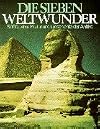
Seven Wonders of the World
by John Romer, Elizabeth Romer
On This Page
Description
This fascinating and well-illustrated exploration, now republished, uses archaeological and documentary evidence to reconstruct each of the seven wonders of the ancient world in turn. Beginning with the Olympian statue of Zeus and continuing eastwards around the Mediterranean to the pyramids, they investigate the physical and symbolic remains of these works, each of which was originally created to represent an ideal.Tags
Recommendations


















Member Reviews
The "seven wonders of the world" were created in the Hellenistic Age. Dominated by Alexander, mankind began to measure itself in human terms for the first time. Not one of these "wonders" remains for us to examine today, however, remnants do remain. Ancient descriptions and remnant stones are examined to exhume the revenant wonders that served as yardsticks of human achievement, millenia ago: Pyramids, Mausoleum of Helicarnassus, Temple of Artemesis (Ephasus), the Colossus of Rhodes, the Pharos of Alexandria, the Olympian Zeus, and the Gardens of Babylon. Includes a map, illustrations and beautiful photographs of many objects and landscapes. The authors capture the birth of what they call the "modern imagination". They also analyze the show more mind of the list-makers who were clearly taking stock of an emergent set of skills. Humanity becomes the wonder. [41]
I find this work to be invaluable, and recommend it for all who love beauty and the human enterprise around making meaning. I found these Themes in the work of these authors:
(1) Zeus became Jesus. (Ieus-us) The "image of God" becomes obvious in the Phidias images. [24] Seamless transition from Olympian to emperor-cult to Unitarian Goth-God/Pantocrator. [24 ff]
(2) Assault on women. From a female-dominated yearning for fertility and awe for life, to a relentless destruction of Semiramis/Gardens, Isis oasis nymphea, Artemisian bathing.
(3) Wonder and Beauty as the conduit of the sacred. [164]
(4) Words are powerful. The "vision" outlasts the never-built garden. [125]
(5) Heritage has a common root. [127] Scratch below a difference, you find exactly the same identity, longing, value, and hunger for connection. show less
I find this work to be invaluable, and recommend it for all who love beauty and the human enterprise around making meaning. I found these Themes in the work of these authors:
(1) Zeus became Jesus. (Ieus-us) The "image of God" becomes obvious in the Phidias images. [24] Seamless transition from Olympian to emperor-cult to Unitarian Goth-God/Pantocrator. [24 ff]
(2) Assault on women. From a female-dominated yearning for fertility and awe for life, to a relentless destruction of Semiramis/Gardens, Isis oasis nymphea, Artemisian bathing.
(3) Wonder and Beauty as the conduit of the sacred. [164]
(4) Words are powerful. The "vision" outlasts the never-built garden. [125]
(5) Heritage has a common root. [127] Scratch below a difference, you find exactly the same identity, longing, value, and hunger for connection. show less
Less of an ancient history lesson, more like a modern history of responses to an ancient fantastic tale of seven fantastic buildings or statues. First written by Philo (or Philon if you are not a Latinist), who I knew as a librarian of Alexandria and a precursor to Hero of Alex. in his descriptions of automata and Alexandrian Greek executice toys for the filthy rich to impress their mates with, yet I had no idea that he started the whole seven wonders thing. Some of the wonders, like the Hanging Gardens of babylon Philo had never seen, and Romer examines the extant evidence and concludes that no-one lese did either! Romer then concentrates on how us moderns responded to these legends, and in many cases made up reconstructions based more show more on the ancient texts than archaelogical evidence.
This is one of those books that once read is immediately put by to be re-read. An excellent set of illustrations as well. Would make a nice coffee table book. Romer also is a funny guy. I remember him on some TV show excavating in Egypt and finding a shrivelled piece of organic debris in a tomb. He shouted, "I've found the Pharoah's dick! Let's give it to an old lady". show less
This is one of those books that once read is immediately put by to be re-read. An excellent set of illustrations as well. Would make a nice coffee table book. Romer also is a funny guy. I remember him on some TV show excavating in Egypt and finding a shrivelled piece of organic debris in a tomb. He shouted, "I've found the Pharoah's dick! Let's give it to an old lady". show less
2914 The Seven Wonders of the World: A History of the Modern Imagination, by John & Elizabeth Romer (read 4 Oct 1996) This is an erudite examination of the ancient wonders. The book is carefully done and told me as much as I need to know about the interesting subjects. Only the Pyramids, of those ancient wonders, still exist. The most recent to disappear was the Pharos (lighthouse) of Alexandria. The Hanging Gardens may not have existed, at least in the form the imagination gives them.
Ratings
Members
- Recently Added By
Author Information

16+ Works 2,183 Members
7 Works 474 Members
Elizabeth Romer studied textile design at the Royal College of Art, London, and has practiced and taught in that field. She lives in Tuscany with her husband
Common Knowledge
- Canonical title
- Seven Wonders of the World
- Original publication date
- 2005, 1995 (Great Britian) (Great Britian)
Classifications
Statistics
- Members
- 243
- Popularity
- 134,277
- Reviews
- 3
- Rating
- (3.79)
- Languages
- 5 — Dutch, English, German, Italian, Spanish
- Media
- Paper
- ISBNs
- 13
- ASINs
- 2