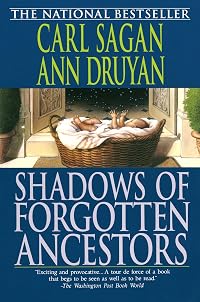
Shadows of Forgotten Ancestors: A Search for Who We Are
by Carl Sagan, Ann Druyan
On This Page
Description
World renowned scientist Carl Sagan and acclaimed author Ann Druyan have written a ROOTS for the human species, a lucid and riveting account of how humans got to be the way we are. It shows with humor and drama that many of our key traits--self-awareness, technology, family ties, submission to authority, hatred for those a little different from ourselves, reason, and ethics--are rooted in the deep past, and illuminated by our kinship with other animals. Astonishing in its scope, brilliant in show more its insights, and an absolutely compelling read, SHADOWS OF FORGOTTEN ANCESTORS is a triumph of popular science. show lessTags
Recommendations






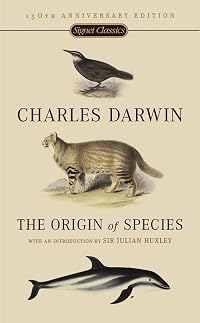
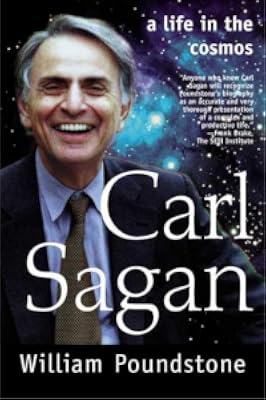
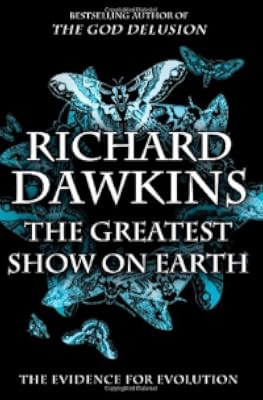
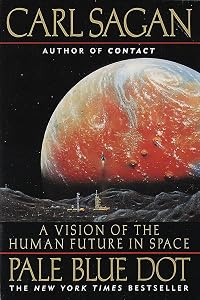


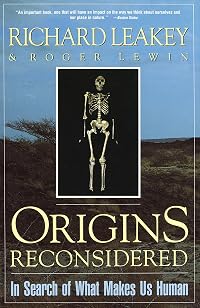
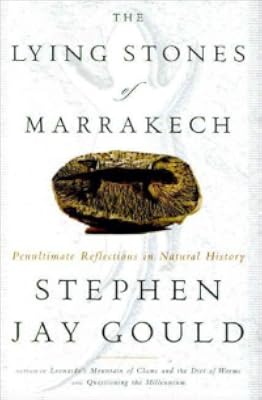
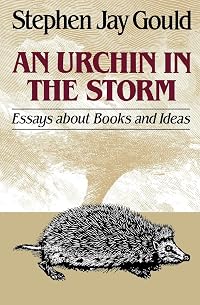


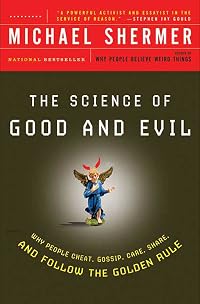

Member Recommendations
Member Reviews
I really admire the ambition of Sagan and Ann Druyan to embark on the multi-volume examination of the roots of humanity beginning with this tome. At times, however, I feel they could of gained in cohesion and clarity what they may have lost in breadth had they constrained themselves to a single opus. This just seems to wander at times, which makes me wonder...
However, it is a wondrous topic and the pair bring humanity down from a self-ascribed special realm closer to the animals, which are raised up. (Especially chimps and bonobos.) This was an excellent read after Are We Smart Enough to Know How Smart Animals Are? which is a slimmer and more concise consideration of many of the same topics using updated research.
However, it is a wondrous topic and the pair bring humanity down from a self-ascribed special realm closer to the animals, which are raised up. (Especially chimps and bonobos.) This was an excellent read after Are We Smart Enough to Know How Smart Animals Are? which is a slimmer and more concise consideration of many of the same topics using updated research.
Carl Sagan and his wife Ann Druyan poetically present the humble beginnings of homo sapiens. They begin with the formulation of the universe and then with the many processes that went into the origination of our planet. The wonder that is DNA and genetics is then explained, showing how closely linked humans are to everything but just how intimately related we are to the great apes, mostly the chimpanzees.
The book is 80% about chimpanzee and other ape behavior and how they relate to us. I found it fascinating how many of our social behaviors are nearly identical with the apes. They function as a family unit. Mothers breastfeed their young and the young learn by seeing what the elders do. Apes groom each other and we like to give massages show more or cuddle with our loved ones. Chimps like Lucy displayed intelligence and the ability to think abstractedly. They have emotion and use facial expressions to communicate.
Apes are also highly sexual and can be really violent. Especially the Hamadrya baboon. Where the male chimps loosely guard their females when they are not ovulating, the male baboon treats the females like private property and will violently discipline them if they stray to another male. Apes will go patrolling in groups and are masters of stealth and strategy. The military branches of the world can take a page out of the chimp's playbook.
I found it all to be engrossing and enlightening. Carl and Ann shed a sliver of light on the shadows of our ancestors and bring them to the forefront for us to appreciate. We can learn so much about our past if we can continue to study our great antecedents. show less
The book is 80% about chimpanzee and other ape behavior and how they relate to us. I found it fascinating how many of our social behaviors are nearly identical with the apes. They function as a family unit. Mothers breastfeed their young and the young learn by seeing what the elders do. Apes groom each other and we like to give massages show more or cuddle with our loved ones. Chimps like Lucy displayed intelligence and the ability to think abstractedly. They have emotion and use facial expressions to communicate.
Apes are also highly sexual and can be really violent. Especially the Hamadrya baboon. Where the male chimps loosely guard their females when they are not ovulating, the male baboon treats the females like private property and will violently discipline them if they stray to another male. Apes will go patrolling in groups and are masters of stealth and strategy. The military branches of the world can take a page out of the chimp's playbook.
I found it all to be engrossing and enlightening. Carl and Ann shed a sliver of light on the shadows of our ancestors and bring them to the forefront for us to appreciate. We can learn so much about our past if we can continue to study our great antecedents. show less
To my mind, this is a five out of five star book. That despite considering its writing subpar. I found the writing poorly organized, overly verbose, and tortuous, except in the last several chapters.
Nevertheless, I would recommend the reader hang in there through all the verbosity and extraneous content (to me) in order to fully appreciate the last several chapters. They are the meat of the book that should be absorbed by all that have the open-mindedness and backbone to look at the reality of human existence.
Nevertheless, I would recommend the reader hang in there through all the verbosity and extraneous content (to me) in order to fully appreciate the last several chapters. They are the meat of the book that should be absorbed by all that have the open-mindedness and backbone to look at the reality of human existence.
Loved the first half covering the beginnings and evolution of life, particularly the chapters covering DNA. The second half read like the contributions of each author were merely glommed together with no further editing - a lot of duplication. I skipped most of it.
A look at the evolution of humanity, spending quite a bit of time on the mechanisms of evolution, then on the capabilities and social lives of our closest primate relatives. A bit dated in places, such as his plug for group-selection, but overall rather good. Perhaps I find the topic a bit overdone, and so I was never really that enthused by the book. Solid, though, and thought provoking in many places.
3.5 oc
3.5 oc
Fascinating and well-written, this is the book that helped me finally feel like I understand evolution. I think it is the “evolution for dummies” book that everyone should read to understand how we got here and where we came from. Excellent!
Mostly about monkeys. Nothing controversial, I refuse to believe it was controversial when it was written. Unless you refuse the claim that people are animals.
Members
- Recently Added By
Lists

Best Science Books for Non-Scientists
113 works; 57 members
Author Information

88+ Works 48,314 Members
A respected planetary scientist best known outside the field for his popularizations of astronomy, Carl Sagan was born in New York City on November 9, 1934. He attended the University of Chicago, where he received a B.A. in 1954, a B.S. in 1955, and a M.S. in 1956 in physics as well as a Ph.D. in 1960 in astronomy and astrophysics. He has several show more early scholarly achievements including the experimental demonstration of the synthesis of the energy-carrying molecule ATP (adenosine triphosphate) in primitive-earth experiments. Another was the proposal that the greenhouse effect explained the high temperature of the surface of Venus. He was also one of the driving forces behind the mission of the U.S. satellite Viking to the surface of Mars. He was part of a team that investigated the effects of nuclear war on the earth's climate - the "nuclear winter" scenario. Sagan's role in developing the "Cosmos" series, one of the most successful series of any kind to be broadcast on the Public Broadcasting System, and his book The Dragons of Eden (1977) won the Pulitzer Prize in 1978. He also wrote the novel Contact, which was made into a movie starring Jodie Foster. He died from pneumonia on December 20, 1996. (Bowker Author Biography) show less

10+ Works 3,122 Members
Some Editions
Awards and Honors
Distinctions
Notable Lists
Common Knowledge
- Canonical title
- Shadows of Forgotten Ancestors: A Search for Who We Are
- Original title
- Shadows of Forgotten Ancestors: A Search for Who We Are
- Original publication date
- 1992
- Epigraph
- Thus she spoke, and I longed
to embrce my dead mother's ghost
Thrice I tried to clasp her
image, and thrice it slipped
Through my hands, like a
shadow, like a dream.
Homer 'The Odysse... (show all)y' - Dedication
- To
Lester Grinspoon,
whose example reassures us
that our species
may have
what it takes - First words
- Introduction
We were very lucky.
The immense, overpowering blackness is relieved here and there by a faint point of light—which, upon closer approach, is revealed to be a mighty sun, blazing with thermonuclear fire and warming a small surrounding volume of... (show all) space. - Last words
- (Click to show. Warning: May contain spoilers.)Its key central section—chronicling the dawn of our species and its evolution up to the invention of civilization—is the subject of the next book in this series.
- Blurbers
- Peters, Tom; Strickberger, Monroe; Bahcall, John; Knight, Steve
- Original language
- English
Classifications
Statistics
- Members
- 1,502
- Popularity
- 15,395
- Reviews
- 11
- Rating
- (4.15)
- Languages
- 8 — Czech, English, German, Hungarian, Korean, Polish, Portuguese, Spanish
- Media
- Paper, Audiobook, Ebook
- ISBNs
- 20
- ASINs
- 8