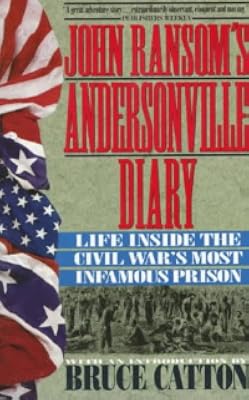
Andersonville Diary
by John L. Ransom
On This Page
Description
This book is an extraordinary day-to-day documentary of the Civil War's most infamous Confederate prison, Camp Sumter, better known as Andersonville. Here thirteen thousand wretched Union prisoners died within barely fourteen months, from starvation, scurvy, and other diseases that spread through the camp. There was little shelter but makeshift tents; little in the way of blankets, warm clothing, or even shoes; and a scarcity of food and fresh water. Often they were forced to sleep on the show more muddy ground in very crowded conditions.While the deplorable conditions bear witness to man's inhumanity to man, they also are witness to one man's undaunted spirit to survive to tell the dreadful tale—and tell it he did.
. show less
Tags
Recommendations


















Member Reviews
It's difficult to critique someone's diary -- especially when that someone survived the hell-hole that was the Andersonville POW camp during the Civil War.
I think for most anyone who is at all familiar with the Civil War, the name Andersonville brings to mind the most horrific of conditions, thousands dead, survivors who came out looking like skeletons. John Ransom's diary recounts the day-to-day events of a union soldier taken POW and eventually sent to that most infamous of Confederate prison camps. It is sometimes repetitious because life was repetitious -- day after day, scrounging for food, fighting off the "raiders" -- fellow prisoners who were as brutal as their captors -- dealing with the grossest of unsanitary conditions, show more starvation, disease, cruelty, death. (So many dead!)
I must say that I can hardly believe Ransom survived it all, and I get the feeling he's surprised, too. I'm impressed that he had the tenacity to keep up the writing through all his trials -- trading food for pencils and notebooks to write, entrusting filled notebooks to fellow prisoners when he was too incapacitated to carry them all. Ransom had a great eye and ear for detail, and somehow managed to maintain some semblance of humor through much, if not most, of the horror he endured. His diary is a fascinating account of survival with honor. Recommended. show less
I think for most anyone who is at all familiar with the Civil War, the name Andersonville brings to mind the most horrific of conditions, thousands dead, survivors who came out looking like skeletons. John Ransom's diary recounts the day-to-day events of a union soldier taken POW and eventually sent to that most infamous of Confederate prison camps. It is sometimes repetitious because life was repetitious -- day after day, scrounging for food, fighting off the "raiders" -- fellow prisoners who were as brutal as their captors -- dealing with the grossest of unsanitary conditions, show more starvation, disease, cruelty, death. (So many dead!)
I must say that I can hardly believe Ransom survived it all, and I get the feeling he's surprised, too. I'm impressed that he had the tenacity to keep up the writing through all his trials -- trading food for pencils and notebooks to write, entrusting filled notebooks to fellow prisoners when he was too incapacitated to carry them all. Ransom had a great eye and ear for detail, and somehow managed to maintain some semblance of humor through much, if not most, of the horror he endured. His diary is a fascinating account of survival with honor. Recommended. show less
The Civil War’s most infamous Confederate prison, Camp Sumter, better known as Andersonville, is the central venue in John Ransom’s diary of his 14 months as a P.O.W. in the Confederate prison system. After spending some time at Belle Isle prison in Virginia was sent to Andersonville in Georgia. There he finds a lack of food, privation, and a brutal administration resulting in the death of about half the prisoners at the camp, tens to scores daily. Among the lethal threats are the “dead lines” separating prisoners from the only source of fresh water in the camp. Crossing means death by rifle shot. Infamous Capt. Henry Wirz is not as near a threat as groups of marauders among the Yankee prisoners. Mosby’s Marauders were the show more worst. Ransom escapes twice, both times when being transferred to another camp. He escapes when being transferred to a prison south of Andersonville (to escape Sherman in his march through Georgia), only to be recaptured after 6 days of freedom. During that time, he finds help from the slaves he encounters, while he has a demeaning opening of the enslaved Africans. Sherman’s March to the Sea campaign results in his being shipped from Andersonville (to prevent the prisoners being freed by Union forces) and transferred again later. That advance also makes it possible for Ransom and the Buck boys, his two companions, to finally reach Union lines and freedom.
Union leadership ceased the policy of prisoner exchanges figuring that the exchanges were helping the Confederacy. Rumors of such exchanges are reported several times by Ransom, a Michigander by birth like me. show less
Union leadership ceased the policy of prisoner exchanges figuring that the exchanges were helping the Confederacy. Rumors of such exchanges are reported several times by Ransom, a Michigander by birth like me. show less
Generally I like to share my own particular thoughts on a work. However, the previous reviewer (in my opinion) has presented an outstanding, and accurate, summation of this work. Highly recommended for its compelling historical content and user friendly writing style.
I read this in high school after I found out one of my ancestors was a prisoner of war in Andersonville during the Civil War. Terrible place, terrible conditions. Glad he made it out alive or I wouldn't be typing this up right now.
Ratings
Members
- Recently Added By
Author Information

2 Works 246 Members
John L. Ransom joined the Union Army in 1862, serving as brigade quartermaster of the Ninth Michigan Volunteer Cavalry. A year later, the 20-year-old soldier was captured in Tennessee and interned at the notorious Georgia prison camp, Andersonville. Ransom's harrowing firsthand account of Civil War prison life constitutes a valuable historical show more record-a true story not only of cruelty, death, and deprivations but also of acts of courage and kindness that ensured the young soldier's survival and preserved his faith in humanity show less
Common Knowledge
- Canonical title
- Andersonville Diary
- Original title
- Andersonville
- Alternate titles
- John Ransom's Diary
- Original publication date
- 1881
- People/Characters
- John Ransom
- Important places
- Andersonville Prison, Macon County, Georgia, USA; Macon County, Georgia, USA; Georgia, USA
- Important events
- American Civil War (1861 | 1865)
- Related movies
- The 1996 TV movie Andersonville, directed by John Frankenheimer
- Dedication
- This book is respectfully dedicated by the author to the mothers, wives and sisters of those whose names are herein recorded as having died...
- First words
- Belle Island, Richmond, Virginia, Nov.22, 1863.-- I was captured near Rogersville, East Tennessee, on the6thof this month, while acting as Brigade Quarter-Master Sergt.
- Last words
- (Click to show. Warning: May contain spoilers.)What Became of the Boys... Of Dr. Lewis, John McGuire and Jimmy Devers. The relics which had been entrusted to my keeping were all lost with two exceptions, and through no fault of mine. At the time of my severe sickness when first taken to Savannah, and when I was helpless as a child, the things drifted away from me some way, and were lost. But for the fact that Battese had two of my diary books and Sergt. Winn the other, they also would have been lost.
I hope that this Diary may prove successful in its mission of truly portraying the scenes at Andersonville and elsewhere during the time of my imprisonment, and if so, the object of its author shall have been accomplished. Yours very Respectfully, John L. Ransom, Late 1st Sergt. Co. A, 9th Mich. Cav.
(Click to show. Warning: May contain spoilers.)Publishers Note:
After the war, John Ransom returned to his home in Jackson, Michigan, where he regained his health. He went back to work in the composing room of the Jackson "Citizen", married, moved to Learwater, Michigan, where he continued to follow the printer's trade. Eventually, he move to Chicago and worked for the Merganthaler Linotype Company. He died in 1919 at the age of 76. His only child, a daughter, died in California many years ago.
Classifications
Statistics
- Members
- 243
- Popularity
- 134,122
- Reviews
- 4
- Rating
- (4.28)
- Languages
- English, Italian
- Media
- Paper, Audiobook, Ebook
- ISBNs
- 22
- ASINs
- 14